Ended Apr 17
Miriam Böhm
e e e B n n N n
Mar 5 – Apr 17, 2021
More from Miriam Böhm on Gallop
[Please scroll down for German version / Für Deutsch bitte scrollen Sie nach unten]
Wentrup is pleased to present the third solo exhibition of Berlin-based photographer Miriam Böhm at the gallery.
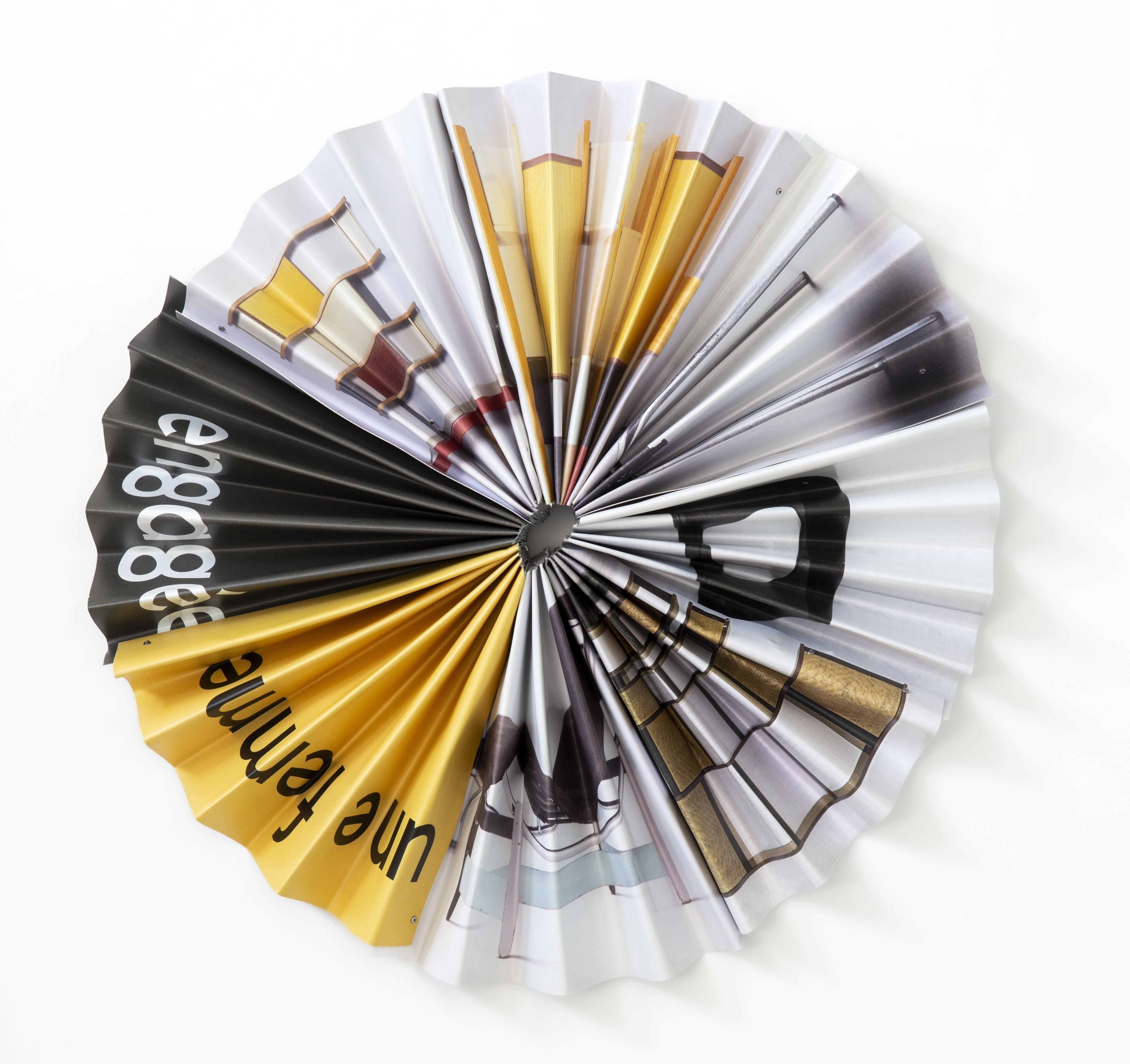
e e e B n n N n: a sequence of individual letters that seduces us into wanting to create words. But even without forming a word, these letters have their own reality. This is also true for Miriam Böhm’s photographic oeuvre. Just as a word consists of individual letters, and a sentence of individual words, the artist constructs her photographs out of individual pictorial elements. These in turn are equally weighted elements within the picture that are positioned in relation to one another, and combined or superimposed in such a way that they are in equal measure motif, carrier of meaning, and visual content. From folded paper, cut cardboard, drawn lines or shadows, landscapes, textile, glass, structures, folds and creases, Böhm creates minimalist, formally emphatic compositions through which she thinks visually in different ways about space in the broadest sense. Böhm’s photographs emerge—using sometimes analog and sometimes digital technologies—somewhere on the contested field of plane, fragment, and space; between the poles of spatial design and intangible idea. They engage with visual shifts, fragments, and formal interventions. Exploring the visuality of her working material, and of making, as well as thinking about the possibilities of expanding her visual vocabulary, play a central role on Miriam Böhm’s photographic work. The issue for her is by no means the representation of reality; rather, her compositions make claims and create meaning poetically.
In terms of their presence, Böhm’s photographs remind us perhaps most of all of haiku, a traditional Japanese form of poetry that is considered the shortest poetic form. Haiku plays with rhetoric means, it has a pronounced inner rhythm, a strict form, and every word has a singular position—it stands for itself and is at the same time part of the structure and of a complex sentence. Haiku does not distinguish between the object of a word and its meaning. It is read in one breath. Due to the poem’s brevity, every single world has great significance, but the connection between the words is rather loose. At the end, the sentence fades away without a defined ending, floating in the air. Similarly, Miriam Böhm’s photographs in the end don’t want to be defined or legible down to the last detail. Rather, every work stands for itself as what it is: a picture. It represents something or expresses something that cannot be conceptually grasped.
In One (2019), the numbers 4 and 5 shine towards us in royal blue. They were superimposed on one another. Every number has its own meaning within the sign system, but Böhm dissolves this meaning by superimposing them on one another. In this way, she creates something new that does not have any meaning in the sign system we know, and cannot be defined linguistically. One claims to be something. The series Only (2020) is similar. Here, Böhm “only” takes out a piece from a sky shown on a piece of folded paper, and replaces it elsewhere, namely behind the framed photograph in the form of a wallpaper, with a new sky motif. A superimposition of two skies, with different coloring, photographed at different times, both of them not fully visible. It is these gaps, sometimes not visible at first, sometimes provocatively placed in the foreground, that interest Böhm and challenge our habits of perception.
Like in a poem, Miriam Böhm arranges in her exhibition e e e B n n N n abstract shapes next to landscape motifs, creates geometric forms from the silhouette of a mountain, causes cut cardboard pieces to float before a textile underground in impossible perspectives, or places papers on top of one another in such a way that their edges look like delicate pencil lines. Sometimes the photographs are framed, sometimes mounted on aluminum, sometimes realized as wallpaper. It is this interplay of forms that allows us to move through the exhibition rhythmically. Sometimes we pause because we want to get to the bottom of what we see. Wherever our thoughts may take us, directly in front of the works we become aware of the powerful silence the exude. A silence that allows us to become calm.
Miriam Böhm (born in 1972 in Germany) has had solo and group exhibitions at Wilhelm-Hack-Museum in Ludwigshafen; Kunstmuseum Bochum (both Germany); Norton Museum, West Palm Beach, Florida; Contemporary Art Museum St. Louis, St. Louis, Missouri; Aspen Art Museum, Aspen, Colorado; Berkeley Museum, Berkeley, California; Kumu Art Museum, Tallinn, Estonia; Kunstforum NRW, Düsseldorf; Museum für Konkrete Kunst, Ingolstadt (Both Germany); as well as in the galleries Ration3 in San Francisco, California and Helga de Alvear in Madrid, Spain.
In 2020, Miriam Böhm participated in the Festival Fotografischer Bilder in Regensburg and in a group show at Sprüth Magers in Berlin (both Germany).
Miriam Böhm’s works can be found in the collections of the Berkeley Art Museum & Pacific Film Archive, Berkeley, California; E.ON Art Collection; Essen Germany; the Museum of Modern Art, New York; the Norton Museum of Art, Norton, Florida; Sammlung Wemhöner, Herford, Germany; San Francisco Museum of Modern Art, San Francisco; California; The Pizzuti Collection of the Columbus Museum of Art, Columbus; Ohio; Wilhelm-Hack-Museum, Ludwigshafen, Germany.
In 2014, Böhm was nominated for The Rudin Prize for Emerging Photographers.
*****
Wentrup freut sich, die dritte Einzelausstellung der in Berlin lebenden Fotografin Miriam Böhm (*1972) zu präsentieren.
e e e B n n N n – eine Aneinanderreihung von einzelnen Buchstaben, die einen dazu verleitet Worte zu kreieren. Aber auch ohne ein Wort zu bilden haben diese Buchstaben ihre eigene Realität. Ähnlich verhält es sich mit dem fotografischen Werk von Miriam Böhm. Wie ein Wort aus einzelnen Buchstaben und ein Satz aus einzelnen Worten besteht, baut die Künstlerin ihre Bilder aus einzelnen Bildelementen auf. Diese Bildelemente sind wiederum gleichwertige Bildkomponenten innerhalb des Bildes, die so zueinander positioniert und zusammengesetzt werden oder sich überlagern, dass sie gleichermaßen Motiv, Bedeutungsträger und Bildinhalt sind. Aus gefaltetem Papier, zugeschnittenen Kartonflächen, eingezeichneten Linien oder Schatten, Landschaften, Textilien, Glas, Strukturen, Falten und Knicken erschafft Böhm minimalistische, formal betonte Bildarrangements, die auf unterschiedliche Art und im weitesten Sinne visuell über Raum nachdenken. Böhms Fotografien entstehen – teils analog, teils digital – irgendwo im Spannungsfeld von Fläche, Fragment und Raum; zwischen den Polen von räumlicher Gestaltung und ungreifbarer Idee. Sie beschäftigten sich mit visuellen Verschiebungen, mit Fragmenten und formalen Interventionen. Das Erforschen der Bildlichkeit des Arbeitsmaterials und des Gestaltens an sich, wie auch das Nachdenken über die Möglichkeiten einer Erweiterung der Bildsprache, spielen eine zentrale Rolle im fotografischen Werk von Miriam Böhm. So geht es ihr keineswegs um die Abbildung von Realität, vielmehr behaupten oder bedeuten ihre Kompositionen in poetischer Art und Weise.
Vielleicht erinnern Böhms Fotografien in ihrer Präsenz am Ehesten an das Haiku, eine traditionelle, japanische Gedichtform, die weltweit als die kürzeste gilt. Das Haiku spielt mit den rhetorischen Mitteln, es hat einen ausgeprägten inneren Rhythmus, eine strenge Form und jedes Wort hat eine singuläre Position – es steht für sich selbst und ist gleichzeitig Teil der Struktur und eines komplexen Satzes. Das Haiku trennt nicht zwischen dem Gegenstand des Wortes und seiner Bedeutung. Gelesen wird es in einem Atemzug. Durch die Kürze des Gedichts kommt jedem einzelnen Wort eine große Bedeutung zu, die Verbindung der Worte ist jedoch lose. Am Ende verklingt der Satz ohne einen definierten Abschluss und schwebt in der Luft. Und so wollen auch die Fotografien von Miriam Böhm am Ende nicht bis ins letzte Detail definierbar oder lesbar sein. Vielmehr steht jedes einzelne Werk für sich als das, was es ist: ein Bild. Es stellt etwas dar oder drückt etwas aus, dass begrifflich nicht greifbar ist.
In königsblau strahlen uns in der Arbeit One (2019) die Zahlen 4 und 5 entgegen. Sie wurden übereinandergelegt. Hat jede Zahl innerhalb des Zeichensystems ihre eigene Bedeutung, so löst Böhm diese Bedeutung auf, indem sie die Zahlen übereinanderlegt. Gleichzeitig erschafft sie durch die Überlagerung der beiden Zahlen etwas Neues, dass jedoch innerhalb des uns bekannten Zeichensystems keine Bedeutung hat und sprachlich nicht definiert werden kann. One behauptet etwas zu sein. Ähnlich verhält es sich in der Serie Only (2020) in der Böhm einem auf gefaltetem Papier abgebildetem Himmel „nur“ ein Stück entnimmt und dafür an anderer Stelle, nämlich hinter der gerahmten Fotografie in Form einer Tapete, ein neues Himmelmotiv einsetzt. Eine Überlagerung zweier Himmel, mit unterschiedlichen Färbungen, die zu verschiedenen Zeiten aufgenommen wurden, beide nicht vollständig sichtbar. Es sind diese Leerstellen, manchmal nicht auf Anhieb sichtbar, manchmal provokant in den Vordergrund gesetzt, die Böhm interessieren und die unsere Sehgewohnheiten irritieren.
Einem Gedicht gleich arrangiert Miriam Böhm in ihrer Ausstellung e e e B n n N n abstrakte Formen neben Landschaftsmotiven, erschafft geometrische Formen aus der Silhouette eines Berges, lässt zugeschnittene Kartonflächen in nicht möglichen Perspektiven vor einem textilen Untergrund schweben oder legt Papiere so aneinander, dass die Stoßkanten an zarte Bleistiftlinien erinnern. Mal sind die Fotografien gerahmt, mal auf Aluminium aufgezogen, mal als Tapete realisiert. Es ist das Wechselspiel der Formen, dass uns rhythmisch durch die Ausstellung gehen lässt. Manchmal innehaltend, um dem Dargestellten doch auf den Grund zu gehen zu wollen. Wohin die Gedanken einen auch führen, unmittelbar vor den Bildern wird man sich einer kraftvollen Stille bewusst, die von den ihnen ausgeht. Eine Stille, die einen selbst zur Ruhe kommen lässt.
Miriam Böhm hatte Einzel- und Gruppenausstellungen im Wilhelm-Hack-Museum in Ludwigshafen; dem Kunstmuseum Bochum; Norton Museum, West Palm Beach, Florida; Contemporary Art Museum St. Louis, St. Louis, MO; Aspen Art Museum, Aspen, CO; Berkeley Museum, Berkeley, CA; Kumu Art Museum, Tallinn, Estland; dem Kunstforum NRW, Düsseldorf; dem Museum für Konkrete Kunst in Ingolstadt, sowie bei den Galerien Ration3 in San Francisco und Helga de Alvear in Madrid.
2020 war Miriam Böhm Teil des Festivals Fotografischer Bilder in Regensburg, sowie einer Gruppenausstellung bei Sprüth Magers in Berlin.
Werke von Miriam Böhm sind vertreten in den Sammlungen des Berkeley Art Museum & Pacific Film Archive, Berkeley, Kalifornien; E.ON Art Collection, Essen; Museum of Modern Art, New York; Norton Museum of Art, Norton, Florida; Sammlung Wemhöner, Herford; San Francisco Museum of Modern Art, San Francisco; The Pizzuti Collection of the Columbus Museum of Art, Columbus; Wilhelm-Hack-Museum, Ludwigshafen.
2014 war Böhm für den The Rudin Prize for Emerging Photographers nominiert.