Ended Nov 13
Georg Baselitz
New Drawings
Oct 21 – Nov 13, 2021
More from Georg Baselitz on Gallop
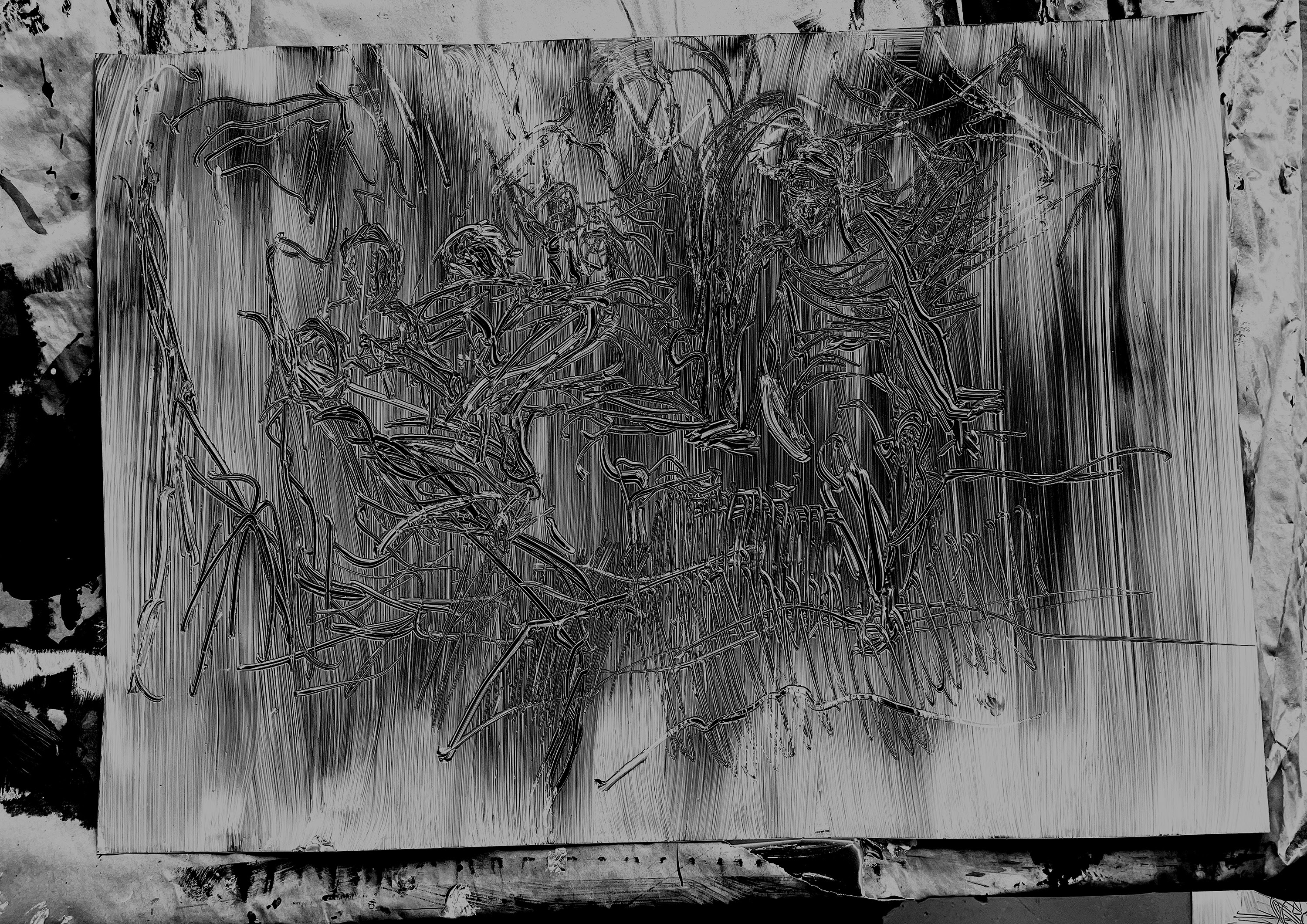
Coinciding with his retrospective at the Centre Pompidou, the exhibition Georg Baselitz, New Drawings at Thaddaeus Ropac Paris Marais brings together a selection of expressive, sensitive and intimate portraits in ink and watercolours on paper. These works are mainly realised in a new palette of vivid reds, and are engaged in a dialogue between ink lines, washes of colour and undefined space. They include several self-portraits and a portrait of Henri Matisse, as well as numerous renderings of his wife, Elke, a figure who has occupied a prominent position in the development of Georg Baselitz’s practice for over 50 years.
Georg Baselitz has continually renewed his practice through formal developments while often revisiting motifs from his own extensive oeuvre. Asked about this self-referentiality in 2017, he said: ‘I kept sinking into myself, and everything I do is being pulled out of myself.’ His choice to rework Elke repeatedly over the years in the same familiar poses (seated on her chair, or from close up with her head resting in her hands) represents an ever-renewing declaration of love, as well as an intimate reflection on change and stability, on the inevitability of ageing and on the function of portraiture. Diverging from his recent black ink drawings, the vibrant flesh-red palette of many of the new works shown in New Drawings, inspired by Henri Rousseau’s 1895 lithograph La Guerre (The War), intensifies the fragility and sensuousness of his depictions, making for expressive, sensitive portrayals of his wife. The intimacy of Georg Baselitz’s portrayals of Elke is also found in his self-portraits, as he lays his own body out on the paper for examination with a disarming frankness, which is heightened by the contrast between the artist’s sharp ink lines and his translucent application of watercolour.
Georg Baselitz often integrates references to art history into his work, turning the introspection of his self-portraits into a way of looking collectively at the history of painting itself. He looks to ‘the painters he cherishes, and more precisely to those who, like him, felt the end coming, felt death creeping in – whether it was physical or artistic’, wrote Judicaël Lavrador in the October 2021 Beaux Arts special issue about Georg Baselitz’s retrospective at the Centre Pompidou. The artist’s depiction of Henri Matisse recalls how Matisse depicts himself painting in his renowned 1918 Self-portrait: the wooden chair on which the French artist painted himself is turned upside down to resemble the wooden chairs Baselitz so often places his subjects on. Henri Matisse is an artist Georg Baselitz feels a particular affinity with as he ages: ‘I remind myself of the old Matisse, standing there with his fat stomach and long stick’, he said in an interview with Cornelius Tittel for Blau International in 2021, comparing his feeling of being ‘more and more run down’ with how Matisse’s ill health affected him towards the end of his career. This comparison sheds further light on the similarities between Baselitz’s portrait of Matisse and his seated self-portraits.
This portrait is not Georg Baselitz’s first depiction of a fellow artist, but follows his earlier painting of Matisse, Ich habe mal Matisse gesehen (I once saw Matisse,2018), as well as his 2015 series of ink portraits of Hokusai. By choosing to render both Matisse and Hokusai in ink, Baselitz pays homage to artists who have famously worked with ink while situating himself within the historical map of not only European ink painting, but also of the Japanese ink traditions which have served to influence his artistic approach, notably the depiction of suspended figures in an undefined space that are also common to Hokusai’s works in black ink.
The artist has been painting his compositions upside down since 1969, a format that he employed as a way to empty form of its content, to navigate between abstraction and figuration, and to revolutionise a medium that was then regarded as irredeemably conventional. The works presented in New Drawings all follow this distinctive configuration. When painting Elke, this gesture also serves to disrupt any harmony or beauty that is likely to seep into the portrayal of a figure so beloved to him, creating a defamiliarising effect which never undermines the artist’s expressivity as he traces his particular path through the difficulties of representation in portraiture.