Ended Dec 30
Sigmar Polke
Ultra Polke
Oct 14 – Dec 30, 2017
More from Sigmar Polke on Gallop
[Scroll down for French version / Veuillez trouver ci-dessous la version française]
The Galerie Suzanne Tarasieve has organized an exhibition that brings together a remarkable ensemble of artworks by one of Germanyʼs greatest contemporary artists: Sigmar Polke (1941-2010). The child of refugee parents, he was born in Silesia and lived in Cologne, when he wasnʼt travelling around the world. With his friend Gerhard Richter, he created the pictorial movement known as ʻCapitalist Realismʼ. In 1986, he was awarded the Golden Lion Prize at the 42nd Venice Biennale.
His undefinable artwork oscillated between figuration and abstraction, and embraced multiple techniques: painting, drawing, engraving, photography, film and installation. In 2014-2015, there were a number of large retrospectives devoted to the artist: at the Musée de Grenoble, the Museum of Modern Art (MoMA) in New York, Tate Modern in London and at the Ludwig Museum in Cologne, as well as the Palazzo Grassi, Venice in 2016. Renowned for his wit, he once explained that while his family ʻhurried to read the newspaper, he, due to short- sightedness, saw only a series of small black dots that would become his brothers and after all, he was just a dot himself.ʼ From this memory was born the artistʼs ubiquitous use of dots. By enlarging the raster, he deformed it, playing with perspectives from a distance and up-close, leading even to the dissolution of the image.
The self-deprecation of this artist, who was above all else a free thinker, undoubtedly hindered his reputation. Polkeʼs paintings are painted drawings: fields of power and energy, an alchemy of materials and colours. His narrative takes its inspiration as much from pop imagery, ancient myths, and popular tales, as it does from history and political satire.
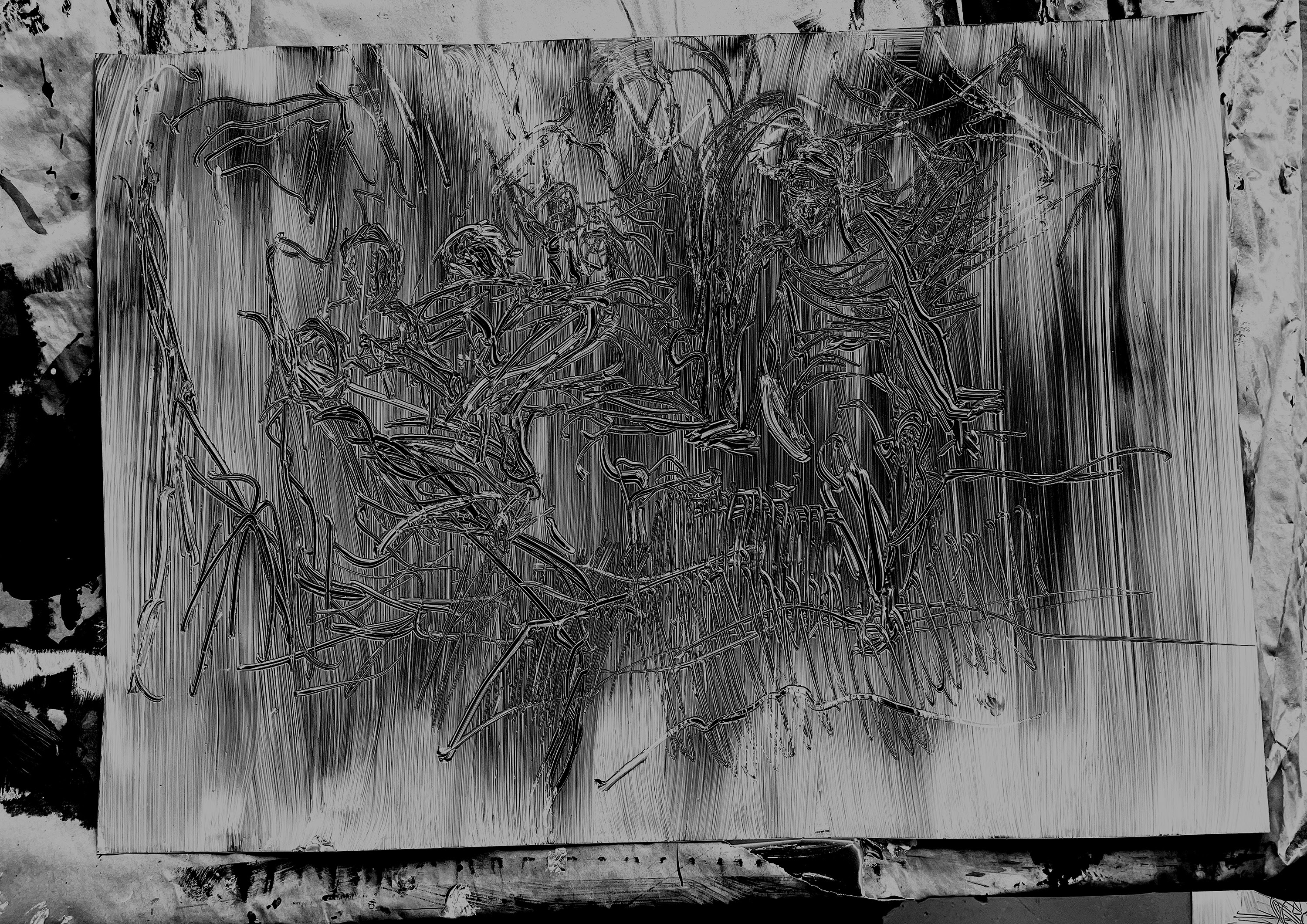
His drawings are reminiscent of the cadavre exquis (exquisite corpse) card game: one form is transformed into another, generating a series of thoughts by free association, similar to the Surrealist game. In Figurenstudie (1973), one of the drawings exhibited at the Galerie Suzanne Tarasieve, several figures are superimposed, fragments of bodies and female faces that lead us to a mental image: a fantasy of open, group sex.
The stuff of Polkeʼs dreams may be compared to a diary, a place of experimentation. The pictorial space becomes an immense collage where portraits, words, realistic elements and lyrical abstraction are juxtaposed, like an intellectual puzzle of sorts. The surprise effect fills his artworks with a suggestive power. His vocabulary bears the inflections of a childʼs spontaneity and a lively political conscience, as well as a cosmic dimension, inherited from German Romanticism.
Jeanette Zwingenberger
Translation: Emma lingwood
*****
La Galerie Suzanne Tarasieve a pu réunir un ensemble dʼœuvres remarquables dʼun des plus grands artistes allemands contemporains, Sigmar Polke (1941-2010). Enfant de refugiés, né en Silésie, il a vécu à Cologne, sʼil ne sillonnait pas les quatre coins du monde. Avec son ami Gerhard Richter, il crée le mouvement pictural baptisé le « Réalisme capitaliste ». En 1986, il reçoit le Lion d'or de la 42ème Biennale de Venise.
Son œuvre, inclassable, oscille entre figuration et abstraction, embrassant des techniques multiples : peinture, dessin, gravure, photographie, film et installation. En 2014-2015, des grandes rétrospectives lui sont consacrées au musée de Grenoble, au Museum of Modern Art à New York, à la Tate Moderne à Londres, au musée Ludwig à Cologne et en 2016 au Palazzo Grassi à Venise.
Plein dʼhumour, il expliquait que lorsque « sa famille sʼempressait de lire le journal lui nʼy voyait en raison de sa myopie, qu'une série de petits points noirs qui sont devenus ses frères et que lui-même est également un point. » De ce souvenir, est né lʼusage omniprésent des points. En grossissant la trame, il la déforme, jouant avec une vision de très loin et de très près jusquʼà la dissolution de lʼimage.
Lʼautodérision de cet artiste qui est surtout un libre penseur, a certainement entravé sa notoriété. Les peintures de Polke sont des dessins peints : un champ de forces et dʼénergie, une alchimie de matières et de couleurs. Sa narration se nourrit autant de lʼimagerie pop, mythes millénaires, contes populaires, que de la grande histoire et de la caricature politique.
Ses dessins évoquent le jeu à plusieurs mains du cadavre exquis : une forme se transforme dans une autre, enchaînant des associations libres proches de lʼunivers surréaliste. Dans Figurenstudie (1973), un des dessins exposé à la Galerie Suzanne Tarasieve, plusieurs figures se superposent. Morceaux de corps et visages féminins nous entraînent dans une image mentale : un fantasme au sexe ouvert.
L'étoffe dont sont faits les rêves de Polke sʼapparente à un journal intime, un lieu dʼexpérimentation. Lʼespace picturale devient alors un immense collage où se juxtaposent portraits, mots, éléments réalistes et abstraction lyrique tel le rébus dʼun jeu de réflexion. Lʼeffet de surprise anime les œuvres dʼune puissance suggestive. Son langage tient de la spontanéité de lʼenfant, mais aussi dʼune conscience politique engagée et dʼune dimension cosmique issue du romantisme allemand.
Jeanette Zwingenberger