
Ended
Atsuko Tanaka & Yayoi Kusama
May 8 – Jun 27, 2025
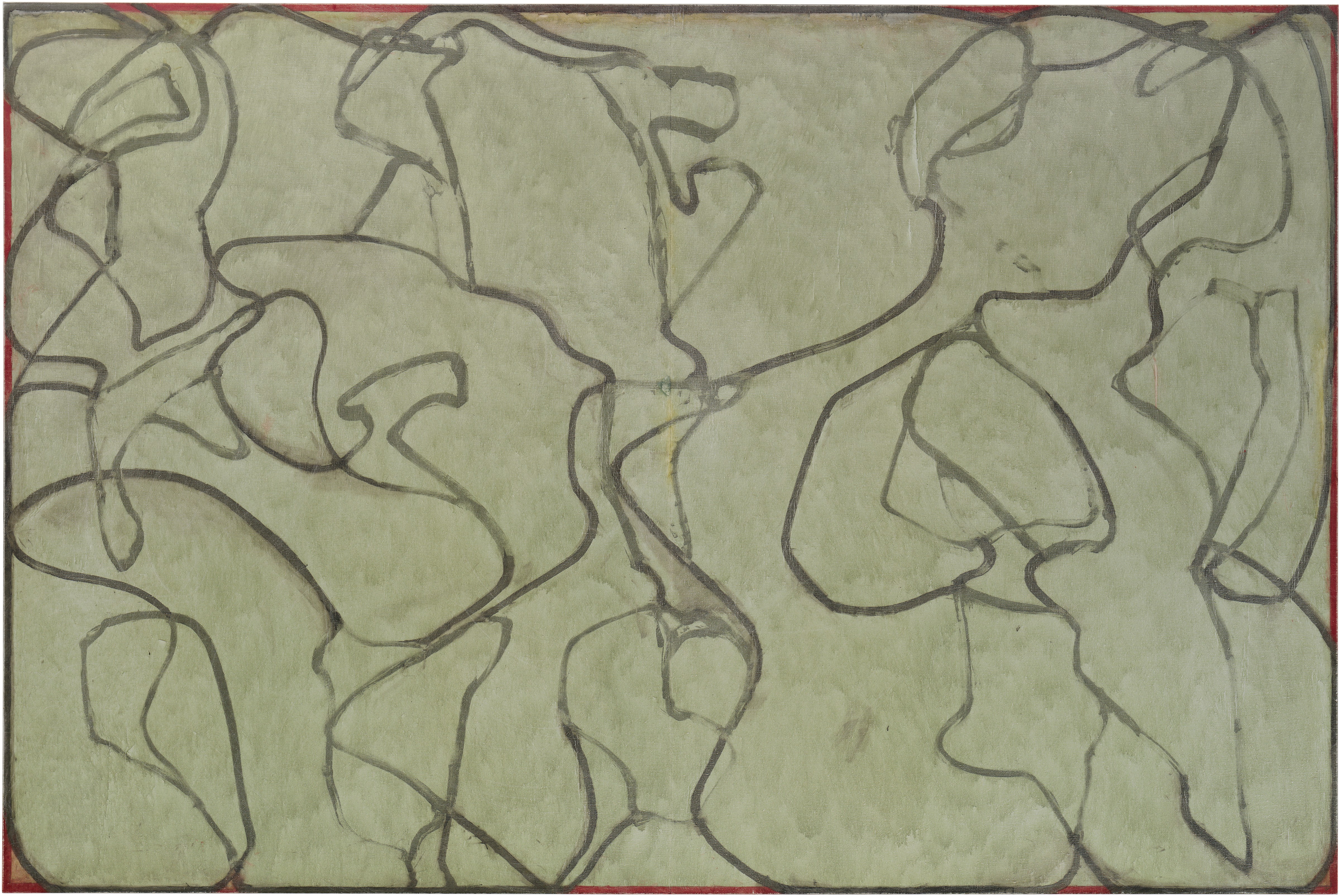
Paula Cooper Gallery is delighted to present Atsuko Tanaka, Yayoi Kusama, an exhibition that brings together the works of two of Japan’s most innovative and influential artists. Featuring a selection of works on canvas and paper spanning Tanaka's career, and early works in various media by Kusama, this exhibition offers an opportunity to explore the parallel yet distinct artistic concerns of these pioneering figures in postwar abstract art.
Atsuko Tanaka (1932-2005) and Yayoi Kusama (b. 1929) both came of age in the aftermath of World War II, during a period of profound societal transformation in Japan that sparked radical shifts and innovations in the arts. Tanaka, a core member of the avant-garde Gutai movement from 1955 to 1965 and one of its few female artists, is best known for her vibrant works where circles and lines engage in dynamic interplay. Her Electric Dress (1956), a garment composed of incandescent bulbs and connecting wires, remains her most iconic work and encapsulates her fascination with notions of technological change, artificiality, and disjunction at the heart of modernity. Meanwhile, Kusama lived in New York from 1958 through 1973, and actively participated in the vibrant art scene of the 1960s. Her work of this period engaged with the hypnotic power of repetition, often evolving into immersive pieces that evoked hallucination, boundlessness and self-obliteration. Her art reflects a preoccupation with themes of obsession, depersonalization and liberation, hallmarks of an alienated age. Both artists shared a broadened approach to artmaking, incorporating textiles, fashion, sensory environments, performance, and participatory elements into their work. Each developed a deeply personal abstract language built around repeated motifs and a keen interest in large, enveloping scale.
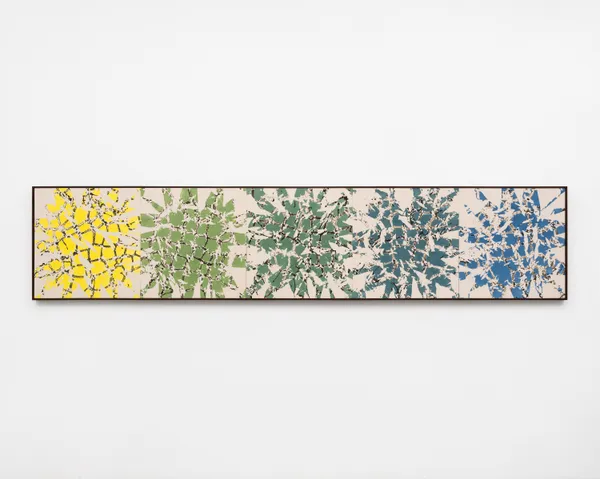
The exhibition will present a diverse selection of works on paper and canvas by each artist. It will include examples of Tanaka’s early drawings inspired by her Electric Dress, paintings from the Gutai period and beyond, as well as a small group of watercolors made for Sam Francis. Also on view will be a selection of Kusama’s pioneering Infinity Nets paintings from the 1960s, alongside rare collages, photographs and early pastels. In addition to these works, the exhibition will include documentary photography by Peter Moore and Kiyoji Otsuji, capturing pivotal moments in the artists’ careers, and three films: Kusama’s Self-Obliteration by Jud Yalkut along with Round on Sand and Tanaka’s Round Circle by Tanaka.
Atsuko Tanaka (1932–2005) was born in Osaka, Japan, and educated in Osaka and Kyoto. After founding the short-lived art collective Zero-kai with Kazuo Shiraga and Akira Kanayama, Tanaka became a core member of the pioneering Gutai group and participated in over a dozen exhibitions and performances from 1955 to 1965. In 1964, she was awarded the Guggenheim International Award by curator Lawrence Alloway. After her departure from Gutai in 1965, Tanaka briefly withdrew from the public eye. In the mid-1980s, she experienced a major resurgence as Japanese avant- garde art and Gutai were reexamined in key exhibitions across Europe and the U.S., including Japon des avant-gardes (Centre Pompidou, Paris, 1986) and Scream Against the Sky (Guggenheim, New York, 1994). In 2001, she had a retrospective in Japan at the Ashiya City Museum of Art and History. Three years later, she was the first former Gutai artist to receive a survey exhibition in the U.S. (Electrifying Art, Grey Art Gallery, New York University). Tanaka's work was further recognized with a posthumous retrospective in 2011–12 (The Art of Connecting, IKON, Castello, MOT Tokyo), and her work was included in documenta 12 (2007), the 53rd Venice Biennale (2009), and the Centre Pompidou’s Elles (2010). This presentation of Tanaka’s work at Paula Cooper Gallery follows a major one-person show in 2004 and a focused presentation in the gallery’s Palm Beach space in 2021.
Yayoi Kusama (b. 1929) was born in Matsumoto City, Japan, and studied painting in Kyoto before moving to New York in the late 1950s. Arriving in the U.S. during a period of heightened artistic innovation, as Abstract Expressionism began to cede ground to Minimalism and Pop Art, Kusama quickly became a central figure in the city’s avant-garde art scene. She developed close relationships with prominent artists such as Donald Judd and Joseph Cornell, among others. After a series of groundbreaking exhibitions, performances, and happenings, Kusama returned to Japan in 1973 and briefly withdrew from public view, entering a psychiatric hospital where she still resides today. However, in the late 1980s, interest in her work was reignited through several important exhibitions, beginning with a retrospective at the Center for International Contemporary Arts in New York (1989). Kusama’s prominence further increased in 1993 when she represented Japan at the 45th Venice Biennale, receiving widespread critical acclaim. In 1998, her work was the subject of the retrospective Love Forever: Yayoi Kusama, 1958–1968, which was co-organized by the Los Angeles County Museum of Art and the Museum of Modern Art, New York, and traveled to the Walker Art Center, Minneapolis, and the Museum of Contemporary Art, Tokyo. Today, Kusama’s works are in major museum collections worldwide, including MoMA in New York; the Tate Modern, London; the Whitney Museum of American Art, New York; and the Yayoi Kusama Museum, Tokyo, an institution dedicated solely to her works. Upcoming exhibitions include a major retrospective at Fondation Beyeler, Basel, her first in Switzerland (opening Oct. 2025), and Love you for infinity at the Sprengel Museum in Hannover, Germany, with Niki de Saint Phalle and Takashi Murakami (opening Sept. 2025). This presentation of Kusama’s work at Paula Cooper Gallery follows a one-person exhibition in 1995 at the gallery’s former location on Wooster Street.