
Ended
Walton Ford
Lion of God
Apr 1 – Sep 22, 2024
This year in Venice, Walton Ford unveils a major site-specific exhibition featuring a new body of work conceived in response to the collection of the city’s historical institution Ateneo Veneto di Scienze, Lettere ed Arti. Lion of God is Ford’s first solo exhibition in Italy, consisting of a series of monumental watercolor paintings that explore the historical, biological, and environmental resonance of the subjects of the library’s collection, particularly the figure of the lion in Tintoretto’s Apparizione della Vergine a San Girolamo (The Apparition of the Virgin to St. Jerome) (c. 1580). The presentation spans two rooms in the Ateneo—the Aula Magna on the ground floor, and the Sala Tommaseo hall where Tintoretto’s work will be moved into public view for the exhibition’s duration. Lion of God is curated by Udo Kittelmann, who worked with Ford on the artist’s 2010-11 traveling European retrospective Bestiarium.
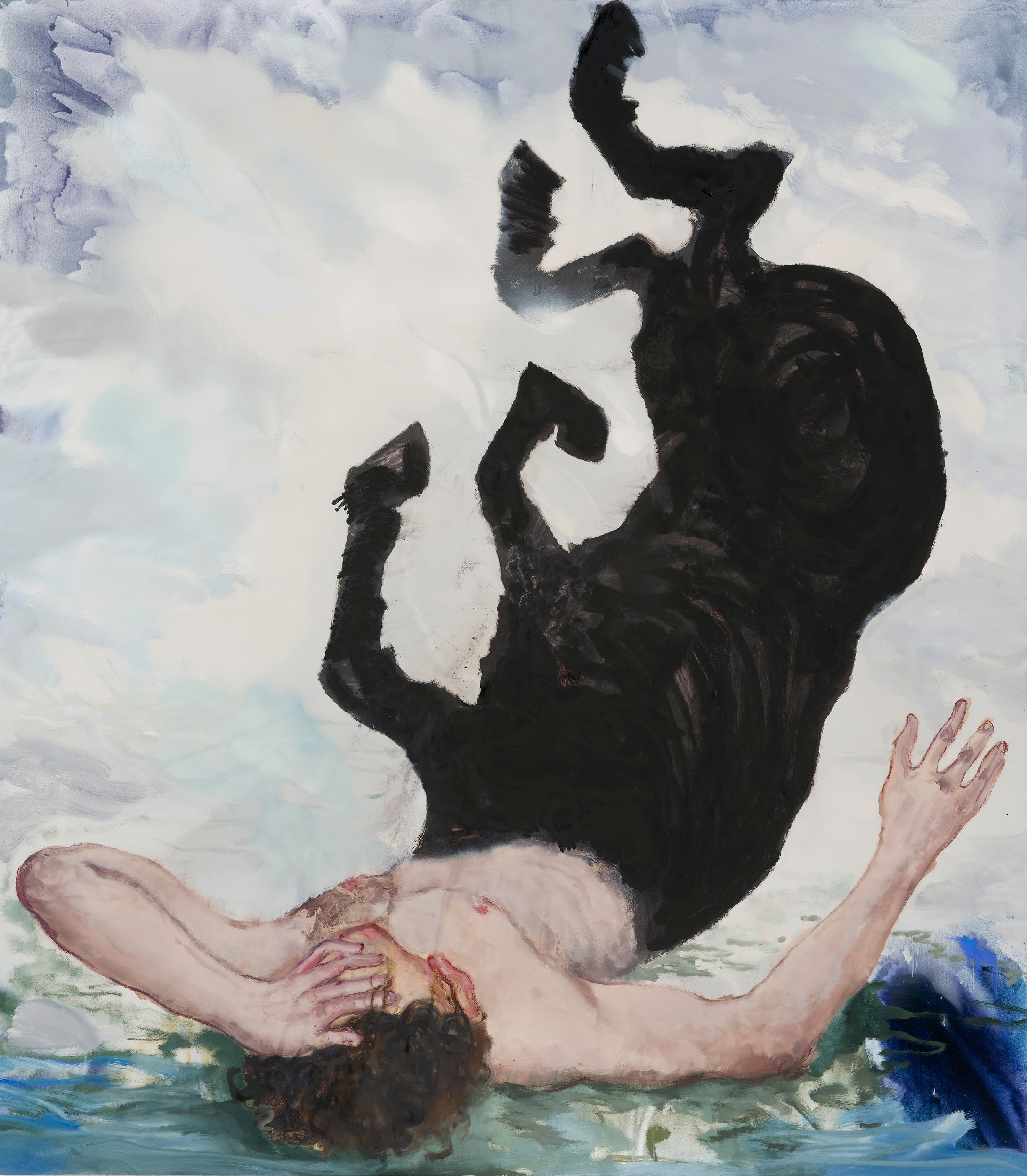
Ford has described Tintoretto’s Apparizione della Vergine a San Girolamo as “A poignant entry point into a visual discussion of our relationship with the natural world.” Depicting Saint Jerome in ecstasy, in the midst of a vision in which the Virgin Mary descends from heaven, the historic painting features the lion that the legend describes as befriending St Jerome after he pulls a thorn from its paw. The unlikely bond between the two characters is detailed in the The Golden Legend, a text that was widely circulated in Europe during the late Middle Ages and which has acted as a reference for Ford. Demonstrating a mastery of narrative that Ford himself shares, Tintoretto has rendered his lion in shadow. One of Ford’s new paintings—spanning almost ten feet in length—will invert the Venetian painter’s framing to powerfully foreground the animal’s experience.
Ford’s ongoing philosophical inquiry into the ways in which we interact with and estrange ourselves from the animal species on this planet invokes one of the most urgent questions of our time. Curator Udo Kittelmann says of the project: “In search of finding analogies between the past and the present, Walton Ford’s paintings superimpose intricate natural history depictions with current perceptions and critical commentaries, as well as adding quotes from literary sources from past centuries, rendered in the style of the old masters. In his artworks, which can be seen as satires on political oppression and the exploitation of the environment, he casts doubt on the 'ever new' and the 'ever better’. At the same time Ford has always been raising questions on a diverse range of expectations and established rules in contemporary aesthetics. To be precise, his paintings are a plot about the arrogance of human nature. Yesterday, today and tomorrow.”
Ford’s work subverts conventions relating to humanity’s attempts to categorize and interpret the natural world by drawing on naturalist sketches and dioramas, zoological records, mythology, fables, and art history. While alluding to the form of naturalist field studies from the 19th century, Ford’s coded poetics are wide-ranging in their references, calling upon the viewer to use these fragmented clues as a guide by which to untangle the folkloric, historical, or imaginary event depicted in the work. Anatomically precise as a result of close observation of taxidermized specimens in museum collections, these works by Ford vividly project the lives, experiences, observations, and hidden histories of their human and animal subjects.
The exhibition in Venice runs concurrently with Walton Ford: Birds and Beasts of the Studio, a major solo exhibition at The Morgan Library & Museum in New York City celebrating the artist’s drawings. On view from April 12 through October 20, 2024, the exhibition is organized by Isabelle Dervaux, Acquavella Curator and Department Head of Modern and Contemporary Drawings.
Lion of God is organized by Kasmin, New York. Kasmin has presented 11 solo exhibitions of Ford’s work since 1997, including Barbary in 2018—a body of work exploring the fate of the North African Barbary lion. The exhibition has been designed by Studio MDA.
Walton Ford’s monumental watercolor paintings and editioned prints expand upon the visual language and narrative scope of traditional natural history painting, mediating on the often violent and bizarre moments that lie at the intersection of human culture and the natural world. Drawing from an extensive research practice that references scientific illustrations, field studies, fables, and myths, he develops stories about animals as they exist in the human imagination. Although human figures rarely appear in his paintings, their presence and effect is always implied.
Ford’s mid-career survey, Tigers of Wrath, opened at the Brooklyn Museum in New York in 2006, and traveled to the Norton Museum of Art in Florida and the San Antonio Museum of Art in Texas through 2008. Ford’s first major institutional retrospective exhibition in Europe, Bestiarium, curated by Udo Kittelmann, opened at Berlin’s Hamburger Bahnhof–Museum für Gegenwart in 2010, and traveled to the Albertina in Vienna and the Louisiana Museum of Modern Art in Humlebaek, Denmark, through 2011. In 2015-16, the Musée de la Chasse et de la Nature in Paris staged an exhibition of works by Ford, highlighting a series inspired by the Beast of Gévaudan.
Museum director and curator Udo Kittelmann (born 1958 in Düsseldorf, Germany) has served at several of the most important German museums, most notably from 2008 to 2020 as the director of the Nationalgalerie, State Museums of Berlin, comprising six museums among them the Neue Nationalgalerie, Alte Nationalgalerie and Hamburger Bahnhof - Museum for Contemporary Art, Museum Berggruen, Scharf-Gerstenberg Collection and Friedrichswerdersche Church. During his tenure, he also initiated the renovation of Mies van der Rohe's architectural masterpiece, the Neue Nationalgalerie, by the British architect David Chipperfield, and petitioned the German government to construct the Museum of 20th Century designed by Herzog & de Meuron beside the Mies building at the Kulturforum in Berlin. In 2013 he was honored with the award of European Cultural Manager of the Year.
Prior to the Nationalgalerie, he was director at the Kölnischer Kunstverein (1994 to 2001) and the Museum für Moderne Kunst (MMK) in Frankfurt (2002–2008). In 2001, Kittelmann was commissioner and curator of the German Pavilion at the 49th Venice Biennale and was awarded a Golden Lion for best international pavilion. In 2013 at the 55th Biennale di Venezia he curated as the first non-Russian commissioner the Russian Pavilion, where he showed the installation Danaë by Vadim Zakharov. Throughout his career, Kittelmann also staged several exhibitions among them for Fondazione Prada in Milan, Venice and Shanghai as well as Fondation Beyeler in Basel, Switzerland and Centro Botín in Santander, Spain.