
Ended
Daniel Richter
Limbo
Apr 14 – Sep 25, 2022
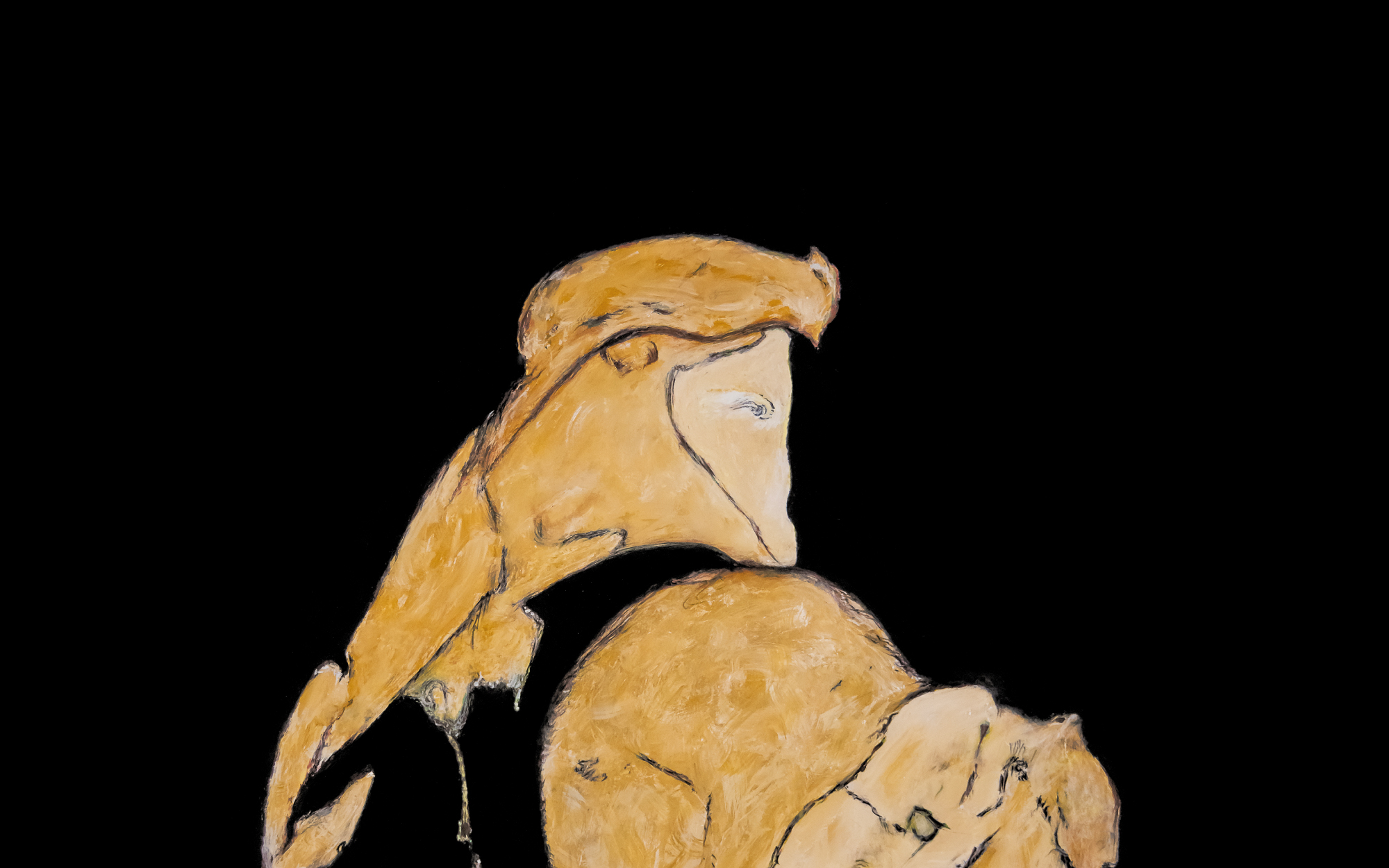
Coinciding with the 59th Biennale di Venezia, the Ateneo Veneto presents new paintings by Daniel Richter in the rooms of the Scuola Grande di San Fantin. The works are shown in the palazzo’s historical setting amidst its remarkable decorative programme and alongside 17th-century works from the museum’s collection. Large-scale oil paintings by Richter are exhibited in the Aula Magna on the ground floor, while the Sala Tommaseo on the upper floor offers insights into the artist’s archive through a selection of books, ephemera and paraphernalia, alongside new ink drawings and collages.
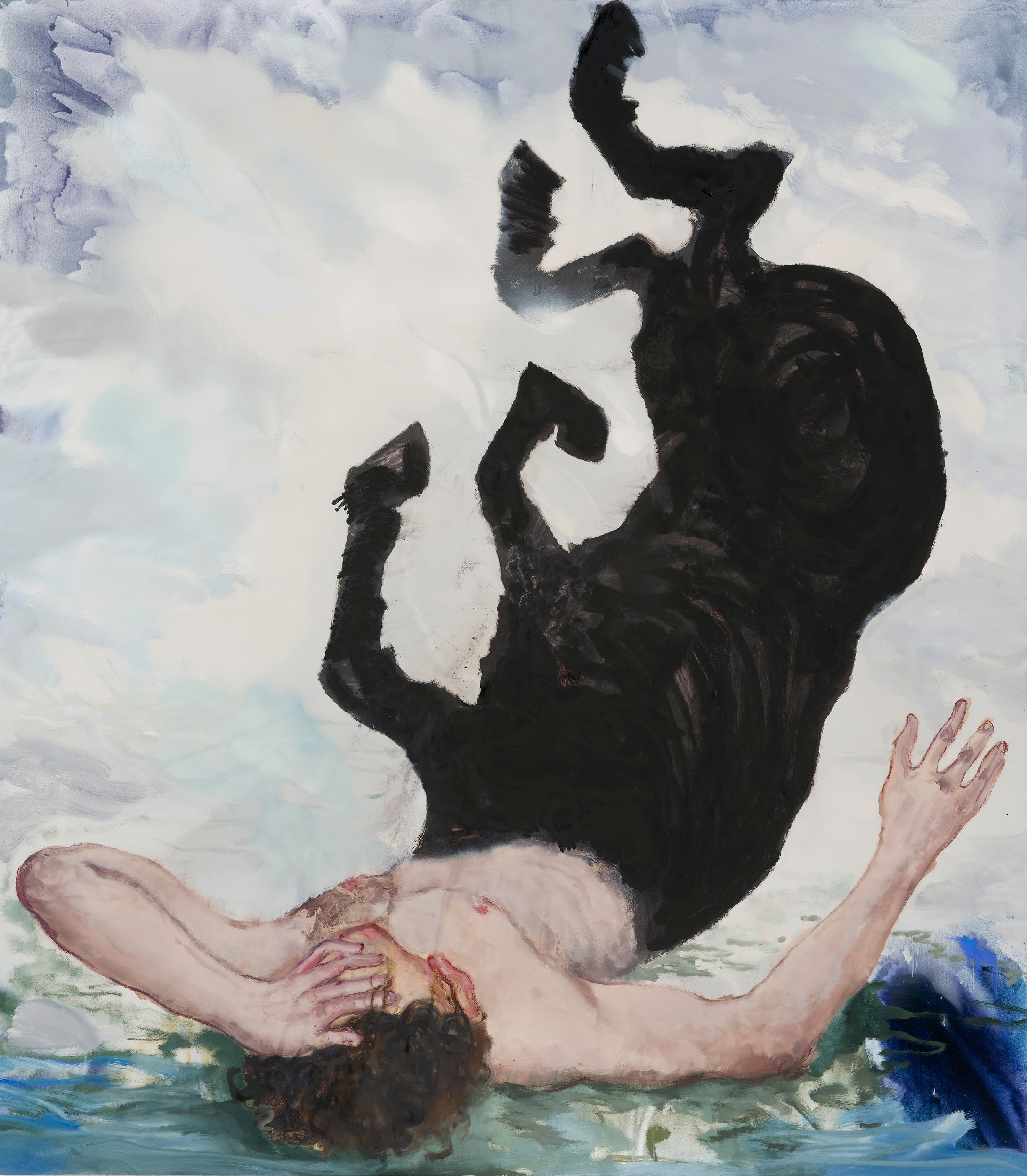
Treading the path between abstraction and figuration, Richter has formulated a pictorial language of his own. His figures are linked together in violently distorted poses, seeming to float in an indefinable cosmos. The exhibition’s title, Limbo, can refer both to the spiritual space inhabited by souls waiting to ascend to heaven and to the acrobatic game of backbending that Richter’s figures seem to perform.
Built as a caritative institution which offered spiritual guidance for those sentenced to death, the building was converted into an educational institution when the fraternity was dissolved during the course of secularisation in the 19th century. Today, the Ateneo Veneto accommodates a museum and a major cultural institution. This context opens up a lively visual dialogue between the Scuola’s religious programme and Richter’s aspiration to question art in terms of social and political responsibility.
The early modern painting cycles that decorate the palazzo’s walls and ceilings have an inherent immediacy that arises from the contrast between the dark background and the bright biblical scenes in the foreground. Richter also uses the stylistic feature of chiaroscuro, which is characteristic of the late Renaissance and Baroque, as a central creative device in his works. The curator Eva Meyer-Hermann further points out that the epithet of the Scuola, which was known as the institution of the ‘good death’ (Scuola della Buona Morte) resonates with Richter’s own artistic endeavour to ‘paint beautifying ugliness’.
Richter’s works can sometimes be read in political terms but mostly they evade any single interpretation. By stripping the works of any historical context and explicit symbolic meaning, they become almost allegorical, thereby bringing them closer to the decorative programme in the Ateneo Veneto. This raises questions about the tradition of painting and the formation of historical consciousness, as well as its sociological and psychological implications.
The exhibition is organised in collaboration with the Ateneo Veneto, Venice, with the support of Zuecca Projects and curated by Eva Meyer-Hermann. The exhibition architecture is designed by Viola Eickmeier and executed by Giacomo Andrea Doria (Ott Art). An artist’s book designed by Yvonne Quirmbach has been published on the occasion of the exhibition.
The Ateneo Veneto is thankful for the kind support provided by Grimm Gallery, Regen Projects and Thaddaeus Ropac gallery.
Daniel Richter first came to prominence in the 1990s when he transitioned into fine arts from the world of music, where he used to design record sleeves and posters. Figures began appearing in his works in the 2000s, often inspired by reproductions from newspapers or history books and rendered in bright colours, and described by the artist as a new form of history painting. Ever the innovator, his recent works are the next experimental step in a visual language that has evolved across his career, typified by chaotic entanglements of fragmented bodies against dichromatic backgrounds.
Born in Eutin, Germany, in 1962, Richter completed four years of studies with Werner Büttner at the Hamburg Academy of Fine Arts and worked as assistant to Albert Oehlen. Influenced by the legacy of Symbolists such as James Ensor and Edvard Munch, his works can often be read in political terms, but they evade any single interpretation. He uses vivid chromatic contrasts and abstracted patterning to convey a disquieting emotional tenor, heightened by the temporal and spatial indeterminacy of scenes that refuse to resolve into a coherent time, place, or even pictorial space. The same is true of his contoured colour fields, which are reminiscent of maps in an atlas but do not correspond to any specific region. The artist describes them as an ‘encirclement, a sort of pressing, entwining, squeezing’, which conveys a strong sense of confrontation and flux.
Daniel Richter’s works are on show in renowned collections worldwide, such as the National Gallery of Canada, Ottawa; Louisiana Museum of Modern Art, Humlebæk; Centre Pompidou, Paris; Kunsthalle Kiel; Hamburger Kunsthalle; Nationalgalerie Berlin; Kunstmuseum Stuttgart; Museum der Bildenden Künste Leipzig; Kunstmuseum Den Haag, The Hague; Contemporary Art Collection of the Federal Republic of Germany; Museum of Modern Art, New York; Denver Art Museum; and Musée d’Art Moderne et Contemporain de Strasbourg.
Comprehensive solo exhibitions have been held at the Kunsthalle Kiel and Kunstsammlung Nordrhein-Westfalen, Düsseldorf (both 2001); National Gallery of Canada, Ottawa (2005); Hamburger Kunsthalle and Kunstmuseum Den Haag, The Hague (both 2007); CAC Málaga and Denver Art Museum (both 2008); and Kestner Gesellschaft, Hanover, (2011). More recently, Schirn Kunsthalle, Frankfurt (2014–15); Louisiana Museum of Modern Art, Humlebæk (2016); 21er Haus, Vienna (2017); and Camden Arts Centre, London (2017) have devoted monographic shows to Richter. His work was also shown in the group exhibition Radical Figures: Painting in the New Millennium at the Whitechapel Gallery, London in 2020.