
Exhibition · Irish Arts Center
The Space We Occupy
Dec 4 – May 22
About the show
George Bolster, Neil Carroll, Colin Crotty, Katie Holten, Fiona Kelly, Ailbhe Ní Bhriain
Curated by Miranda Driscoll, Irish Arts Center Curator-in-Residence
The Space We Occupy is an exhibition of work by six visual artists based in Dublin, Cork and New York City, selected to mark the opening of the New Irish Arts Center building. The visitor is invited to explore all four floors of the building to view the works, which were installed in careful consideration of this new space, its former use and the materials used in its renovation. The six artists included represent the depth and breadth of contemporary visual art being made across the island of Ireland and by the many Irish artists who call the U.S. home.
The title contains a multitude of meanings. It alludes to our relationship with place and time; from the macro to the micro—Earth’s place in the solar system, humankind’s time on Earth, the place we occupy in community, the physical space of the Irish Arts Center building and that occupied by the artist or viewer.
Several threads run through the works. The title of Neil Carroll’s monumental triptych of built paintings —Rupture—suggests a sudden or violent schism in time or place, of the body or the mind. The materials include peeled-back layers of burlap, plaster and paint, exposing what might otherwise remain hidden, or alluding to layers of geological strata that reveal deep layers of time. Ailbhe Ní Bhriain’s layering of found colonial photographs with her own imagery of damaged quarry walls points to a geological history revealed by the extraction of material and subsequent destruction of the landscape and its ecosystems. The use of the colonial archive here also serves as a record of the exploitation, damage and destruction of indigenous cultures by imperialism. The images are layered using digital collage, obscuring the features of the figures, disempowering them and reducing them to anonymity. The collage-like process in Colin Crotty’s figurative paintings also gives an increased sense of displacement, suggesting an ambiguous relationship to belonging and alienation. Figures are reduced to forms, and take on the character of place, mimicking the color and light of their environment, appearing as both active performers and passive observers. Nature in these scenes of social gatherings is pastoral, appearing as carefully contained and at times artificially constructed.
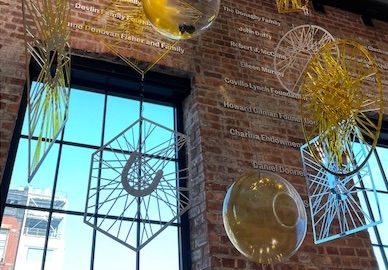
Katie Holten’s simple but devastating This was once forest—followed by the statement This will be forest again—along with a nine-foot tall, ghostly white tree, serve as a sobering reminder of Humankind’s passing yet infinitely destructive time on Earth. This thread appears again in Fiona Kelly’s use of industrial tar to screen print imagery of piles of rubble and construction waste onto birch plywood. She tackles the idea of entropy, by asking the viewer to think in deep time, as a way to reimagine our problematic present. This concept of a human-centric view of nature, Earth, and what is beyond us runs throughout the exhibition. George Bolster’s suspended mobile echoes a cosmic array appearing initially above the heads of the viewer on the first floor. It serves as a parallel as to how the planets appear to us, and how we understand the solar system to be. In this case however, viewers can access the work from multiple positions, as they journey up through the floors of the building.
About Irish Arts Center
We present, develop, and celebrate work from established and emerging artists and cultural practitioners, providing audiences with emotionally and intellectually engaging experiences in an environment of Irish hospitality. Steeped in grassroots traditions, we also provide community education programs and access to the arts for people of all ages and ethnic, racial, and socioeconomic backgrounds.
More about Irish Arts Center →