Ended Jul 29
Xavier Veilhan
Portrait Mode
Jun 2 – Jul 29, 2023
More from Xavier Veilhan on Gallop
[Scroll down for French version / Veuillez trouver ci-dessous la version française]
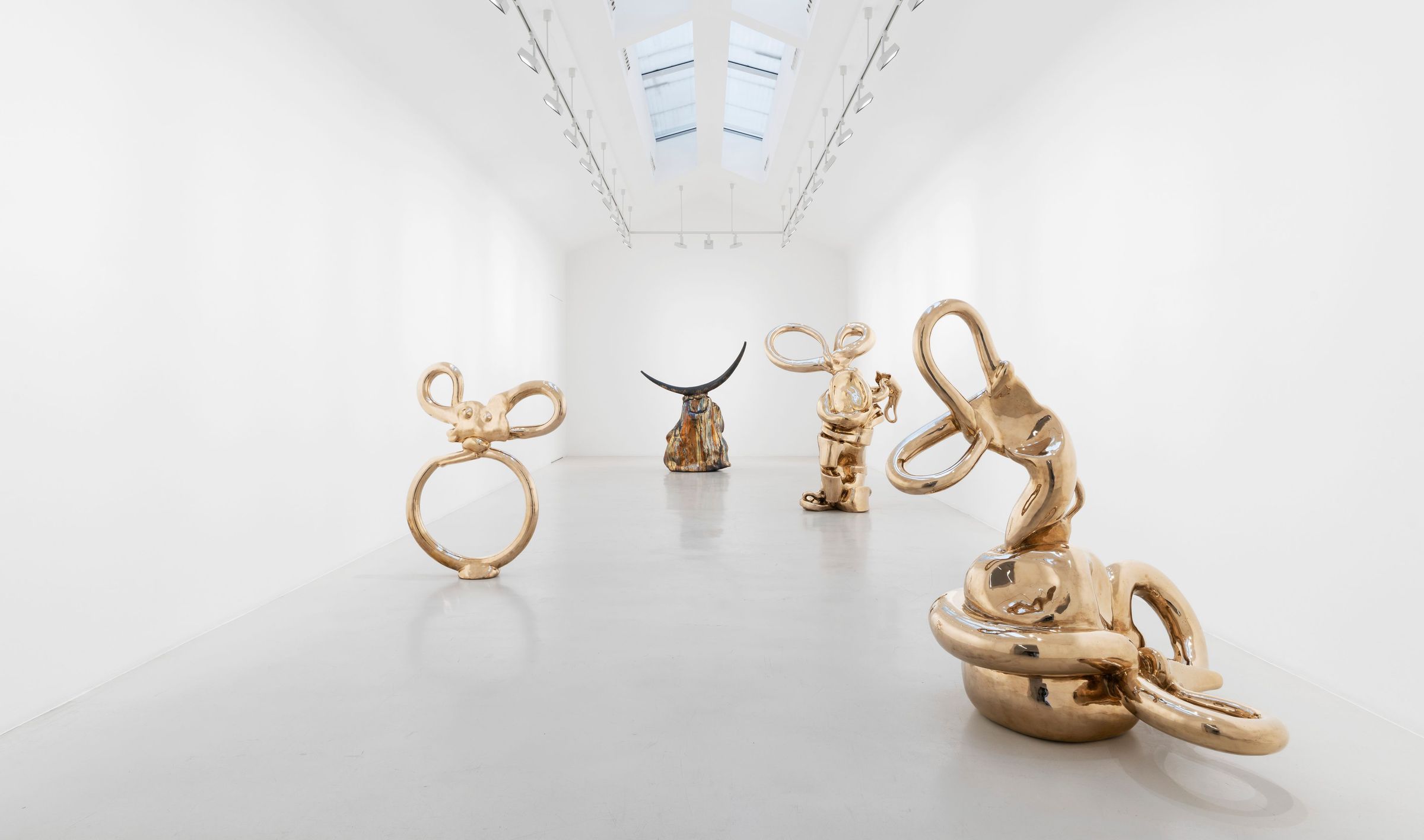
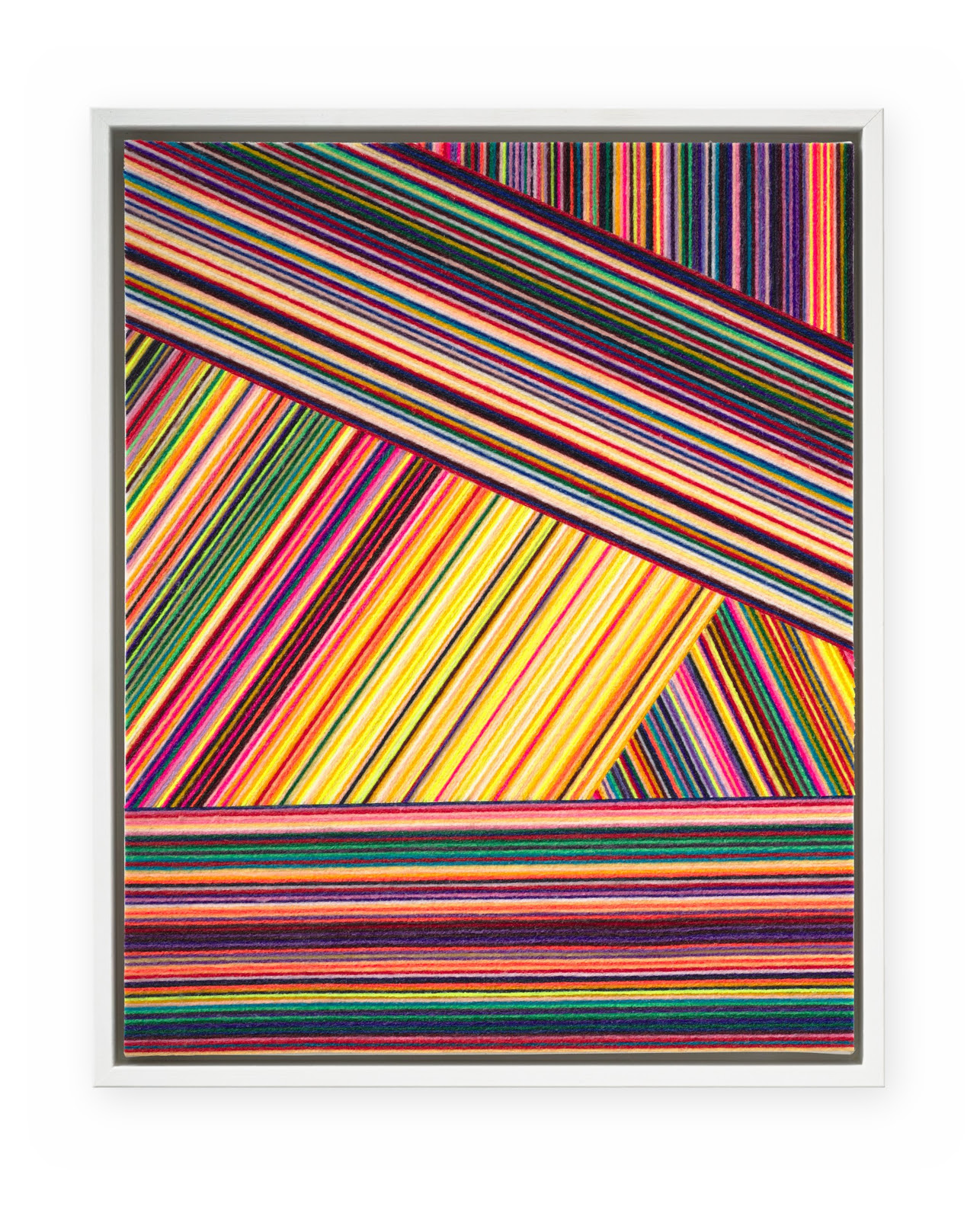
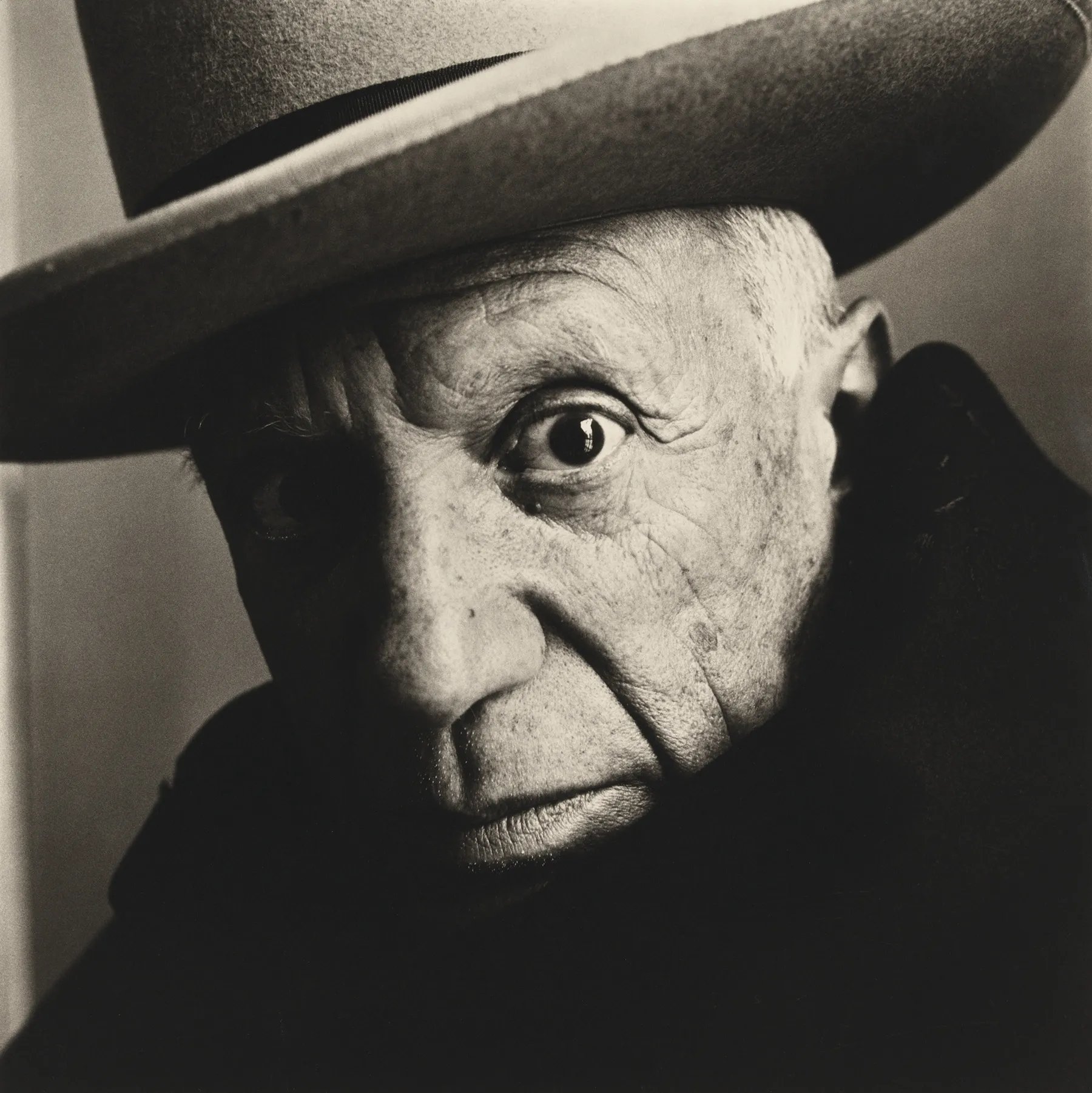
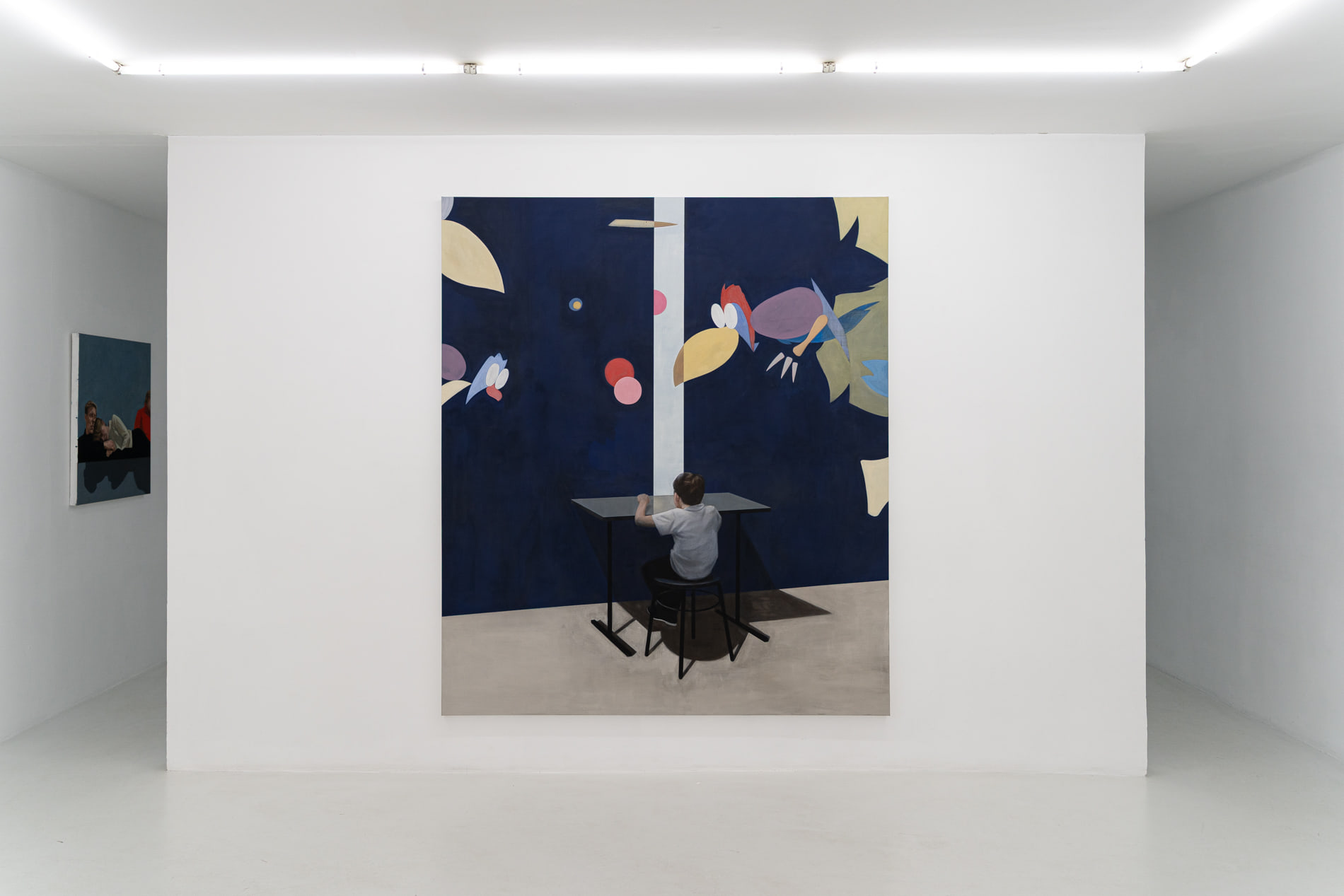
Perrotin is pleased to present Portrait Mode a solo exhibition by Xavier Veilhan. The portrait mode seems like the renewal of a historical genre through its digital transformation: the portrait (and the self-portrait) has proliferated endlessly. In the exhibition, the portrait is presented in two dimensions (by combining the techniques of marquetry and painting) and in three dimensions (using digital sculptures of solid wood, among others). The subjects are friends of the artist, members of the studio staff, and everyday animals (birds). Here the self-celebration of each individual through the image is replaced by the celebration of all through the object (here the image passes through the object: marquetry and statuary).
The seats by Vico Magistretti and Rick Owens that furnish the studio were used during the sittings. They are reproduced in a smaller size in the statues but also “really” present in the space: they serve as a living room suite so that the artist can comfortably receive and interact with the visitors.
There is a term that Xavier Veilhan often uses when talking about his work: presence. The presence in the space of the sculptures and of the images that are freed from the two-dimensionality of the wall by materializing as bas-reliefs or illusionistic volumes. The presence of spectators’ bodies walking around perfectly designed exhibitions in the form of gardens or synthetic landscapes. The presence of passersby who share the urban space with his statues of animals, anonymous people, monsters, and architects. The presence of the moving bodies of the performers and dancers who often appear in his films or shows.
More recently, the physical presence of Xavier Veilhan the artist has emerged as a new component in his work. He was very physically engaged during the entire Studio Venezia exhibition, the participative recording studio that he created for the French Pavilion at the 2017 Venice Biennale. And he was on stage in Compulsory Figures (2019), a performance created with figure skater Stephen Thompson and designed with scenographer Alexis Bertrand (with whom he has been working since the early 2000s).
This primacy of presence could seem strange in a body of work that has often been identified with digital production processes and the interplay of scale they make possible, or which has been reduced to pixelated colored surfaces. But the pandemic that we have all experienced over the past few years—and the in-person/remote dichotomy it established as a daily reality in our lives—patently revealed that thinking about presence cannot be dissociated from reflections on information technologies.
Technical imagination has fueled much of Xavier Veilhan’s work since his early days as an artist: he has made sculptures of vehicles, machines, and mechanisms;[1] he has been inspired by the great modern story of the conquest of space;[2] he has accompanied the massification of digital images—and the software that allows them to be created and transformed—by producing intriguing generic forms that allegorize this new state of fluid, disembodied, and ubiquitous images. He has highlighted the “transformation of the way we relate to materials today,”[3] and invented surfaces to give form to the widely shared (but not always conscious) intuition that the world of materials and the world of information are now engaged in processes of hybridization. He has reminded us that the systems we use are, first and foremost, programmable and that they are markers of time. By organizing the large-scale circulation of his highly photogenic sculptures, online and through images, he has also seized upon the disruptions to the public space resulting from the democratization of the internet, to which his body of work is the exact contemporary.
It would be simplistic, however, to assimilate his work to a discourse with modernistic and technophile overtones. The technical bodies that people his oeuvre are bodies among many others. Inspired by classi- cal statuary, Xavier Veilhan also rapidly made room for the bodies of animals—penguins, pigeons, bears, rhinoceroses, sharks, dogs—as well as the bodies of viewers, designing exhibition systems that always take the physical existence of visitors into account. In other words, Xavier Veilhan’s corpus shows us that the terrifying fantasy of a mode of disembodied existence in the metaverse, an unchanging productivity punctuated by Zoom meetings, or of an art accessible via viewing rooms and virtual museum visits, meets its limits in the biological reality of human and animal bodies, and the bodies of artworks and machines.
The recent shift in his work, from the series of faceted sculptures to the series of blurred, more organic sculptures, thus holds a demons- trative value. It reveals the passage between two historic moments (from modernity to another period yet to be named) and our general awareness—as we go through an unprecedented crisis of living things and increasingly take into account the interactions that link us to non- human species—that we share the space of this world with other bodies that have their own agency and make us think and act. When Xavier Veilhan explains that what he seeks to recreate in his work are the moments when conversation has been exhausted and the quality of nonverbal copresence afforded by “concerts, shows, and road trips,” he is formulating the idea of the exhibition that has underpinned his practice since the early 1990s. The exhibition is this tool—this technology even—that enables different bodies to stand together.[4] It constitutes a potential model for the cohabitation and composition of different worlds.[5]
—Jill Gasparina
1 - See, for example, Le Tour (1996), La Ford T (1999), Les Vélos (2000), Le Coucou (2005), and La Crocodile (2019).
2 - At Versailles in 2009, Veilhan showed a recumbent statue reproducing the silhouette of Soviet cosmonaut Yuri Gagarin, who in 1961, became the first man in space. Veilhan is currently preparing a performance inspired by scientific and popular texts about the universe and the infinitely large.
3 - Tristan Garcia in an unpublished interview with Rémi Dufay and the author, 2017.
4 - In 1976, artist and critic Brian O’Doherty, theorist of the white cube, already evoked the space of the contemporary art exhibition: “The space is devoted to the technology of esthetics,” in Inside the White Cube: The Ideology of the Gallery Space (Berkely: University of California Press, 1999), p. 15.
5 - See Philippe Descola, La Complication des mondes. Entretiens avec Pierre Charbonnier (Paris: Flammarion, 2014).
*****
La galerie Perrotin est heureuse de présenter Portrait Mode, une exposition personnelle de Xavier Veilhan à Paris. Le mode portrait, c’est l’évocation du renouvellement d’un genre historique par l’avènement de sa mutation numérique : le portrait (et l’autoportrait) s’est multiplié sans limite. Dans l’exposition le portrait est traité en deux dimensions (en combinant les techniques de la marqueterie et de la peinture) et trois dimensions (au travers de la sculpture numérique de bois massif entre autres). Les sujets sont des amis de l’artiste, des membres de l’équipe de l’atelier, des animaux qui nous sont familiers (oiseaux). Ici l’autocélébration de chacun par l’image est remplacée par la célébration de tous par l’objet (l’image passant ici par l’objet : marqueterie et statuaire).
Des sièges de Vico Magistretti et de Rick Owens qui meublent l’atelier ont été utilisés lors des séances de pose. Ils sont reproduits plus petits dans les statues mais aussi présents « en vrai » dans l’espace : ils servent de salon pour que l'artiste puisse recevoir confortablement les visiteurs et échanger avec eux.
Un terme revient souvent dans les propos de Xavier Veilhan lorsqu’il évoque son travail : la présence. Présence dans l’espace des sculptures et des images qui s’émancipent de la bi-dimensionnalité du mur en se matérialisant sous la forme de bas-reliefs ou de volumes illusionnistes.
Présence des corps des spectatrices et spectateurs qui déambulent dans ses expositions parfaitement scénographiées sous la forme de jardins et de paysages synthétiques. Présence des passantes et passants qui partagent l’espace urbain avec ses statues d’animaux, d’anonymes, de monstres et d’architectes. Présence des corps en mouvement des performeuses et performeurs, danseuses et danseurs qui apparaissent souvent dans ses films ou ses spectacles.
Plus récemment, c’est la présence physique de Xavier Veilhan en tant qu’artiste qui est apparue comme une nouvelle composante de son œuvre. Il fut très engagé physiquement pendant toute l’exposition Studio Venezia, installation en forme de studio d’enregistrement participatif, qu’il réalisa dans le pavillon français pour l’édition 2017 de la Biennale de Venise. Et dans Compulsory Figures (2019), spectacle monté avec le patineur Stephen Thompson et conçu avec le scénographe Alexis Bertrand (avec qui il collabore depuis le début des années 2000), il était sur scène.
Ce primat de la présence pourra sembler étrange dans le cas d’une œuvre qu’on a souvent identifiée à des processus de production numériques et aux jeux d’échelle qu’ils rendent possibles, ou qu’on a réduite à des surfaces pixélisées et colorées. Mais la période de pandémie que nous avons traversée ces dernières années, avec le couple présentiel-distanciel qu’elle a instauré comme une réalité quotidienne de nos vies, nous a révélé avec la plus grande clarté que la pensée de la présence est devenue indissociable d’une réflexion sur les technologies de l’information.
Les imaginaires techniques ont nourri une grande partie du travail de l’artiste depuis ses débuts : il a créé des sculptures de véhicules, de machines et de mécanismes[1], il s’est inspiré du grand récit moderne de la conquête spatiale[2], il a accompagné la massification des images numériques, et des logiciels qui permettent de les créer et de les transformer, en produisant d’intrigantes formes génériques qui allégorisaient ce nouvel état des images, fluides, désincarnées et ubiquitaires. Il a mis en lumière la “transformation du rapport contemporain aux matériaux[3]”, et inventé des surfaces pour donner forme à cette intuition largement partagée (mais pas toujours conscientisée) que les mondes de la matière et ceux de l’information sont désormais engagés dans des processus d’hybridation. Il nous a rappelé que les systèmes que nous utilisons sont, d’abord et avant tout, des systèmes programmables et qu’ils sont des marqueurs du temps. En organisant à grande échelle, en ligne et par l’image, la circulation de ses sculptures hautement photogéniques, il s’est également saisi des bouleversements de l’espace public induits par la démocratisation du web, dont son œuvre est l’exacte contemporaine.
Mais il serait réducteur d’assimiler son travail à un discours aux accents modernistes et technophiles. Les corps techniques qui peuplent son œuvre sont des corps parmi d’autres. Très tôt, l’artiste, inspiré par la statuaire classique, a fait aussi une place à ceux des animaux – pingouins, pigeons, ours, rhinocéros, requins, chiens – comme à ceux des spectatrices et spectateurs, dont l’existence physique est toujours prise en compte dans les dispositifs d’exposition qu’il conçoit. Autrement dit, l’œuvre de Xavier Veilhan nous montre que le fantasme glaçant d’un mode d’existence désincarné dans le métavers, d’une productivité inaltérée, rythmée par les réunions Zoom, ou d’un art accessible sous la forme de viewing rooms et de visites virtuelles de musées trouve ses limites dans la réalité biologique des corps humains et animaux, comme dans ceux des œuvres d’art et des machines.
Le basculement récent, au sein de son œuvre, des séries de sculptures facettées à celles des sculptures floues, plus organiques, possède ainsi la valeur d’une démonstration. Il est révélateur du passage s’opérant entre deux moments historiques (de la modernité à une autre période, qu’il nous reste à nommer), et de la prise de conscience généralisée – alors que nous traversons une crise du vivant sans précédent et que l’on prend de plus en plus en compte les interactions qui nous lient aux espèces non humaines – que nous partageons l’espace du monde avec d’autres corps, qui possèdent leur propre agentivité et nous font penser et agir. Lorsque Xavier Veilhan explique que ce sont les moments d’épuisement de la conversation, et la qualité de la coprésence non verbale qu’offrent “les concerts, les spectacles, les voyages en voiture”, qu’il cherche à restituer dans son travail, il formule ainsi la pensée de l’exposition qui sous- tend sa pratique depuis ses débuts dans les années 1990. L’exposition est cet outil, cette technologie même[4] qui permet à différents corps de tenir ensemble. Elle constitue un modèle possible pour la cohabitation et la composition des différents mondes[5].
—Jill Gasparina
1 - Voir par exemple Le Tour (1996), La Ford T (1999), Les Vélos (2000), Le Coucou (2005) ou La Crocodile (2019).
2 - En 2009, à Versailles, l’artiste a exposé un gisant reprenant la silhouette de Youri Gagarine, le premier homme à avoir atteint l’espace en 1961. Il travaille actuellement à la préparation d’un spectacle inspiré de textes scientifiques et de vulgarisation portant sur le cosmos et l’infiniment grand.
3 - Tristan Garcia, dans un entretien mené avec Rémi Dufay et l’autrice, 2017, non publié.
4 - C’est déjà en ces termes que le critique et artiste Brian O’Doherty, théoricien du white cube, évoquait en 1976 l’espace d’exposition d’art contemporain, “un espace dédié à la technologie de l’esthétique” (“a space devoed to the technology of esthetics”), dans Inside the White Cube: The Ideology of the Gallery Space, University of California Press, 1999, p 15.
5 - Cf. Philippe Descola, La Composition des mondes. Entretiens avec Pierre Charbonnier, Flammarion, Paris, 2014