Ended Dec 21
Donald Sultan
Love Letters
Oct 24 – Dec 21, 2024
More from Donald Sultan on Gallop
Ryan Lee Gallery is pleased to present Love Letters, an exhibition by Donald Sultan (b. 1951). This is his fifth solo exhibition at the gallery, comprising paintings and drawings that explore the mimosa flower. In the language of flowers, the mimosa is a symbol of secret love. Sultan has been a frequent interpreter of the language of flowers throughout his career, with images of poppies and tulips. He offers these paintings as love letters to the viewer.
In this most recent group of Mimosa paintings and drawings, Sultan incorporates a bright, multi- hued color palette to create lively and lush compositions with a sense of movement and dimension. The blossoms take center stage as the leaves in many of the paintings are depicted more sparingly. Sultan’s simplified geometric florals are buoyant and festive, demonstrating a fresh take on this classic subject that continues to hold his attention. Mimosas have captivated Sultan as a vehicle to explore abstraction; the forms are minimal but have a strong, powerful presence.
Following his signature style, Sultan incorporates industrial materials such as cement and masonite to depict delicate flora. This creates a study in contrasts, also seen in the juxtaposition of matte and reflective elements that play with light in various ways. Sultan’s use of silver paint in some of these works resembles the shimmer of leaves moving in the wind.
Sultan’s approach to composition in this body of work is influenced by that of Jackson Pollock’s painting, Blue Poles (1952). Pollock learned from the painter Thomas Hart Benton, his mentor, how to create dynamic movement across the canvas using what Sultan describes as “loops and counter-loops.” Indeed, the arrangement of flowers and branches in Sultan’s Mimosa paintings generates a rhythm that is at once repetitive and chaotic, ultimately creating a harmonious cadence that Sultan compares to a “glorious waltz.”
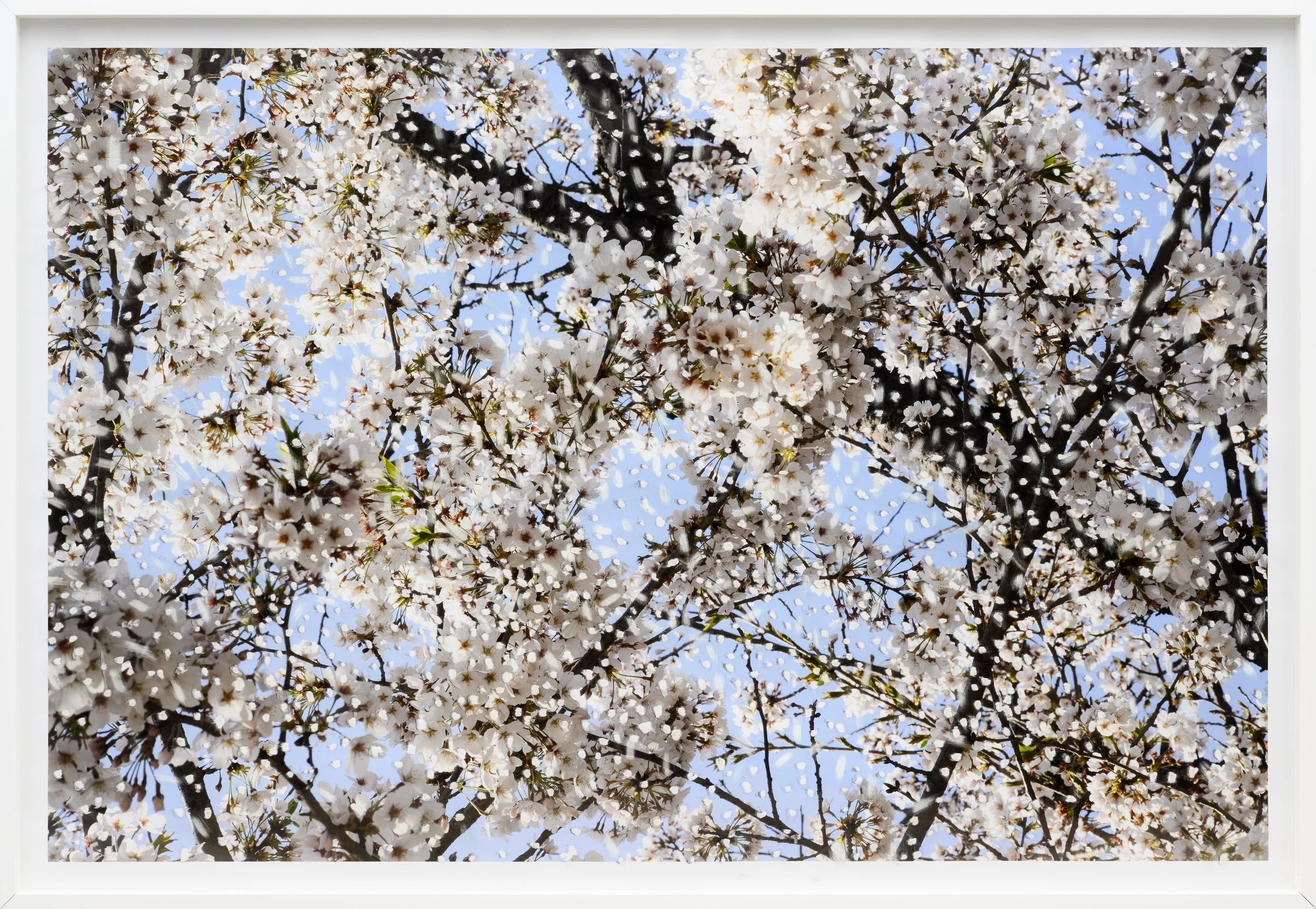
In White Mimosa August 20 2024, among the largest Mimosa paintings Sultan has made, abundant blossoms envelop the viewer through their sheer scale. Occasional streaks of blue paint evoke the sky, while shades of chartreuse and brown compose the leaves. Flickers of red and yellow dance throughout. The overwhelming size of this work alludes to the rolling hills of mimosas in the Alpes-Maritime region in southern France where the trees flourish, an inspiration for Sultan since he discovered them decades ago.
Every element, down to the sculptural structure on which he paints, holds meaning. This structure is a theatrical platform, and the exposed sides allow the viewer to see “backstage” — to see how the painting is made. The viewer is also made aware of the materiality of the painting — all of the products used to create them are obvious and visible. Sultan is interested in the paradox produced by the strength of the sturdy physical structure and the ephemeral fragility of the flowers. This contradiction echoes throughout Sultan’s still lifes, including his Smoke Ring series and his Lemon paintings.
Many of the brushstrokes that make up the branches and leaves are gestural, sketch-like and free, giving the composition an improvisational feeling. Combined with the yellow, white, and gray blossoms, this creates a sense of lightness and airiness. Yet the artist has a plan: “Every mark I make is an ideological statement — a statement about how I see and organize the world.”
Donald Sultan (b. 1951, Asheville, NC) is an artist who rose to prominence in the late 1970s as part of the “New Image” movement. Sultan has challenged the boundaries between painting and sculpture throughout his career. Using industrial materials such as roofing tar, aluminum, linoleum and enamel, Sultan layers, gouges, sands and constructs his paintings—sumptuous, richly textured compositions often made of the same materials as the rooms in which they are displayed. Intrigued by contrasts, he explores dichotomies of beauty and roughness, nature and artificiality, and realism and abstraction. Weighty and structured, Sultan’s works are simultaneously abstract and representational: his imagery is immediately recognizable—flowers, daily objects, idle factories—but ultimately reduced to simple geometric and organic shapes. As Sultan says, “I try to pare down the images to their essence, and capture the fleeting aspect of reality by pitting the gesture against the geometric—the gesture being the fluidity of the human against the geometry of the object.”
Sultan has exhibited worldwide in landmark solo and group exhibitions at the British Museum, London; Museum of Modern Art, NY; Museum of Modern Art, Fort Worth, TX; Smithsonian American Art Museum, DC; and Whitney Museum of American Art, NY, among others. His work is included in the collections of the Metropolitan Museum of Art, NY; Museum of Contemporary Art, Tokyo; Museum of Fine Arts, Boston, MA; Museum of Fine Arts, Houston, TX; Museum of Modern Art, NY; San Francisco Museum of Modern Art, CA; Singapore Museum of Art, Singapore; Solomon R. Guggenheim Museum, NY; Tate Modern, London; and the Whitney Museum of American Art, NY, among others. Sultan studied at the University of North Carolina, Chapel Hill and later received his MFA from the School of the Art Institute of Chicago. He lives and works in New York, NY.