Ended Feb 19
Bernard Frize
Come to Me Again
Jan 15 – Feb 19, 2022
More from Bernard Frize on Gallop
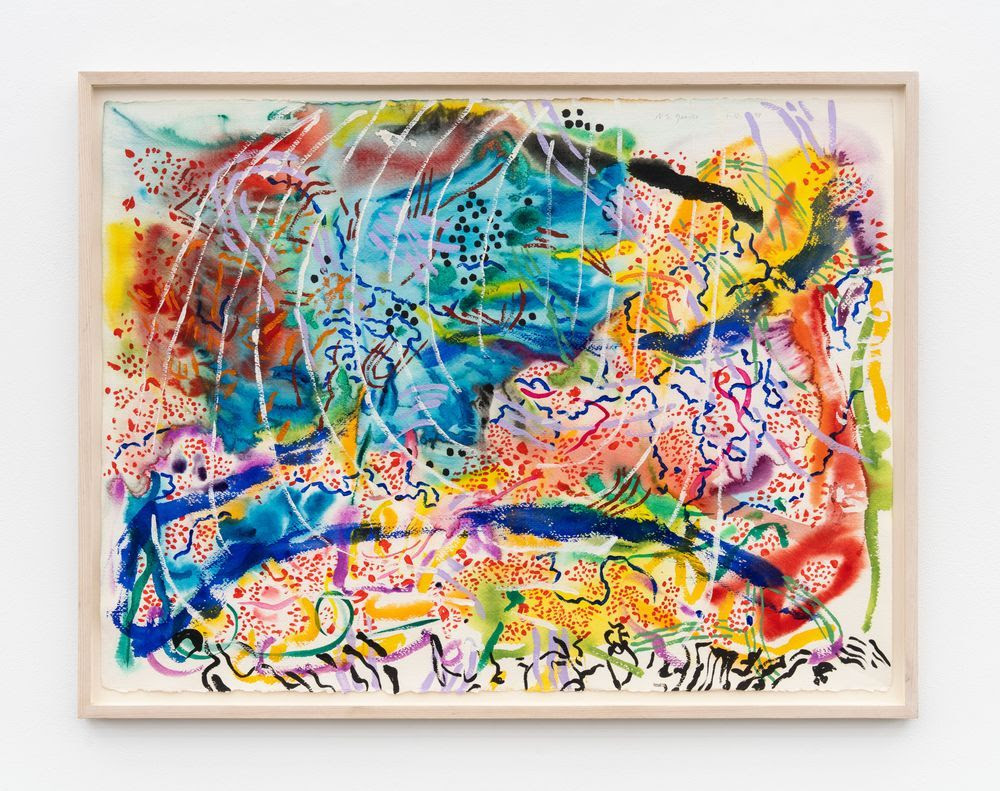
A painting is flirtatious —malleable with its intentions, mysterious in its constituents. Bernard Frize’s new exhibition, Come to Me Again, is comprised of twenty paintings that aim to accomplish this very sentiment; in the Berlin-based painter’s handling, color is a seductive glance, lines are subtle whispers, and paint an open invitation. For over four decades, Frize has been an explorer of abstraction himself, cruising its gridded paths and maneuvering through its serpentine contours. The way Proust entwined time against its linearity, Frize defies a painterly trajectory, adventuring through abstraction’s fruitful gardens with a wondering appetite. Acrylic and resin generate splashes of reds, greens, and blues over canvas, in the energetic ethereality of sun-lit hues that would put spring to envy.
A burning curiosity for Frize’s method is quite inevitable for his audience, a desire to be a “fly on the wall” at his Mitte studio to decode his process of populous vertical lines and solar blotches. Do, however, avoid prioritizing the process in the artist’s rendition of an absorbing lexicon. “Process does not leave space for ideas and instead makes the work mechanical,” he says. A rigidness in the artist’s day-to-day operation is key—he retires each finished painting to dry at his storage prior to committing to a new one—while a controlled receptivity is welcome facing the canvas. “Process would not let me make decisions.”
Echoing between the brush and the canvas is a waltz, dips of paint abandoning the bushy apparatus with swift sways for the fleshy surface. Call them divisions, grids or patterns, Frize’s geometric composition is a commitment to the intention to paint, a devotion to discover the extents of something larger than any motif or shade. “Painting is a challenge, a field of speculation in which I have to invent ways to use paint,” he says. “A mental game,” he mediates on his mathematics, not of numbers or figures but of a structured letting-go of form and color.
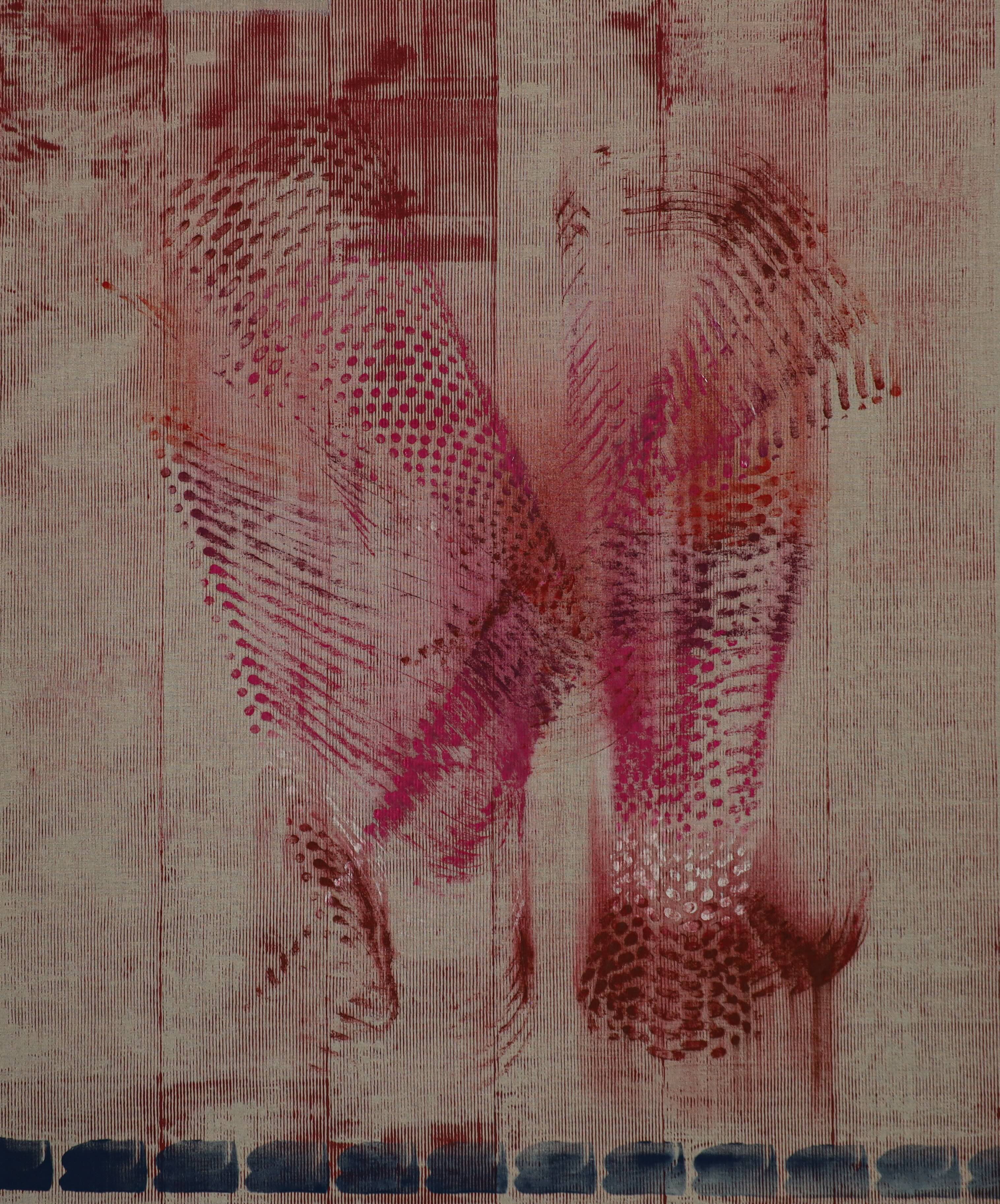
Laying the canvas flat lets Frize proceed with a surgeon’s precision whilst not compromising a poet’s assumption of what may come. The horizontal span yields mercurial renditions, almost topographical formations that are most vivid in a suite of paintings from 2021. Seer, Arkan, Okan, Lape and Fracht host such color bursts, erratic splashes of pastels of blue, purple or green. They swirl like sinuous memory smears of the consciousness or rare bugs spreading their extraordinary wings. Frize considers this sudden shift from a regimented order of continuous vertical lines to liquid sensations as “moments of collapse,” or “combat between chaotic and organized parts.” He revels in the conformity of the paradox which may well be what harmony is in its essence: “There is no difference between building and destroying.”
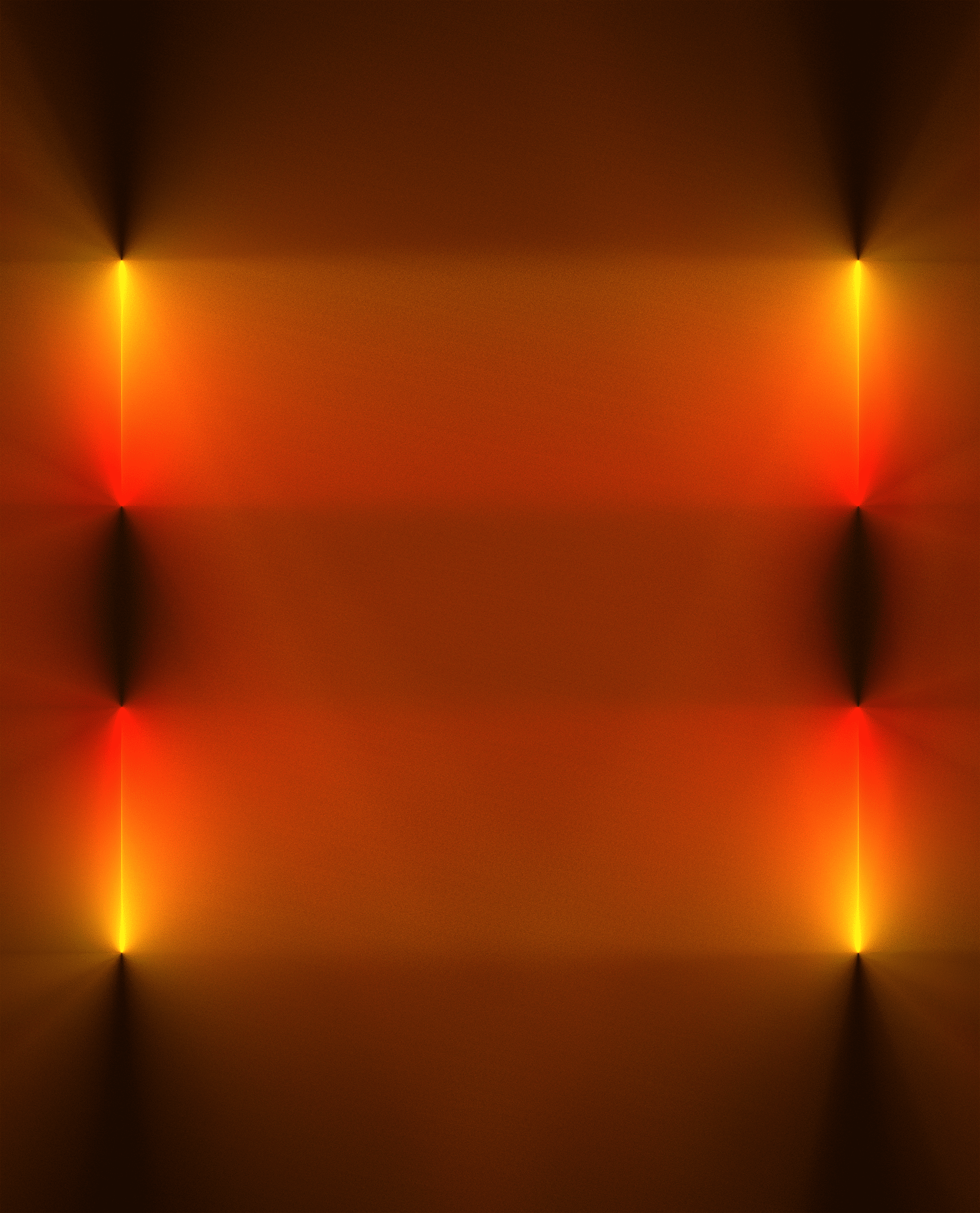
While last year welcomed flat drips and oozes, 2020, for Frize, was the year of license for a geometric fluidity. Iong, Gnoi, Nigo and Ingo from the same year contain woven paths of brushstrokes, orchestrated in determined grids. Their neon brightness renders paint marks nearly three dimensional, washed in energetic finishes, almost as if the paintings were a few hours old. The alchemy of acrylic and resin bears an optic transparency, a sense of physicality that gives the canvases a hominoid quality. Markers of being alive—sweating, breathing and even uttering—become traceable in each attempt of paint, whether a determined line or a swirled marker.
“They are not what one expects from abstraction,” Frize says. The paintings are perhaps shapes of an otherworldly land, as much as of a world right before our eyes where the cues escape us. They confront the human stain of striving to reason every unknown and familiarize each mystery. Time travel is yet a failure on the humankind’s end, but Frize’s 2016 paintings zoom us to a yesteryear of multicolored mayhem. Zer, Erz, and Rez erupt with molten brushstrokes, devoid of the vertical lines in the paintings from the ensuing years. They are bird’s eye views of a mind’s bubbling remembrance, or a sea’s volcanic ebbs. Regardless, they are mimetic—visions of a morphing matter in mind and in flesh—that be of the vistas of the Berliner Fernsehturm which appears to Frize through his narrow studio window or a painterly voyage over what he calls “fields of operation.”
—Osman Can Yerebakan