
Exhibition · Harkawik
Savannah Claudia Levin
God Ain’t Poor No More
Mar 22 – Apr 21
About the show
"Nocturne of a Bloodstone
Down tunnels cacophonous With their own massivity My little heels clank clanking Over deadstill stairways, Windeaten streets, A few bodies of water…
I searched for us
Devout as a madman Blinded in the heart of light A solitary creature of the tides packing and unpacking with The moon
I searched
I went to our burial, This plot was the only earth I’ve ever owned I willed it to our unborn Spirits tend the whole tiny property now
Was it enough? No- You swore it was a wall But i swore i seen a door
You heard no clank clanking, Just the distant whine of a car backfire muffled in the rug of habit
I cant know this So I repeat it
You are a stranger now"
—Savannah Claudia Levin
Harkawik is pleased to present God Ain’t Poor No More, the first New York solo exhibition of Savannah Claudia Levin. In ten new paintings, Levin ponders darkness and light, salvation and damnation, atrophy and viscosity, transgression and complicity. She uses surface texture as a compositional tool, building layers of contextual meaning into her rich, blackened pictures, creating an experience that foregrounds material intelligence and the parity between rote occupational labor and creative process over content and narrative construction. Levin’s paintings are made via a process of relentless reworking; each has lived a life in multiple cities, witnessed acts of tenderness and callous indifference, been pulled from a rubbish heap, washed in the rain, walked on and survived to be worn down again. They speak a truth of their making, a language of her native New Orleans, and let us draw our own conclusions about the voracity of their claims, about drama and melodrama. The women of Levin’s paintings give compulsorily, without limit, and seem to survive their depletion, if only barely so. Babies, beasts, ghouls and sprites are exploited for their iconographic potential, and are constantly navigating their own symbolism, lost in a menacing landscape of violent ends, and seeking moments of quiet redemption wherever they can be found.
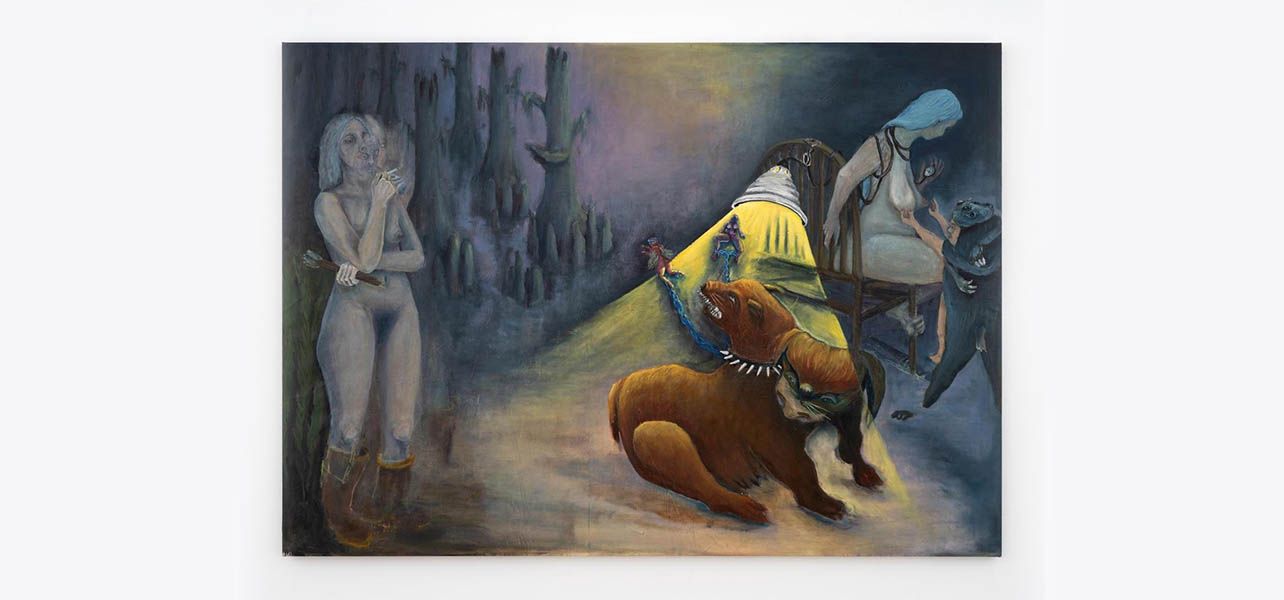
In Mommy’s Little Helper, a gaggle of wretched babies feed on a torrent of pharmaceuticals spewing forth like mother’s milk. Levin combines multiple perspectives and moments in time to produce an image that encapsulates a range of contrary motion, like neighboring still frames from an old videocassette, conjoined in a smeary approximation of movement and gestural action. In Nocturne of a Bloodstone, a cascade of violent yellow light illuminates a two-headed dog, while a child, wearing one as a pelt, grasps wantonly at mother’s nipples. In The Unspeakable Pursuit, another baby, this one rampaging indifferently, encounters a 1950’s era housewife, who offers up what appears to be a skinned bird. Egrets, their necks craned or broken, populate A Heretic, a Whore, a painting sutured together like an old paperback lovingly repaired, and bearing the phrase “All that is mine I carry with me” in blood red thread. Tuesday at Anna’s, Levin’s largest completed work to date, offers an escape from the polar swings of other works, in the form of a kind of purgatory: an inviting local haunt, familiar in its worn surfaces and resigned visages, offering the comfort of the familiar but no way out, no leg up. Heaven and hell lurk in the swirling surfaces of this bar of many vantage points, vignettes and incompatible perspectives, and when we’ve taken it all in, we’re left with the messiness and arbitrariness of the small exchanges of power evident there-and the wonder, too.
Heartbreak, pathos, kitsch and communion linger in the rich, layered canvases of Savannah Claudia Levin. Born in Togalusa, South Carolina, she grew up in New Orleans, immersed in the vernacular aesthetic of the region. While developing her practice, she worked in her free time at a community printshop, and participated in experimental performance groups she describes as “subversive and fringe.” In one of the poems that accompany her paintings, she writes, “Forget the enormous aloneness that meets us at dawn/and clings dripping home to dusk’s red knees.” Levin’s work hits like a guttural scream encased in resin, and the violence in her paintings is all the more powerful because we encounter it as utterly routine, familiar, expected. The subjects of her study are frequently brutalized, demoralized, bound or otherwise disincorporated, and yet their visages, painted with a resigned malaise, show us that these are not exceptional circumstances, but rather the conditions of their daily life. Levin takes up the subject of redemption, a topic so frequently tied to conservative political ideals or religious zealotry, and breathes new life into it. She almost begs us to pity, pathologize, fetishize or otherwise disregard her wretched figures, and when we feel so inclined, she is waiting with a subtle reminder of our complicity in their strife. Levin refuses to paint on “clean” surfaces, instead foraging for found canvas, stitching pieces together and covering them so fully, at times, that they have the feeling of tanned, oiled leather, or perhaps the wall in an apartment so worn that it must be painted over monthly as unhappy tenants cycle through. She culls from visual traditions as disparate as contemporary religious imagery, German Expressionism, graphic novels, Italian Renaissance, and medical diagrams, building up paint via a highly idiosyncratic process that makes the material facticity, the very record of each successive adjustment, itself at issue; each layer added is worthy of consideration. Language, poetry, and oral history are crucial-the back of her paintings are often as compelling as the front, and the poems she hides there tell us everything we need to know about who she is: a shiftless soul, a compassionate friend, a truth-seeker, a unique voice without parallel or compare. As one of her works quietly proclaims, hers are “thickly calloused palms searching for God.”