Ended Oct 26
Nicole Eisenman
Nineteen Nineties
Sep 11 – Oct 26, 2019
More from Nicole Eisenman on Gallop
In 1996 Nicole Eisenman created an immersive installation at Jack Tilton Gallery's Greene Street location. Shipwreck (1996) was made from slabs of wood and plaster that formed a wave across the gallery's floor, enveloping layers of detritus in its wake. It included a painted mural of broken masts, a floor painting of castaways drowning in a whirlpool, and a collection of thrift store paintings and found objects that were littered across the wooden waves, the latter of which included toy ships, hobby art, and gravy boats. It was the artist's first time working with sculpture in a gallery space and as such the bombastic installation marks a significant turning point for Eisenman, who has since immersed herself in a decades-long exploration of sculpture and public art, alongside her tremendous painting, printing, and drawing practice.
At the heart of Shipwreck was a painting, which is presented here for the first time since 1996. Self Portrait with Pirate (1996) depicts Eisenman as a pirate-a figure that was considered fugitive and desperate, living as much in danger from the state and the status quo, as a danger to it. The large oil painting on wood panel was created before Jonny Depp and the Disney corporation popularized the trope, anesthetizing the pirate into a child-friendly swashbuckler, and it speaks to the unpredictability of life at large. It is a claustrophobic painting whose protagonists, cramped and surly, are playing cards in the hull of a ship. Two portholes at the stern of the boat offer a limited view of the ocean waves and the nondescript horizon. That the pirate is holding her cards close to her chest is, in hindsight, a misnomer. With this gesture, the artist is in fact revealing the intense uncertainty of her personal world. It is one of the few honest-to-goodness self-portraits Eisenman has ever made, which is perhaps a surprising fact given the frequency and ease with which she draws from life, often depicting semblances of family, friends, and foes in her large-scale, mise-en-scène paintings and sculptures.
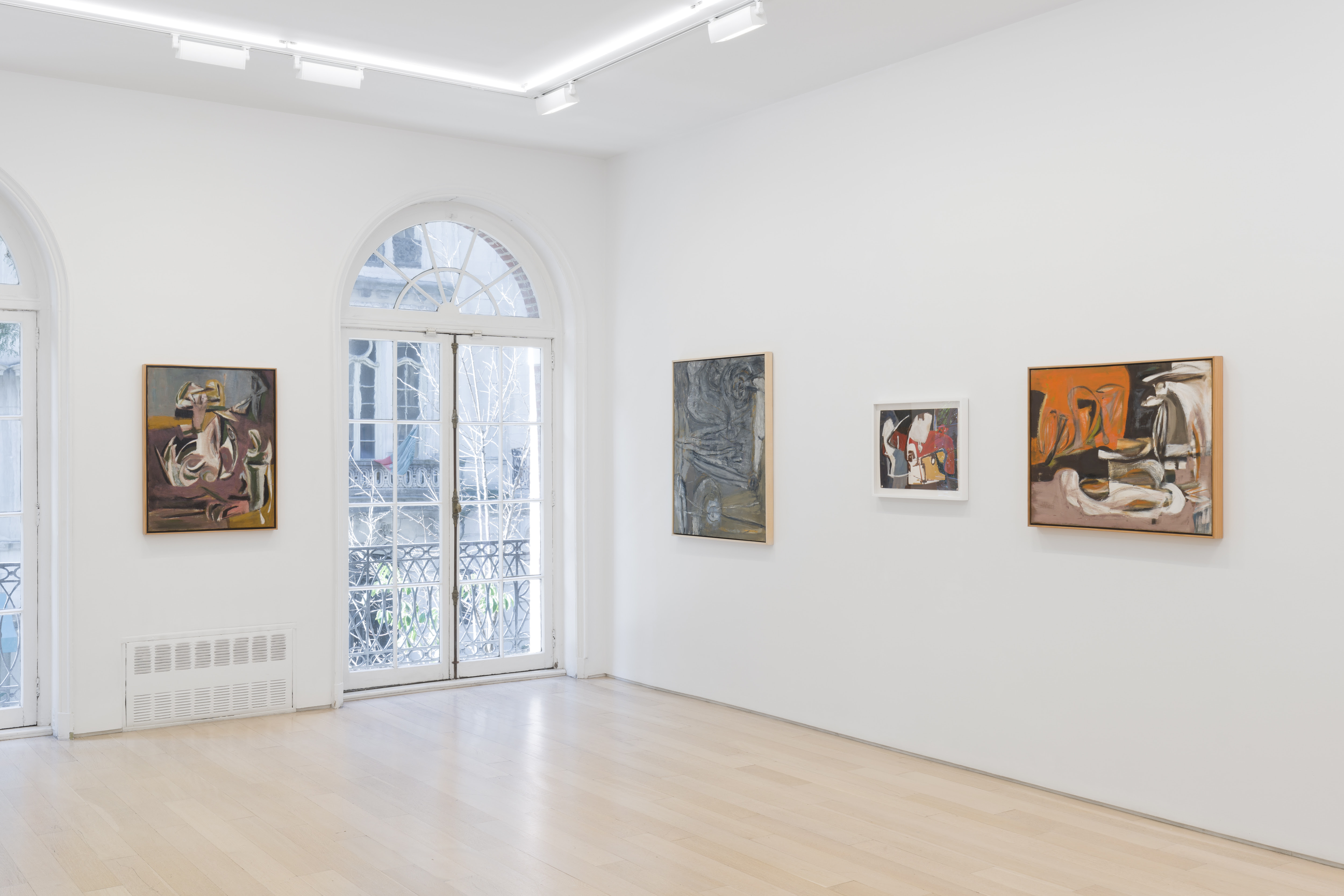
After the exhibition closed and the installation was taken apart, Jack Tilton, founder of the eponymous gallery and the artist's friend, stashed Self Portrait with Pirate away, along with a cache of early artworks by Eisenman. This trove was recently discovered after Tilton passed in 2017 and, along with a handful of additional pieces from the artist's collection, comprises the show Nicole Eisenman: Nineteen Nineties.
"The 1990s were a particular time," says Eisenman, who moved to New York in 1987, "I wanted to paint a world that didn't exist for me." There was gay culture and lesbian culture-lesbian as a word may well seem antiquated now-but they were still underground. Queer culture, as we think of it today, wasn't in the language or visual vernacular. To do this, Eisenman blended the atmosphere of bars like Meow Mix together with archetypal social outlaws and outliers, mixing in historical references, cultural anecdotes, the ache of familial alienation, and the preppy-ness of, say, a J.Crew catalog. The drawings and paintings that emerged highlight Eisenman's uniquely empathic sense of human pathos that continues to permeate her work.
A strong rejection of the imposition of gender on this artist's life also appears throughout these pieces, perhaps most literally in Eisenman's furious drawing of a battlefield and in a detailed comic strip about God deciding whether a baby will be male or female. We can see it in the campy rendition of femininity as monstrosity, as it appears in a John Waters-esque portrait of a woman enveloped in a green hue as though she were rising from a swamp, and in a Christ-like figure who has been depicted with her arms out like an airplane, tempestuously painted over a torn-out page from an art history book, with the logo TWA blazoned across her chest. In some drawings, bodies are piled on top of each other until space has collapsed and the image becomes more of a pattern of orgiastic parts than a picture. Support Systems for Women #4 (1998) mocks the patronizing term, which was popularized in think pieces at the time. And there is Eisenman's Golden Showers (2000), in which toga-clad, occasionally bare-chested women carry ceramic jugs of male piss and pour them into a large, ornate receptacle from which yellow rainclouds spill forth, nourishing a lusciously appointed landscape below.
In as much as these drawings share a sense of humor and violence, sensuously intertwined as Eisenman is apt to do, they also point to the manifold styles, techniques, and themes that have developed across her oeuvre. In these artworks from the 1990s, we see the seeds of Eisenman's practice, which is as much about the nuances, limitations and precariousness of individual perspective, as anything else. "We are like little frogs at the bottom of the well," Eisenman has said. "Looking up and out, seeing just a little piece of the sky."
- Alhena Katsof
Nicole Eisenman was born in 1965 in Verdun, France. She received her BFA from the Rhode Island School of Design, Providence RI in 1987. She currently teaches at Bard College. In 2015, she was a recipient of the MacArthur Foundation "Genius Grant" and in 2013 she was the winner of the Carnegie Prize from the Carnegie International, Pittsburgh, PA. She has received the John Simon Guggenheim (1996), Joan Mitchell Foundation (1995) and Louis Comfort Tiffany (1995) grants, among others.
Eisenman's work is currently on view in the 58th Venice Biennale and the 2019 Whitney Biennial. Her work was also included in the 1995 and 2012 Whitney Biennials. Recent solo exhibitions have taken place at the Kunsthalle Baden-Baden (2018), Vienna Secession (2017), Skulptur Projekte Münster (2017), and the New Museum, New York (2016). A retrospective opened at the Contemporary Art Museum St. Louis in 2014 and travelled to the Institute of Contemporary Art, Philadelphia, PA and Museum of Contemporary Art, San Diego, CA.
Her work is included in numerous public collections both nationally and internationally, including The Museum of Modern Art, New York; Hammer Museum, Los Angeles; and the Ludwig Museum, Cologne, Germany. Eisenman currently lives and works in Brooklyn, New York.