Ended Apr 6
Patricia Treib
Enfold
Mar 7 – Apr 6, 2024
More from Patricia Treib on Gallop
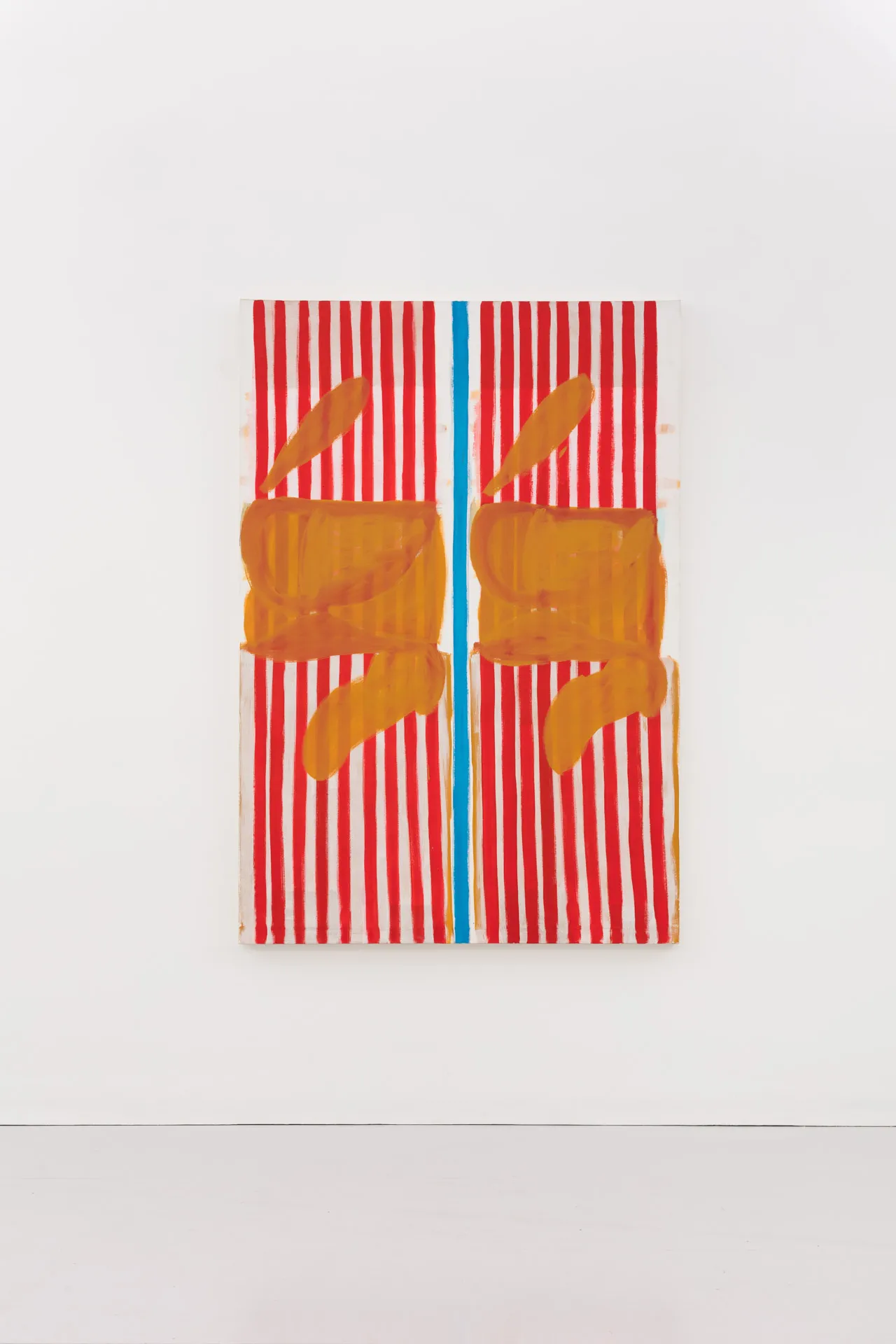
Kate MacGarry is pleased to present Patricia Treib’s third solo show at the gallery. Enfold, the title of Patricia Treib’s exhibition, is two-fold by design. The term’s first definition—“to surround or cover completely”—pertains to the immersive scale of Treib’s canvases that seemingly envelop the space of the gallery with sinuous abstract forms and pulsating colors. The term’s second definition—“to hold in your arms”—elucidates the artist’s desired emotional attachments from binding painterly abstractions to her observations of the physical world. “I need to have a personal connection to the visual source that I’m starting with. It’s not arbitrary; I need to feel an emotional tie to the source and for it to continually radiate and not fully reveal itself. The source acts as a catalyst, an object that provokes,” says Treib whose disparate source materials include a torsion pendulum clock, a 1940s Vogue sewing pattern envelope depicting various sleeves, a still life arrangement of several cameras as well as metal body armor from a Greek icon painting. “In turn, I want the painting to be imbued with this personal connection—for it to manifest through resonant color and a sensuous material presence—for it to be ingrained, but not ‘readable’ or ‘represented’ through known signifiers,” she concludes.
Far from faithfully re-presenting her source materials, Treib’s paintings capture their elusive characteristics; her idiosyncratic shapes derive from perceived details, outlines, or what she refers to as “more or less nonthings” like the serpentine line of a camera’s mount strap in Blue Undulation; the negative space between bodily limbs in Icon Arms; and the silhouette of a sleeve in Manica d’Ombra [“shadow sleeve”]. In developing these recurring motifs, Treib has mobilized an avant-garde technique that the Russian Formalists of the early 20th century called ostranenie (defamiliarization): giving emphasis to an overlooked aspect of the sensible world (overlooked because too routine or trivial), removing it from its context, divesting it of its principal function, and therefore making it appear strange and fresh. At the level of reception, the impact of ostranenie de-automatizes perception because Treib’s abstractions restrict viewers from passively registering her painted signifiers as belonging to the known world of everyday objects.
At the level of production, however, the deployment of ostranenie automatizes perception because the artist, at least in the case of Treib, seeks to embrace—to enfold—painting as the material outcome of sustained looking and rehearsed movement. In Treib's oeuvre, every large-scale painting corresponds to several hand-held sized works on paper, in wich she develops the composition through varied repetition, oftentimes over the course of years, but never in a sequential manner—and, in some cases, even uses the same composition for numerous paintings. Once her body and mind have been primed to the composition. as if committing it to muscle memory, the artist lays the canvas on the floor and uses wide hake brushes to apply thinned-down washes of pigment, frequently erasing gestures and then repeating them until each painterly mark appears organic in relation to the next. To attain this impression of an underlying sense of rhythm, Treib adheres to her self-imposed constraints: she executes each painting in the span of a single day thereby bestowing that specific pictorial arrangement with the contingency of her pointed focus and bodily movements at a particular moment in time and space. “The paintings develop through an accumulation of rehearsals,” she explains. “I want the memory of these previous attempts to be compounded into the final work—and for the initial impression of spontaneity to be at odds with a more measured and deliberate internal structure.”
Just as the artist subjects the physical world to her structural lens, the structures that she discovers in the world shape her abstract paintings. Several titles for works in this exhibition relate to parts of the body and double in meaning with reference to soft coverings or structural containers for the body. La Cintura [“waist” or “belt”], for example, designates the area of the human body below the ribs and above the hips as well as refers to the part of a garment encircling the waist. Likewise, in a more poetic extension of the body to architecture and animals, Volute is the spiral scroll adorning the top part of figurative capitals in Greek architecture as well as the thick spiral shell containing deep-water marine mollusks. And, perhaps most explicitly, Teal Sleeve and Fuchsia Sleeve refer to the fabric covering for a person’s arm. Though these coverings or containers may enfold the body, they also serve as an index of its mass and mobility; or, in other words, as much as they technically conceal the body, their surfaces disclose subtle traces of the body’s animated possibilities.
To return to Enfold. Treib used this term for the title of a painting in 2017, amongst a constellation of other paintings from around the same period titled Hem, Pleat, and Skirt—all words belonging to a tailor’s vocabulary. What has shifted since 2017, from when the word Enfold migrated from an individual work to now an entire exhibition in 2024? In these years, Treib’s manner of abstract painting has displayed a profound grasp of the grammar of ornament in motion: her resuscitation of prior motifs across her oeuvre is never exacting, but rather at the visceral whims of how she handles thinned paint upon each singular surface. Even within this exhibition, the dominant form in Manica d’Ombra—a bulbous, pear-like shape with a feathery quotation-mark, painted in a luscious chocolate brown—recurs in another work: La Cintura; however, in La Cintura, this dominant form evokes different associations due to the artist’s application of vivid purple pigment—now a seemingly narrow neck pitcher spouts water that flows downward to deposit within the whirling contours of a circle and a wedge. On view together in Enfold, these two paintings share familial ground: they are as striking in their sibling compositions—with their featured resemblances—as they are in their unique traits found in gesture and palette. Ultimately, if abstraction is largely understood as an act of distancing—of pulling away from something or someone—, Treib’s abstraction compels the opposite motion: hers is a pictorial language of closeness and intimacy that, in turn, envelops us in her surrounding world.
—Erica Cooke
Patricia Treib was born in 1979 in Saginaw, Michigan, and lives and works in Brooklyn, New York. Treib received a Guggenheim Foundation Fellowship (2020), a New York Artadia Award (2017), and has participated in residencies at Arch, Athens (2021), the American Academy in Rome (2017), the Dora Maar House (2014), and MacDowell (2013). Treib’s first monograph was published in 2020 and features an essay by Joanna Fiduccia and an interview conducted by poet and novelist Ben Lerner. Solo exhibitions have been held at Galerie Nordenhake, Stockholm (2023) and Mexico City (2022); Overduin & Co., Los Angeles (2021); Bureau, New York, USA (2020); Kate MacGarry, London UK (2019); Galería Marta Cervera, Madrid, Spain (2016); Kate MacGarry, London, UK (2015) and Wallspace, New York, USA (2013). Recent group exhibitions include Friends in a Field: Conversations with Raoul De Keyser, Mu.ZEE, Ostend, Belgium (2022); City Prince/sses, Palais de Tokyo, Paris, France (2019) and Quicktime, Rosenwald-Wolf Gallery, The University of Arts, Philadelphia (2017). Treib’s work has been written about in ArtForum, The New Yorker, Art in America, The New York Times and Bomb Magazine. She received an MFA from Columbia University and a BFA from The School of the Art Institute of Chicago.