
Exhibition · Clearing
Larry Stanton
Think of Me When It Thunders
Feb 18 – Apr 5
About the show
As he lay dying, Larry Stanton speculated on ways to stay alive. He was worried about the “dimming” effects of time, so he resolved to plant a Pavlovian seed—how else could he have guaranteed his posthumous survival as a figment of the memories of others? “Think of me when it thunders,” he implored his long-term partner, Arthur Lambert, to whom he left all his work. Writing in the eponymous monograph having outlived Stanton by almost forty years, Lambert confessed his disappointment that “it doesn’t thunder every day.”[1]
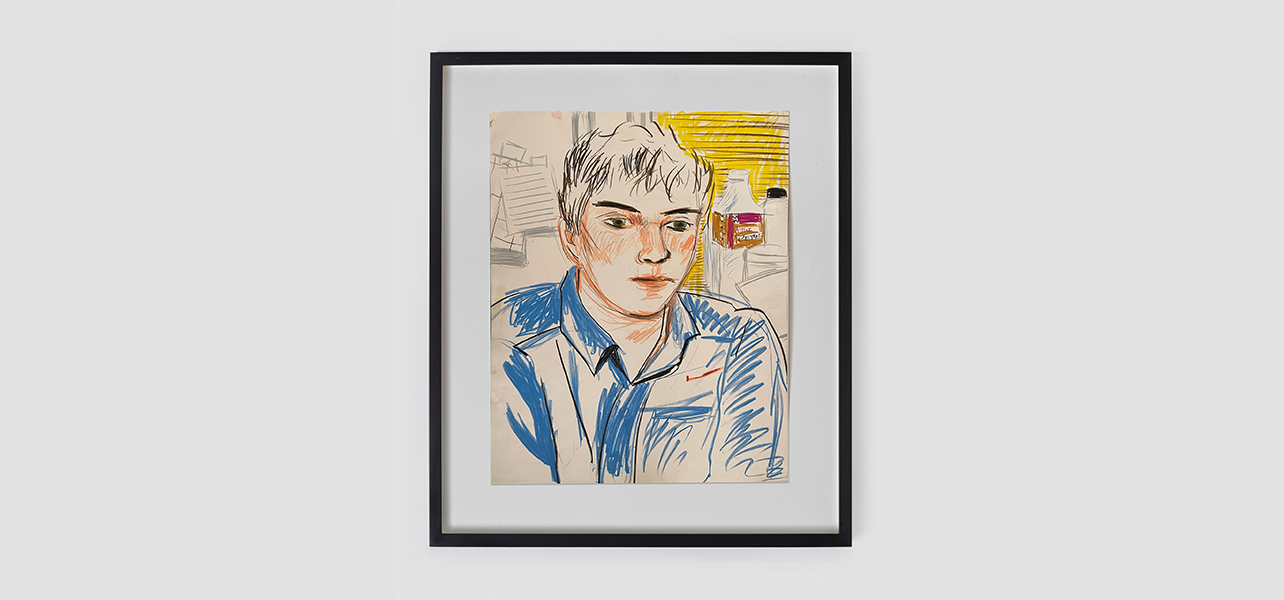
Comprising thirty works, mostly portraits of men on paper and canvas made between 1980 and 1984, “Think of Me When It Thunders” affirms Stanton’s oeuvre as a collective memorial to the victims of the AIDS crisis which decimated the bi-coastal gay scenes in which he had become an “it boy.” Although a handful of the guys who sat for him later contacted Lambert to find out what had happened to their drawings, the majority, like Stanton, died prematurely.
Born on Long Island in 1947 and raised on a farm upstate, Stanton moved to Manhattan aged nineteen. He enrolled at Cooper Union, promptly dropped out, and got a job serving soda on the Upper East Side. Meanwhile, rumours of a new, young, “unusually attractive” blonde sent the gay underworld into a frenzy.[2] One day, on the dock in Fire Island Pines, the burgeoning artist met a man thirteen years his senior—Lambert—and became his lover.
By 1968—feeling the responsibility of his roles as “partner, mentor, and adoptive father”—Lambert whisked his protege away to Los Angeles where he attended two semesters of private art school.[3] By the time Stanton moved back to New York where he had his debut gallery solo in 1970, he had befriended the powerhouse curator Henry Geldzahler, frequently caricatured as a bear or a wolf in a number of fetishistic drawings); and David Hockney, the subject of the slice-of-life Super-8 film David Hockney in Ken Tyler graphics (1978), exhibited alongside its charming, hand-drawn poster. More big names—like the artist and writer Ellsworth Kelly and Christopher Isherwood—followed suit.
“Arthur told me that Larry was liked by everyone—men, women, even cats, his favorite animal,” recalls Fabio Cherstich, the theater and opera director who co-founded the Estate of Larry Stanton with Lambert in 2018.[4] The artist is epitomised as a portraitist whose relationships with his subjects spanned the spectrum of sexual tension—from libidinal, no-strings hook-ups, to more ambiguous, platonic arrangements. As evidenced by two works in pencil, these inconstant desires warranted an inconstant style. In one, a man is depicted lying on an unmade bed, trousers yanked down to reveal his peachy ass. The image is crude, hasty, and casual—just like their sex. Alice (1982) is more obscure. The silhouette of Alice Sulit, his former classmate who remained devoted to him in spite of her unrequited love, emerges through layers of shaded “underpainting” and scribbled outlines. Between her self-conscious slouch, avoidant expression, and shy manner of stuffing her hands into her poofy skirt, Stanton’s portrayal of Sulit exudes the endearing awkwardness of their bond. (Besides Sulit, the only women who appeared in his work were his sisters Lynn and Laureen, and his psychotherapist, Dr. Julia Mayo.)
“It was his dream to repay Arthur’s love, trust and faith by becoming a respected artist,” according to Dr. Mayo, who treated Stanton after the death of his mother at the end of the 1970s triggered a nervous breakdown.[5] High off “renewed zest and purpose,” and despite his full-blown alcoholism, Stanton’s late career was characterised by rapid development for which he was rewarded with a handful of solo shows.[6]
If there was no one available to sit for him, Stanton made work of himself, and more seldomly, landscapes or still lives. The cartoonish effects of the primary color-dominated Self Portrait (1981) and Greenwich Village street scene, Sharidan Square (1982), for example, are at odds with the stifling realism of his untitled, undated Hockney-inspired swimming pool.
He also experimented with abstraction and the imposition of writing, as with the untitled and undated pastel of “doodles” (for lack of a better term) of nails, cigarettes, his eyes, and his beloved cat, interspersed between the names of men, the days he saw them, and presumably, one of their telephone numbers. Importantly, two of his last-ever works (the Hospital Drawings, both 1984), are adorned with words of affirmation: “I’m going to make it.”
Accompanied by a mixtape compiled by the critic and East Village fixture Vince Aletti, “Think of Me When It Thunders” exemplifies the singularity of Stanton’s life and work and its significance as a record of queer history.
This is the first presentation of the Estate of Larry Stanton at Clearing, and the first exhibition of the artist’s work in Los Angeles.
—Olamiju Fajemisin
1 - Larry Stanton: Think of Me When It Thunders, ed. Fabio Cherstich, Arthur Lambert (Barcelona: Apartamento Publishing SL, 2022), p. 244.
2 - Larry Stanton: Think of Me When It Thunders, ed. Fabio Cherstich, Arthur Lambert (Barcelona: Apartamento Publishing SL, 2022), p. 22.
3 - Fabio Cherstich, “Larry Stanton: Think of Me When It Thunders,” Apartamento Magazine (2022).
4 - Quotes attributed to Fabio Cherstich are from a conversation between him and the author on 6 February 2025.
5 - Larry Stanton: Think of Me When It Thunders, ed. Fabio Cherstich, Arthur Lambert (Barcelona: Apartamento Publishing SL), 2022, p.251-52.
6 - Ibid