
Ended
Verena Loewensberg & Nicolaas (Sophie) Warb
Nov 2 – Dec 14, 2024
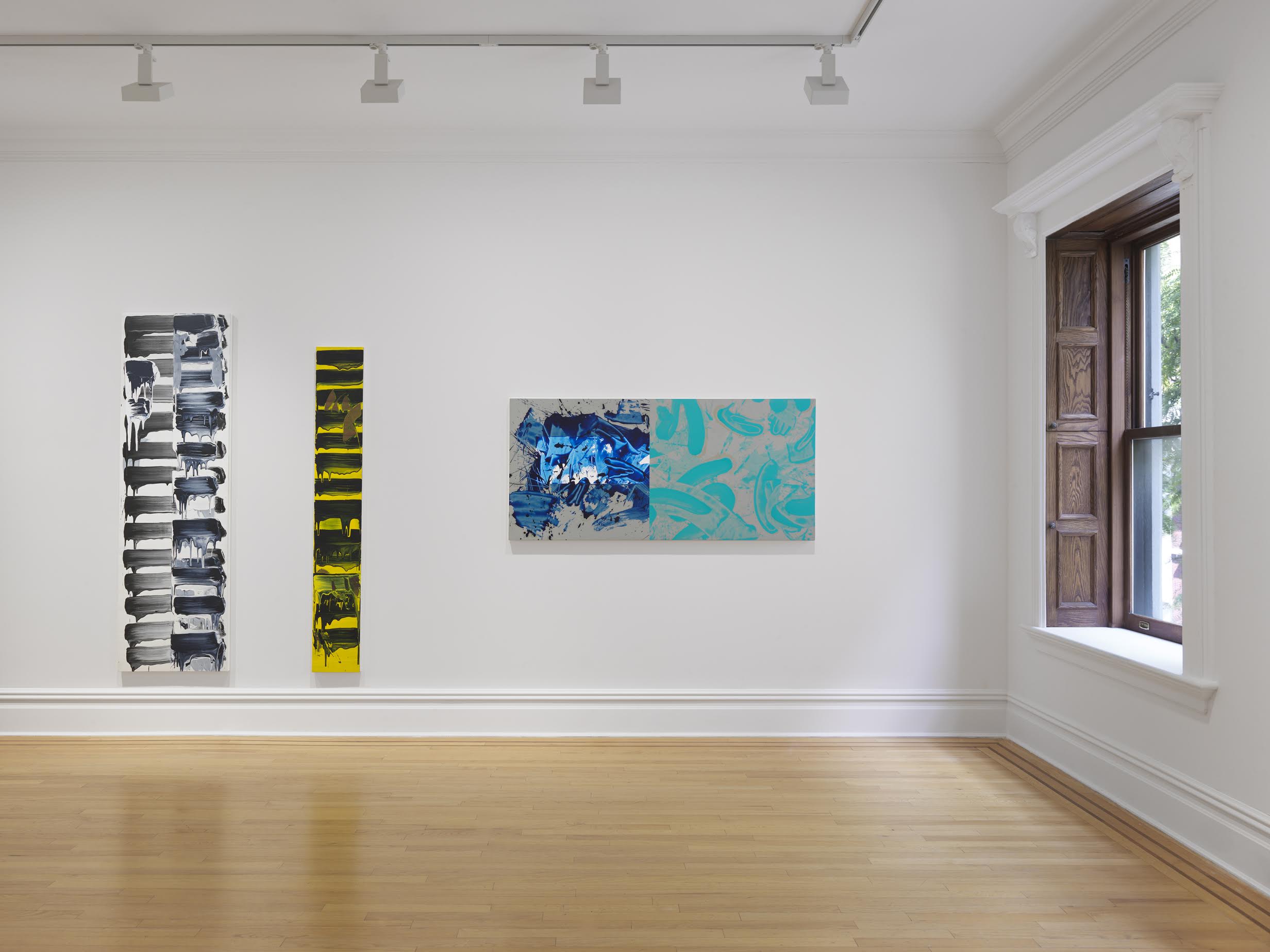
Meredith Rosen Gallery is pleased to present paintings by Verena Loewensberg and Nicolaas (Sophie) Warb from 1940-1970. Loewensberg and Warb’s dynamic compositions of crisp lines and technicolor gestural motion radically introduced feminine form into abstraction, rejecting the masculine straight lines of Piet Mondrian.
In her native Switzerland, Loewensberg was the only woman in the “Zurich Concretes.” She trained in textile, weaving and modern dance before devoting her life to painting. Greatly invested in avant-garde music, Loewensberg opened Zurich’s first jazz record store, City-Discount, in the 1960s. Her work draws from her diverse artistic influences to confront the picture plane through a dynamic interaction between line, color and motion. Often using the centrality of the canvas and compositional system of the grid as a starting point, Loewensberg infused her pictures with an atmospheric quality which transcended the rigid structures of abstract art at the time.
Sophie Warburg took on the pseudonym Nicolaas Warb in 1941 to escape prejudices she faced during the Nazi regime and to be seriously considered by French critics. A decade prior, she wrote a manifesto titled “Perspectives and Thoughts on Abstract Painting” in which she expressed her belief in the power of painting to uplift people morally and spiritually. Warb was intellectually driven by her engagement with Goethe’s theories of color perception, which inspired her to pursue the intrinsic laws of color and forge an intuitive path in abstraction. Warb was a member of the Société Réalités Nouvelles, established by Sonia Delaunay and later came to be associated with the de Stijl movement.
Warb and Loewensberg were deeply impacted by artist-architect-theorist Georges Vantongerloo’s refusal of rigid formal constraints. Loewensberg met Vantongerloo during her studies in the mid 1930s in Paris, where he helped finance her practice. Warb worked alongside Vantongerloo later in the 1930s. All three artists were rejecting Piet Mondrian’s straight lines and sharp angles, which figured prominently in his masculine rectilinear forms. Warb and Loewensberg’s implementation of curved forms and sensual shapes were a clear crossroads into a new form of abstraction.
The paintings of Loewensberg and Warb garner meaning from their direct material expression, rather than symbolic representation, perhaps setting the stage for future conceptual practices such as relational aesthetics. By expanding the formal vocabulary for abstraction, both artists were able express their unique social context as female artists within modernist constraints resolving movement and interaction into each work.
Verena Loewensberg (1912-1986 Zurich, Switzerland) solo exhibitions include Kunsthaus Zurich (1981); House Konstruktiv, Zurich (2007); MAMCO, Geneva (2022);Hauser & Wirth, New York (2024). Notable museum exhibitions include Kunstmuseum Stuttgart (2021) and Kunstmuseum Liechtenstein (2024). Loewensberg will have an exhibition at the Luma Foundation opening Fall 2024.
Nicolaas (Sophie) Warb (1906-1957 Amsterdam, the Netherlands) studied at the Academie Grande Chaumière and was active in Paris, where she became a member of the legendary artist group, Espace. Music was an influence on her work, particularly jazz. Warb’s works have been shown at Salon des Indépendantes (1952), Museum of Modern Art, (1977); Stedelijk Museum (2019) Musée d'art moderne et contemporain de Saint-Étienne (MAMC) (2019); K20 Grabbeplatz, Düsseldorf forthcoming Fall 2024.