Ended May 4
Tom Burr
Mar 10 – May 4, 2023
For his 1974 series, “Men,” James Welling arranged photographs of artists working in their studios into collaged diptychs, each of them parroting the romantic fantasies associated with these private workspaces. Pollock/Serra, for instance, shows both artists in the midst of painting, their physical engagement shoring up the expressive mark’s authorial index; Rothko/Giacometti presents its titular figures on smoke breaks, intimate moments stripped away from the flux of work that capture a stereotyped view of artists’ deep-seated malaise. By doubling these stances, postures and private performances for the camera, which otherwise inspire a sense of heroic individuality, Welling frames the studio as a space scripted like any other, riddled with an assumed set of professional procedures and “prepackaged personae ready for consumption.” [1]
For the past two years, Tom Burr has embarked on a larger scale deconstruction of the studio, this “dwelling place of an awesome god,” and the promises of revelatory access it supposedly offers. [2] His Torrington Project, situated in an abandoned factory in Litchfield County, CT, has all the trappings of the private, isolated atelier. Burr spends much of his time there, preparing works for exhibition, managing the administrative affairs increasingly demanded of professionalized artists, and hosting the array of cultural bureaucrats continually orbiting around him. Indeed, beyond its role as a space of fabrication, the studio is, in the words of Daniel Buren, a “commercial depot” or “purgatory” where artworks await activation by the Midas touch of intellectual and mercantile mediation: dealers, curators, writers, close friends and colleagues. [3] As an indispensable locus of economic reproduction and ideological framing, the studio is but an extension of art’s institution, a transit point from which practitioners are exported to the world as maker and myth. To analyze the particular qualities of this financial-aesthetic intersection, Burr has set up a functional studio that can, at turns, facilitate or distort its normative activity. To the extent that Burr oscillates between standard and subversive uses of this parafictional studio, Torrington might be called a sporadic project, altered selectively. [4]
At Torrington, presentational, social and marginal spaces are overlaid with a conceptual gloss, one that fades in and out of view depending upon the conditions at play. The first time I visited, I was alone, free to roam around the works on display with relatively few distractions. In a certain sense, it was a studio visit like any other, where my desire for access—to artwork, to the artist, for a behind-the- scenes view—was basically accommodated. Rather than confront historical pieces as anesthetically restaged, decontextualized artifacts, however, in Torrington older sculptures by Burr undergo a process of re-inscription. When I was there, for instance, a plywood planter originally composing Construction of An American Garden (1993)—a work that, itself, was a stand-in for Burr’s contribution to Sonsbeek ’93—sat nearby Container 1, 2, 3 (2001), a series of large, hollow, monochrome black sculptures that, in their original presentation at nGbK in Berlin, captured the reflection of paintings by Ull Hohn (the artist’s partner who died of AIDS in 1995). Formerly unrelated, at least in my mind, these sculptures’ proximity surfaced a matrix of newfound affiliation: minimalism, monumentality, the loss of referent or strategies of referral, displacement and homosexuality were only some of the key terms that came to mind most immediately. It was only after visiting that I was told Hohn watered the plants in Burr’s sculpture throughout the duration of its original presentation.
Burr’s exhibition space, therefore, is less about neutrally presenting forthcoming and archival work for interested parties than establishing interpretive routes through his own career, unsettling the art historical gaze that aims to ossify artists by subjecting them to categories, chronologies and conceptual punchlines. The artist also parodies this process. In the first few months of moving into his space in Torrington, Burr fashioned a black stamp bearing the name, address and phone number of his former gallery, “American Fine Arts, Co., Colin de Land Fine Art” in its original font. Emblazoning works once shown at the gallery with this genealogical marker, Burr renders de Land and the other institutional critique artists the dealer was known for supporting as a reified historical “brand,” an informational tattoo that underwrites the institutionalization of his early sculptures and installations. Burr emphasizes here that art history, too, is an active appendage of commercial operations.
My second journey to Torrington, accompanied by a group of curators, collectors and Bortolami staff, was rather different. If Burr’s subtle historiographic interventions were nevertheless present, other aspects of studio visits were also held up for scrutiny. The hours long bus ride from New York City arranged by the gallery, being hosted in and speaking with other visitors in a lounge that was itself a work, and discerning the contours of the intermingling communities gathered there put into relief one’s own motivation for venturing to Torrington. The representational onus normally placed on the artist was subsequently refracted back onto Burr’s various guests, participants in the social choreography and ventriloquizing lure of the artist’s open house.
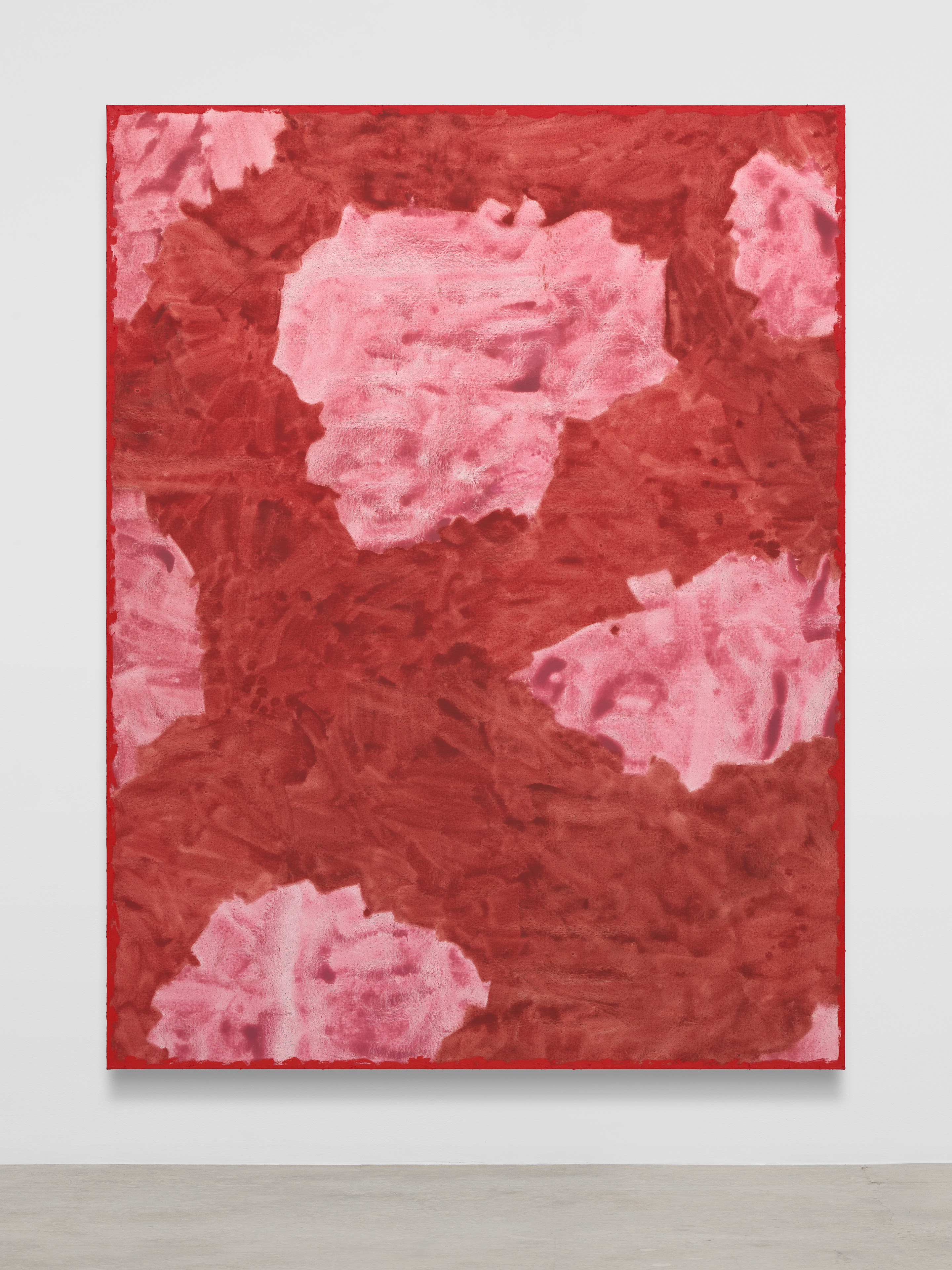
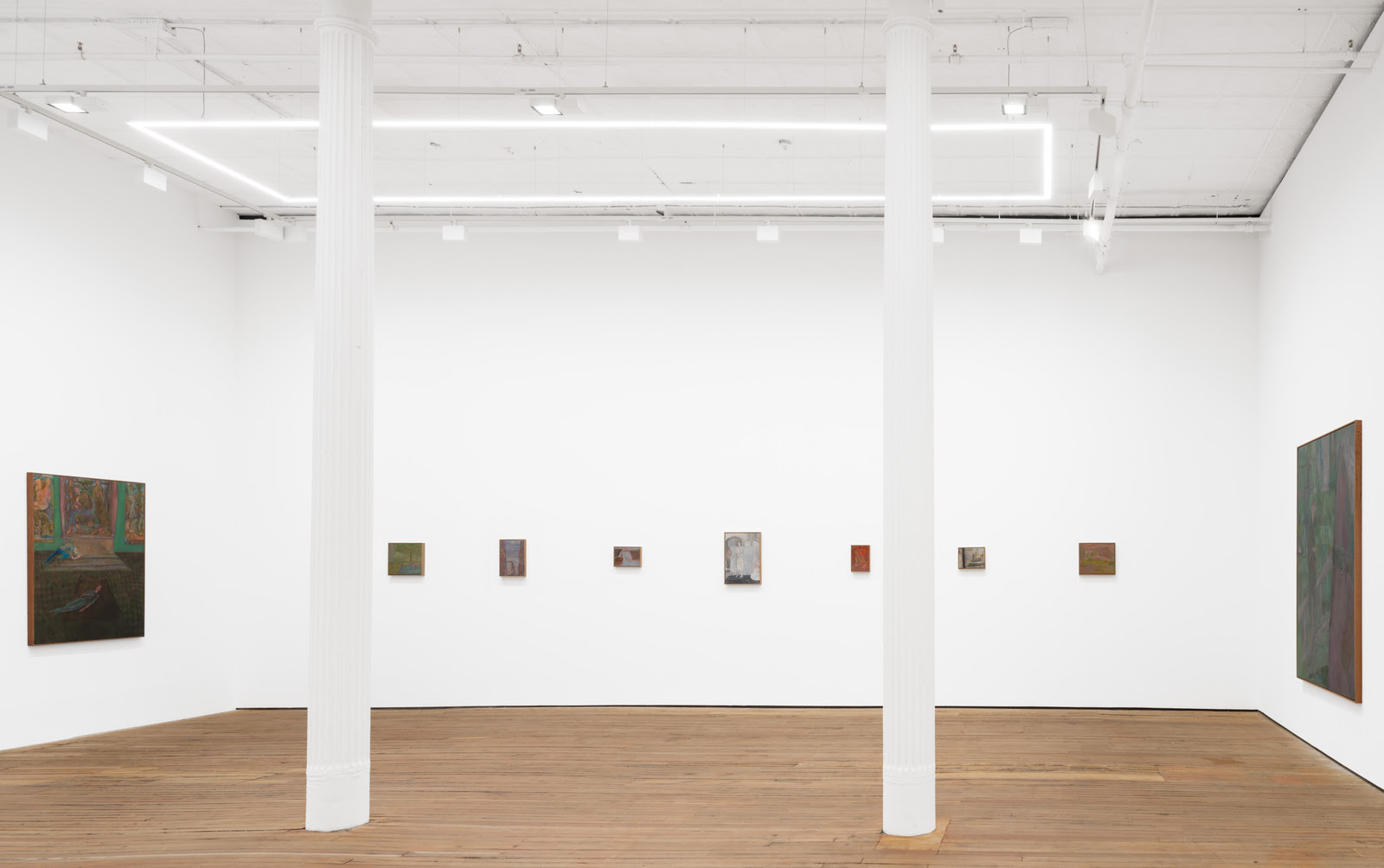
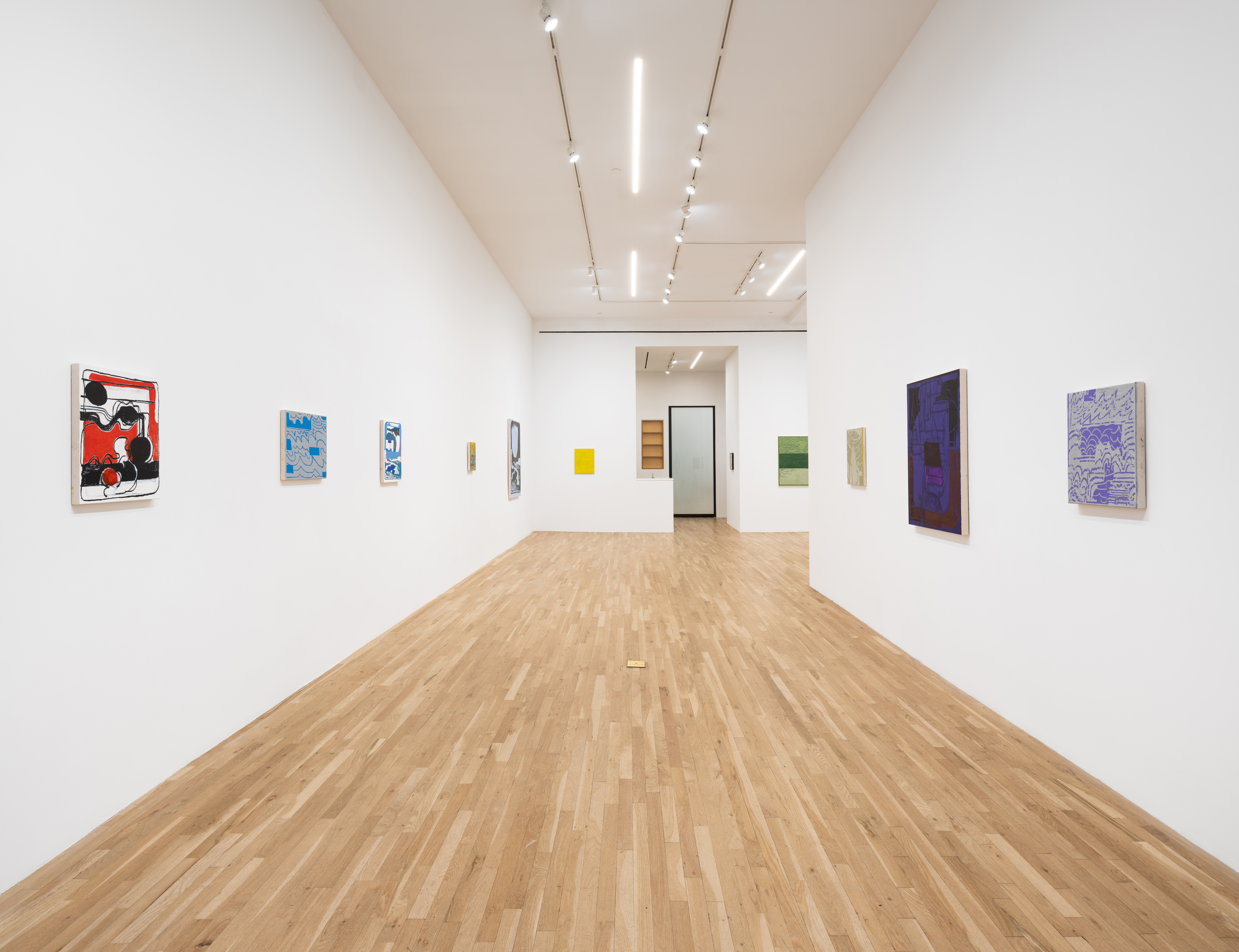
This confused status of the “studio” between workshop and conceptual gesamtkunstwerk seeps into Burr’s current show at Bortolami. Snaking along the gallery’s original walls (as opposed, that is, to the series of walls installed by the artist) is a photographic sequence, “Capricornus.” These photographs show Burr in the midst of what he calls “low density performances”—laying down, leaning, lounging—in the bathrooms at Torrington. Somewhere between Valie Export’s “Body Configurations” and Bruce Nauman’s studio-based dances, exercises and failed levitations, Burr’s photographs frame Torrington as a site of performance, as a zone of potential theatricality where the lines between artmaking and the artist’s most banal activity become increasingly blurred. Other works currently on view at Bortolami extend the Torrington Project’s sidelong glance at appetites for studio access. For instance, in Stefania Bortolami’s office, tucked away from view, Burr has hung a series of collages featuring photographs of the gallerist during a visit to Torrington alongside sections of foliage cut from Construction of An American Garden, each bracketed by LED strip lights. As with Michael Asher’s 1974 intervention at Claire Copley Gallery in Los Angeles, the body of the dealer emphasizes the commercial system that supports Burr’s work and translates it into exchange-value, a framework, he reveals, that often moves beyond the physical boundaries of the gallery. Furthermore, installed throughout the make-shift ambulatory spanning the perimeter of Bortolami is a series of sculptural tableaux. Two of these are directly culled from the furniture composing the “lounge” at Torrington, forming a Smithsonian non-site in which studio and gallery, private visitation and public visibility are figured as interlinking points of contestation. The third configuration includes a chest of drawers and long johns owned by Burr’s father, set against black-stained wainscotting. Keeping in mind the Torrington Project’s dialectical play with seclusion and exposure, this intimate arrangement of objects brimming with diaristic aura seems critically oriented towards the institutional thirst for biography. Indeed, as with Burr’s recent series of sculptures shown at Galerie Neu in Berlin or earlier installations like 42nd Street Structures (1995), the artist showcases an arch inversion of cinéma verité aesthetics, one in which the contemporary market for legible articulations of subjectivity is substituted for the sites and scenes in which it is formed. In these works, identity becomes unspooled into an undetermined, embryonic attitude where it shimmers, unspecified, at the far edge of perceptibility.
As it impacts his current exhibition, then, the artist’s investigation of the studio is more discursive than physically grounded. It operates as a rhetoric, one that encompasses a set of expectations levied on Burr but extending outward to places and people beyond Torrington. Establishing a conceptual thoroughfare between studio and gallery, Burr explores the former as a “functional site,” an “operation occurring between sites, a mapping of institutional and textual filiations and the bodies that move between them (the artist’s above all).” [5] Even while the formal and conceptual significance of Burr’s exhibition exceed beyond this “functional site,” one may argue that the purpose of Torrington Project is to demonstrate how studio practice is nevertheless involved, by hook or by crook, in these sorts of public activities. Burr frames the studio as an ever-present analytic variable, like the museum or market, that demands and exercises his well-trained, reflexive approach to institutionality’s expanded field.
—Blake Oetting, 2023
1 - Douglas Eklund, “Image Art After Conceptualism: Cal Arts, Hallwalls, and Artists Space,” in The Pictures Generation, 1974-1984, ed. Douglas Eklund (New York: The Metropolitan Museum of Art, 2009), 31.
2 - Caroline Jones, Machine in the Studio: Constructing the Postwar American Artist (Chicago: University of Chicago Press, 1996), 32.
3 - Daniel Buren, trans. Thomas Repensek, “The Function of the Studio,” October 10 (Autumn 1979): 53.
4 - See Carrie Lambert-Beatty, “Make-Believe: Parafiction and Plausibility,” October 129 (Summer 2009): 51-84. For Lambert-Beatty, parafictional operations remain outside the “category of fiction as established in literary and dramatic art” by keeping “one foot in the field of the real....intersect[ing] with the world as it is being lived.”
5 - James Meyer, “The Functional Site; or, The Transformation of Site Specificity,” in Space, Site, Intervention: Situating Installation Art, ed. Erika Suderburg (Minneapolis: University of Minnesota Press, 2000), 25.