Ended Nov 30
Here & Elsewhere
Oct 17 – Nov 30, 2025
Golnar Adili
Paria Ahmadi
Setare Arashloo
Ashley Page
Kyung Eun You
All Street Gallery is pleased to present, Here & Elsewhere, a group exhibition spotlighting women printmakers whose practices engage grief, reproduction, and rebirth.
Rooted in the history of printmaking as a tool for dissemination and collective storytelling, Here & Elsewhere reconsiders the medium as a site of personal, cultural, and intergenerational reckoning. Printmaking has long been mobilized for mass communication yet it also carries an equally powerful capacity to hold intimate narratives. The artists in this exhibition leverage repetition, layering, and material translation to render loss, mourning and transformation visible.
Together, their practices imagine grief not only as rupture, but also as a generative process: an opening for remembrance, healing, and the continuation of life across family lines and diasporic histories. Moving through motifs of non-linear temporality, domestic memory, and the symbolic cycles of destruction and renewal, Here & Elsewhere presents printmaking as both a reproductive and transformative act.
By foregrounding women artists, those often positioned as reproducers of both familial and cultural lineage, this exhibition expands printmaking into a language of survival and regeneration. Across varied approaches, from book arts and embroidery to silkscreen, lithography, photography, and installation, each work is marked by meticulous craft and profound emotional charge. Inherent to each of their practices and printmaking as a medium is an aggregation of time spent with each image, a necessarily slow pace, and a traditionally feminine approach to craft through care and attention to detail.
This slowness has been cited as a rebellious act in itself: a mode of resistance that challenges systems’ and structures’ accelerated pace, often to the detriment of those already marginalized. The exhibition centers this creative slowness as a personal and political act, in connection to Jean-Luc Godard’s 1976 film of the same name, Ici et Ailleurs (Here and Elsewhere). The film expresses the challenge of meaning-making when commercial and political images inundate their global audience, particularly through the lens of the Palestinian liberation movement and the responsibility of the artist to create socially conscious work. Alternatively, in Here & Elsewhere, the artists initiate a creative reckoning of radical slowness, focusing on the precious nature of personal archives to offer ruminations on grief, identity, and bridging the present with the past. Both the film and the exhibition grapple with concepts of multiplicity and dissonance through the complexities of merging two distinct places and moments in time: here and elsewhere.
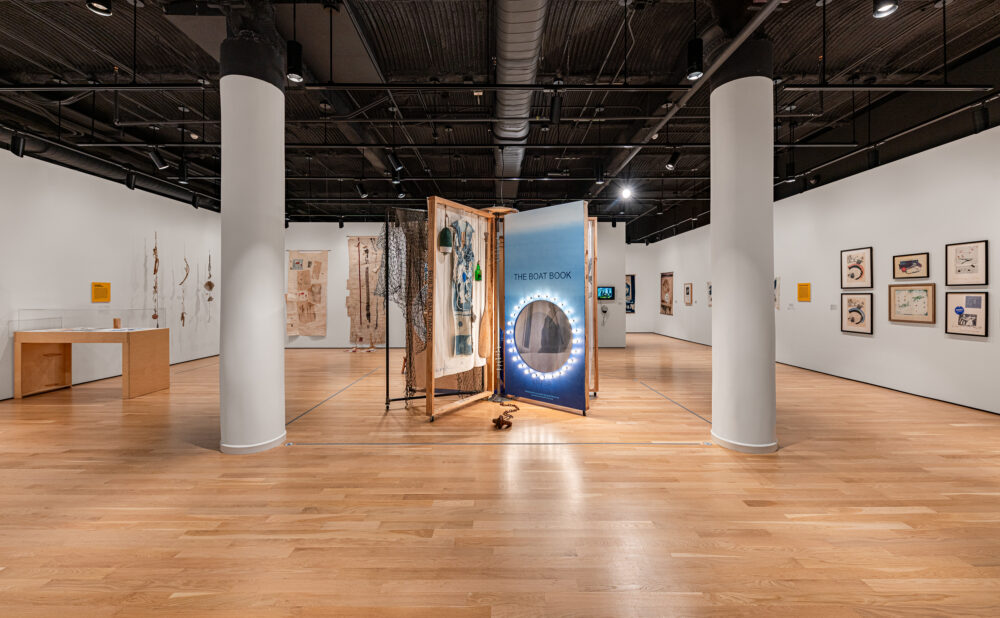
Kyung Eun You’s artist book where are we now represents You’s grief following her mother’s death and subsequent substance abuse problems within her family. It is at once a deeply personal piece as it is an abstracted narrative, in which the grieving process flexes and folds, subverting its own linearity within the same comic strip, repeating the cycle of heartbreak, emotional numbness, and devastation. The geometric arrangements of the included illustrations both induce a sense of internal chaos, while referencing historic systems of organization for quilt patterns, symbolic of home, safety, femininity, and craft, and have often been used as cryptic storytelling devices in unsafe circumstances. You’s work recounts family memories while also destabilizing concepts of linear temporality and interrogating grief as an abstracted, cyclical experience.
Paria Ahmadi’s printmaking practice and her reconceptualization of found imagery calls into question the politics of memory, the archive, and storytelling. Her practice is deeply inspired by communication in everyday life, and Iranian literature and poetry, particularly how Iranian fiction can offer what she describes as “a poetic version of reality, instead of a whole different world of possibilities. In Iranian literature, the real is the greatest fiction.” Just as Iranian literature and poetry often oscillates between reality and fiction, Ahmadi views her use of found images from real events as a series of triggers that conjure personal and collective memories. In her Safety Matches series (consisting of silkscreen prints on phosphorous paper intended to ignite matches), the striking of the match is a metaphor for firing individual and collective revolt, a process that simultaneously dismantles what once was and creates new possibilities. While these images offer nonfictional records, – from Ahmadi’s passport photo to records of time spent with her mother, and protest imagery – they embrace a fictional quality through obfuscation, cropping, and fragmentation that invites the viewer to participate in their meaning-making process. In doing so, Ahmadi and the viewer collaboratively disrupt conventional notions of time, borders, and communication.
Ashley Page is a research- and archive-based artist, focusing primarily on the visual and archival history of the African American diaspora. In her practice, Page envisions the stories of those who have been canonically denied historical documentation, creating space for individuality, and forming an archive that has historically been erased. Page takes a generative approach, situating the painful truth of erasure within the creative context of joy, beauty, and honor, sitting in grief and being healed through her creative acts. This practice of critical fabulation is central in her 2025 Women's Studio Workshop Residency series, Beyond the North Star. The project marries the meticulous crafts of printmaking with papermaking to creatively speculate on historical research relating to the Trans-Atlantic Slave Trade. The time and care that Page puts into her work – crafting her own paper, collecting flowers and plants, dedicating herself to the repetitive practice of printmaking – is a manner of healing, and of extending that healing to her subjects. Page’s practice offers creative imaginings of stories and people that history has erased, serving as a bridge between worlds and a tribute to past lives.
Setare Arashloo’s pieces interrogate the political and familial language of gestures, centering the expressiveness of hands as her subject. Softening of the Mind is a body of work inspired by the hours Arashloo spent watching her grandmother knit and unknit. The pieces explore the connecting threads rooting her to her ancestry, and within a matriarchal lineage. In this series, Arashloo focuses on hands as a powerful creative force and a site for attention and care, particularly in feminine-coded labor. Arashloo’s motif of hands returns in her new piece, Cutting the umbilical cord of the patriarchy, which makes its debut in this exhibition. These hand gestures depart from her grandmother as Arashloo shifts towards a broader vision of political visual language. This work focuses on the symbolic gesture of women cutting their hair in both mourning and rebellion. The piece is a tribute to Mahsa Jina Amini, a woman who died in custody after being arrested by the morality police for violating Iran’s mandatory dress code. Across her works, Arashloo focuses on women’s hands as an expression of meticulous construction and familial devotion, as well as powerful tools for deliberate and tactical dismantling of oppressive systems.
Golnar Adili’s creative practice revolves around her family archive, personal loss, and political grief. Adili presents obscured visions of cropped and fragmented family photos, whose references to political iconography and literary source materials substantiate them as new entry points into her family history. As the child of two political activists, Adili’s personal story is an inherently political one, and the heritage of activism is a central element of her work, spanning the Iran-Iraq War of the 1980s to the current genocide in Palestine. In Dust of Sorrow (Ghobar e Gham), Adili magnifies her mother’s eyes as portals into her experience of political and familial instability. The work is piercing; the gaze is at once distant and inviting. The repeated lasercut text, “Dust of Sorrow,” is engraved across her mother’s face, distorting the image, and giving words to her expression. The title is inspired by the work of 14th century Syrian poet, Hafez, and Adili embeds her family’s archive with Hafez’s poetic style of creative compression, tension, and release.
All of the artists offer new visions of grief, new portals examining the permeability between present and past lives. Printmaking facilitates this generative imagination, its repetitive practice allowing for creative forms of healing and commemoration. Spanning diasporic histories, non-linear narratives, and the transformative processes of death and rebirth, Here & Elsewhere presents printmaking as a creative archive and a tool for personal and political storytelling.
Golnar Adili is an Iranian-American multidisciplinary artist, designer, and educator based in Brooklyn, New York. Her practice explores themes of diasporic identity, memory, language, and displacement, often through the deconstruction and reconstruction of her family’s archival materials such as photographs, letters, and printed matter. Trained in both painting and architecture, Adili creates artist books, installations, and sculptural works that interweave tactile material processes with architectural logic, play, and poetics. She has completed residencies at the Rockefeller Foundation’s Bellagio Center, MacDowell Colony, Women’s Studio Workshop, Smack Mellon, and the Lower Manhattan Cultural Council, among many others. Her work has been widely exhibited at institutions including the Victoria and Albert Museum in London, the CUE Art Foundation in New York, the Craft and Folk Art Museum in Los Angeles, and the International Print Center New York. Adili has received awards from the New York Foundation for the Arts and the Pollock-Krasner Foundation, and her artist books are held in collections such as the Library of Congress, Yale University, Booklyn, and the University of Michigan. In addition to her studio practice, she teaches at Parsons School of Design, where she emphasizes visual literacy, perception, and an iterative, material-driven approach.
Paria Ahmadi is an Iranian artist based in New York whose multidisciplinary practice explores the intersections of memory, archive, and the poetic relationships between language, image, and object. Growing up in Iran and residing in the United States, Ahmadi’s work reflects on the complexities of cultural inheritance and displacement, often using humor and subtle irony to disarm and reframe political and personal narratives. She works across printmaking, sculpture, installation, video, creating spaces in which fragility and play coexist with deep questions of history and belonging. Her installations and printed works frequently draw upon overlooked or repressed archival material, layering fragments of text and image to expose the ways memory is shaped, distorted, and reimagined over time. Ahmadi’s attention to materiality — whether through hand-pulled prints, delicate sculptural arrangements, or ephemeral performative gestures — underscores her interest in the instability of meaning and the shifting terrain of collective and personal memory.
Setare Arashloo is a visual artist residing in Brooklyn, New York. She holds an MFA in Studio Art from Queens College and an Advanced Certificate in Critical Social Practice from Social Practice Queens (SPQ). Her work has received support from the SIP Fellowship at EFA Robert Blackburn Printshop, the Urgent Action Fund for Women’s Human Rights, the Montes Press Writing Grant, the AIM Fellowship at the Bronx Museum of the Arts, and the Archie Green Fellowship from the American Folk Art Center. Arashloo's international exhibitions include the Elizabeth Foundation (New York, 2026), Railspur (Seattle, 2023), Ecole Nationale Supérieure d’Art in Bourges (2019), and the Bronx Museum (2017). Her most recent solo exhibition, Softening of Mind, took place at Transmitter Gallery in Brooklyn. She has also contributed as a museum and art educator at MoMA, Queens College, SUNY Empire State College, and Saint Ann’s School.
Ashley Page is an interdisciplinary artist and curator based in Portland, Maine. She earned a BFA in Sculpture with a minor in Public Engagement from Maine College of Art & Design. Her studio and curatorial projects center storytelling, representation, and intergenerational exchange. Page received the Amelia Peabody Award for Sculpture from the St. Botolph Club Foundation in 2022, studio project grants from the Maine Arts Commission and MyMa, and has been a resident at Ellis‐Beauregard Foundation, HewnOaks Artist Colony, and Able Baker Contemporary. She has curated exhibitions at the Center for Maine Contemporary Art, Portland Public Library, and ICA at MECA, among others. Her work has been exhibited and collected by institutions including the Portland Museum of Art, Hunterdon Art Museum, Tate House Museum, University of Southern Maine Art Gallery, University of New Hampshire, Cape Cod Community College, Center for Afrofuturist Studies, and Abyssinian Meeting House. As an educator, she has led workshops in textiles, papermaking, and printmaking across Maine at venues such as Peters Valley School of Craft, University of Maine Orono, Waterfall Arts, Bowdoin College, Coastal Maine Botanical Gardens, Farnsworth Museum, and MECA. Page is currently the Studio and Programs Manager at Indigo Arts Alliance, working at the intersection of art and social justice.
Kyung Eun You is a Korean visual artist based in New York. Her work spans printmaking, artist’s books, comics, paintings, and animation, often rooted in memory, relationships, psychological terrain, and internal narratives. Among her residencies and awards are the Artist’s Book Residency Grant (Women’s Studio Workshop, 2019), NYSCA/NYFA Artist Fellowship in Printmaking/Drawing/Book Arts (2020), New Prints Artist Development Coursework Award (International Print Center New York, 2019), Immigrant Artist Mentoring Program (NYFA, 2017), Studio Practice Scholarship (National Academy, 2015), and Book Artist in Residence at Center for Book Arts (2023). Her work has been shown and published across the US, UK, Hong Kong, and Korea. Her book, where are we now, created in her 2019 WSW residency, uses black-and-white graphic repetition, linocut, and deeply personal narratives to explore her immigrant experience, family loss, and memory’s fragility.