

Exhibition · All Street Gallery
Jade Doskow
The Dark Bright Sky: A September 11th Memorial Exhibition
Sep 10 – Sep 30
About the show
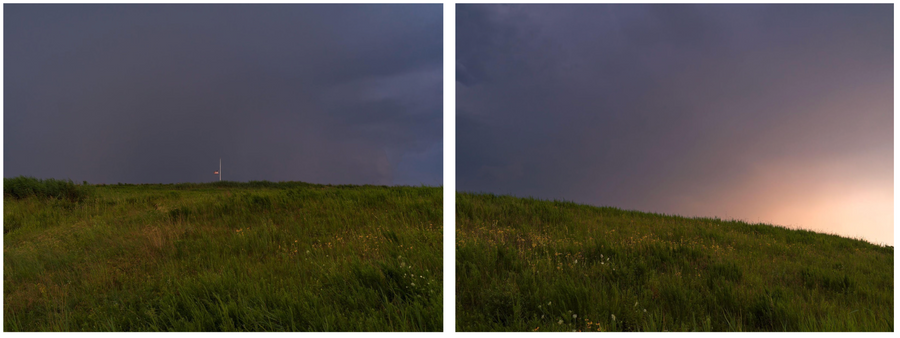
All Street Gallery is pleased to present, The Dark Bright Sky: A September 11th Memorial Exhibition, a solo exhibition of large format photography by Jade Doskow. To commemorate the 25th anniversary of 9/11, The Dark Bright Sky marks the first ever exhibition that spotlights Freshkills Park's West Mound, the interment site of the materials from the World Trade Center tragedy in 2001. This exhibition equally showcases Freshkills Park as a monumental chapter in New York City's urban planning history and in environmental sustainability advancements. The West Mound is the park's largest parcel, as well as the home and resting place of the physical remains and rubble from the 9/11 attacks, materials that were sorted with great care and dedication by assorted government agencies, while the Department of Sanitation orchestrated moving the immense tonnage of materials from Ground Zero to Section 1/9 of the West Mound. Doskow, as Freshkills' Photographer-in-Residence, is the only artist who has had complete access to the location, her images constituting an unparalleled record formed over the past nine years. The Dark Bright Sky showcases Doskow's unprecedented documentation, visualizing West Mound's ethereal, transformative, and ultimately resurrected nature, and offering a unique commemoration of the 9/11 attacks.
This exhibition poetically reflects Freshkills as at once meticulously engineered and wildly flourishing, and demonstrates its role in burying, storing, and regrowing the physical traces of the event that has forever marked the city's history. Both the park and Doskow's photographs are a testament to the resilience and transformative potential of both nature and New York City; in both instances, change is the only constant. At its peak during the 1980s, Fresh Kills landfill received 29,000 tons of garbage daily; in the 1990s, the landfill was ordered to close due to persistent local demand. It was only reopened during a state of emergency in 2001 to receive the materials from the World Trade Center. Freshkills Park is thus a historically-charged, decades-long restoration project and a testament to New Yorkers' compassion and commitment. The park is tentatively scheduled to open in 2036, although, as of 2025/26, less than 1 percent of the park is available to the public.
Doskow first came to Freshkills after completing her long-term series Lost Utopias, which examined the ruins of World's Fair sites worldwide, including Flushing Meadows Corona Park, itself built on a former dump under Robert Moses, the same figure who orchestrated Fresh Kills Landfill. The World's Fair sites operated as monuments to industrialization, expansion, and capitalist enterprise, built without a plan for future use following their temporary display. The parallel between these two projects – one a spectacularly nationalistic, and ultimately ephemeral icon, the other a long-term effort to restore a landscape from its most degraded state – classifies Freshkills as the inverse of Doskow's "lost utopia." Doskow plays a pivotal role in Freshkills' environmental project that is sprawling and multigenerational in scope; her photographs are reflective of a multi-faceted restoration process that will long outlive us.
At first glance, Doskow's work may seem to fit neatly into the canon of American landscape photography, with scenes of rolling hills and wild grasses that echo a tradition dedicated to presenting "untouched" nature. In reality, the park's abundant fields are manmade bucolic plains that have been constructed out of carefully contained dump heaps. This landscape has been crafted by DSNY with meticulous care and impressive technological ingenuity, facilitating the anaerobic decomposition of the massive heaps of trash in concert with an assortment of necessary materials, including protective seals, ventilation pipes, planting soil, sand barrier protection, and vegetation.
In contrast to the conquest-driven ethos of 19th- and 20th-century male landscape photographers, Doskow embraces the durational, open-ended quality of Freshkills. The traditional canon of American landscape photography propagated an ideal of Western expansion, which has resulted in a society of waste that is echoed in the trash mounds of Freshkills and the World Trade Center as the apex of capitalist overproduction. Doskow's practice reflects on and rehabilitates this history. Her long-term engagement mirrors the slow pace of ecological change: a practice of care, patience, and endurance often coded as feminine. Instead of idealizing her subjects as land to be exploited, she offers an image of natural restoration, an engineered invention of rewilded land; Doskow and her camera are pioneers of a complete reimagining of the natural landscape. Freshkills represents total environmental innovation.
This impressive feat of ecological engineering has transformed Staten Island's original marshland into grasslands, wetlands, and woodlands, inviting entirely new species of plants and animals to congregate and flourish. Doskow's photographs capture this process of transformation and Freshkills' breathtaking manmade landscape, while also paying tribute to the material traces of history that have been gathered here. Freshkills Park is a regenerated landscape, a resurrected land. The fact that the West Mound holds the physical memories of 9/11 enhances the park's significance, and offers a new perspective of this chapter in our city's history: one of regrowth and collective care.