Ended Jan 28
Zhi Wei
A Small Lie
Nov 23, 2023 – Jan 28, 2024
[Scroll down for French version / Veuillez trouver ci-dessous la version française]
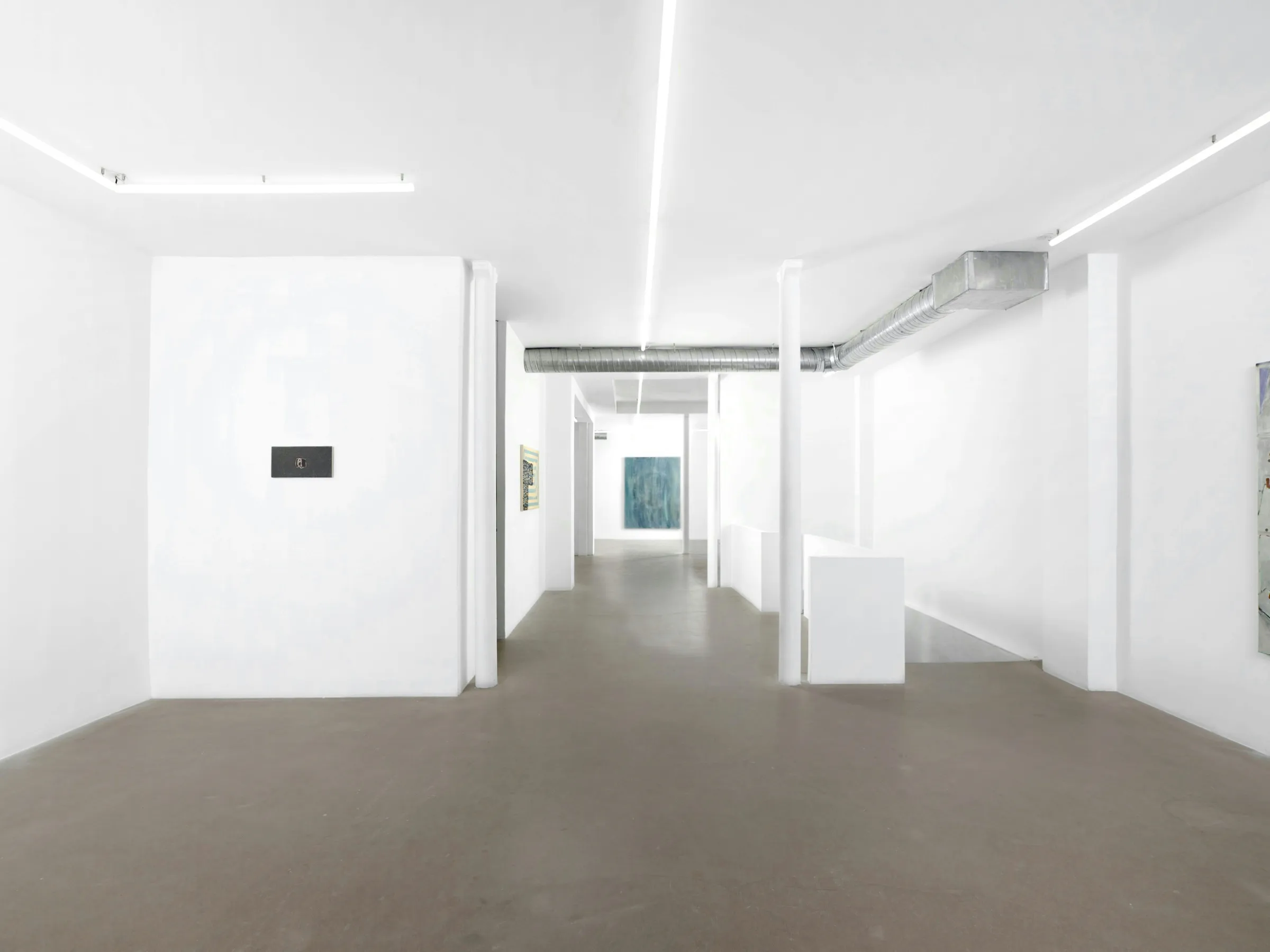
For their first solo exhibition at Balice Hertling, entitled A Small Lie, Zhi Wei introduces a series of textile paintings and imposing sculptural installations. Despite the scale on which the artist’s practice often unfolds, their pieces conjure up feelings of vulnerability and childlike innocence. The softness of the chromatic palette, the selection of fabrics to swathe their paintings in and the materials their sculptures are made of all borrow from the aesthetic codes of toys and child-care.
Influenced by an upbringing in close contact with the textile industry, Zhi Wei mobilises in their works a range of fabrics that complete and accompany their painting practice. Each painting features numerous layers of fabric that either conceal the characters or act as a background, like the strata of tinted tulle that generate striking distortions within the pictorial surfaces of their pieces. Although sensitive to the evocative power of figuration, the artist constantly puts it at a distance through the playful veiling or wrapping of the paintings, relegating it to a space with fluctuating levels of opacity. This is the case of the painting A Small Lie, a variation of a previous work where an innocent (?) Pinocchio is pictured with a phallic, protruding nose and swaddled to the point of obscuring his entire face. Now barely perceptible, he haunts the composition only to appear to the eye of curious and attentive visitors, referencing with its title both the Italian novel’s storyline and the nostalgia for a bygone childhood where the guilt of lying is also enmeshed in the shame of queer desires.
Zhi Wei transports everyday objects within our perspective field while offering them somewhat of an anthropomorphic pictorial framework, since the artist’s paintings are imperatively materialised on a two-meter scale. Furthermore, these items are fictionalised and, in Zhi Wei’s own words, are “offered a narrative arc” as they extend the boundaries of the subject/object relationship on painting. A toothbrush and a comb, both designed for a prison context and acquired on the internet, are paired up to produce the moving Big Spoon Small Spoon painting. These tiny rubber utensils, designed to prevent users from hurting each other and thus rendered practically unusable, are staged in a tender scene that contradicts their original destination: institutions where physical contact and intimacy are forbidden. Objects that become devoid of function populate their work, like that crystal-encrusted cover designed to wrap up a tissue box and infuse it with a dash of elegance – while its task remains to absorb human secretions. Blown up to virtually abstract dimensions, it dwells in the gallery’s lower ground floor, a giant and cute character defying its own obsolescence.
In The Queer Child, or Growing Sideways in the Twentieth Century, Kathryn Bond Stockton describes childhood as an essentially queer experience, marked by the strangeness of the heteronormative breeding we all have to comply with. Zhi Wei’s whole practice – their interest in costumes, in the veiling/unveiling of the self – is imbued with a pervasive sense of nostalgia for the awareness of a state of difference one cannot yet name.
—Thomas Conchou
Zhi Wei was born in 1997 in Beijing, China and currently lives and works between Shanghai and Paris.
They graduated in 2019 from the Ruskin School of Art at the University of Oxford. Their work has been exhibited recently at G Museum, Nanjing, China; TAG Art Museum, Qingdao, China; Magician Space, Beijing, China; the Hive Center for Contemporary Art, Beijing, China.
*****
Pour sa première exposition à la galerie Balice Hertling, intitulée A Small Lie, Zhi Wei présente un ensemble de tableaux textiles et d’imposantes installations sculpturales. Malgré l’échelle à laquelle l’artiste aime déployer son travail, ses œuvres convoquent des sensations de vulnérabilité et d’innocence enfantine. La douceur de la palette chromatique, le choix des tissus qui enrobent ses tableaux et les matières qui composent ses sculptures sont autant d’emprunts volontaires aux codes esthétiques du jouet et de la puériculture.
Élevé.e au contact de l’industrie textile, Zhi Wei mobilise dans ses œuvres une gamme d’étoffes qui complètent et accompagnent son travail de peinture. Chaque tableau présente de nombreuses couches de tissus qui viennent en voiler les personnages ou leur servir d'arrière-plan, comme les strates de tulle coloré qui surimposent des distorsions visuelles saisissantes aux couches picturales des œuvres. Si la puissance d’évocation de la figuration importe à l’artiste, elle est constamment mise à distance par un jeu de voilage ou d'empaquetage des tableaux qui la relègue dans un espace d’opacité plus ou moins prononcé. C’est le cas du tableau A Small Lie, variation d’une œuvre antérieure de l’artiste où un Pinocchio innocent (?) est affublé d’un nez protubérant et phallique, ici emmailloté jusqu’à l’effacement de sa figure. Désormais à peine perceptible, il hante la composition pour apparaître à l’œil du visiteur curieux et attentif, référençant par son titre l’histoire du roman italien autant que la nostalgie d’une enfance révolue où la culpabilité du mensonge est aussi la honte de désirs queers.
Zhi Wei déplace des objets du quotidien dans notre champ perceptif en leur offrant un espace pictural que l’on pourrait décrire d’anthropomorphique, puisque les tableaux de l’artiste respectent toujours l’impératif d’atteindre deux mètres de haut. Plus encore, iel les fictionnalise et, selon ses propres mots, “leur offre un arc narratif” en repoussant dans ses tableaux la limite du rapport sujet/objet. De ce couple formé par une brosse à dents et un peigne designés pour un contexte carcéral, que l’artiste a acquis en ligne, iel réalise l’émouvant tableau Big Spoon Small Spoon. Ces minuscules ustensiles en caoutchouc, conçus pour ne pas pouvoir se blesser avec et ainsi rendus presque inutilisables, sont représentés dans une scène de tendresse qui vient contredire leur destination originelle : des institutions où le contact physique et l’intimité sont interdits. Les objets en perte de fonction peuplent son travail, comme cette couverture perlée, censée recouvrir une boîte à mouchoir et rendre plus élégant un objet dont la tâche est d’éponger les sécrétions humaines. Agrandie dans des proportions qui flirtent avec l’abstraction, elle s’installe au sous-sol de la galerie, personnage géant et mignon qui défie sa propre obsolescence.
Dans The Queer Child, or Growing Sideways in the Twentieth Century, Kathryn Bond Stockton parle de l’enfance comme une expérience queer par essence, marquée par l’étrangeté de l’élevage hétéronormatif auquel nous sommes soumis·es. Le travail de Zhi Wei – son intérêt pour les costumes, le voilement/dévoilement de soi – est tout entier traversé par la nostalgie de se savoir dans un état de différence que l’on ne peut pas encore nommer.
—Thomas Conchou
Zhi Wei est née en 1997 à Pékin, en Chine et vit et travaille entre Shanghai et Paris.
Zhi Wei a obtenu son diplôme en 2019 à la Ruskin School of Art de l'Université d'Oxford. Son travail a été exposé récemment au G Museum, Nanjing, Chine ; au TAG Art Museum, Qingdao, Chine ; à Magician Space, Pékin, Chine et au Hive Center for Contemporary Art, Pékin, Chine.