
Ended
Yunchul Kim
Gyre
Apr 14 – Nov 27, 2022
Gyre at the Korean Pavilion at the 59th International Art Exhibition–La Biennale di Venezia will present a series of interconnected and large-scale installations, as well as site-specific drawings by artist Yunchul Kim, that will invite visitors into an alternative universe wherein objects, beings and nature co-exist. Five installations, including three new works, on display will each work together like a breathing body, powered by invisible matter to de-anthropomorphise perceptions of reality. Scattered around the exhibition will be site-specific drawings by the artist that illustrates dream-like amorphous fluid.
According to Kim, “in the infinite cycles of creation and extinction, the world and its matter constantly gyrates and descends. Gyre explores the world as a labyrinth where “mattereality” matters rather than materiality, embracing non-human objects and material reality.” This is the central theme of the Korean Pavilion’s exhibition, which permeates everything from energy to matter, life, and the universe.
The exhibition will reflect Kim’s transdisciplinary practice that spans art, literature, mythology, philosophy, and science. Gyre will be a swirling cosmic event in the Giardini that invites visitors on a journey into the world of materials, centred around three themes: The Swollen Suns, The Path of Gods, and The Great Outdoors.
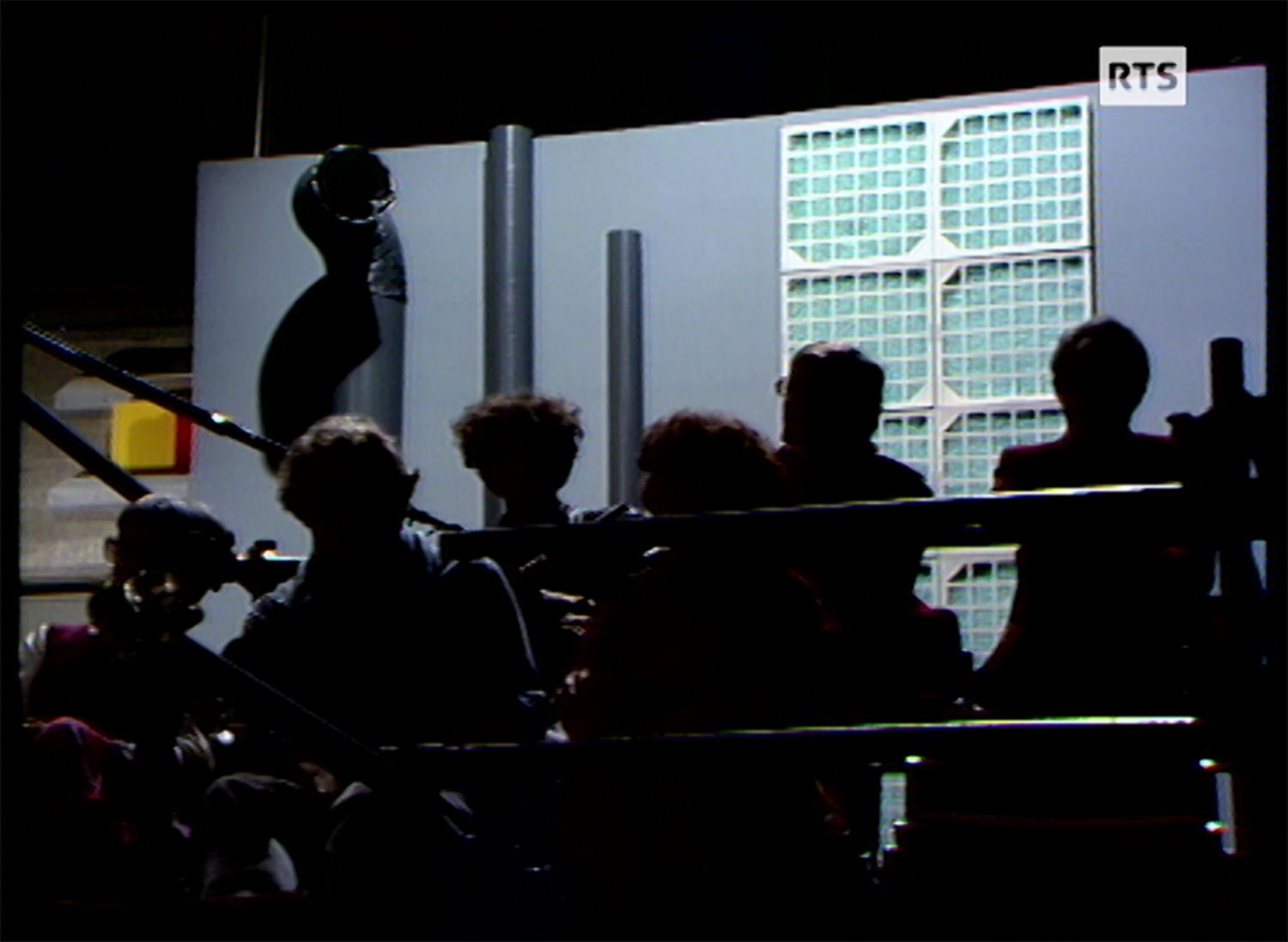
The Swollen Suns references the swelling and scattering of the sun at the end of its life, as a lens through which to view present reality. It is also the name of a monumental installation Argos – the Swollen Suns (2022), consisting of hundreds of glass tubes that flash with light as it detects the imperceptible muon particles, making this invisible matter visible. Once detected, it scatters signals to all the kinetic artworks installations within the pavilion, which signifies the decentralisation of the absolute entity, where all things disperse, illuminating the world anew.
The Path of Gods comes from the Korean word for “nerve” (신경) which is derived from the traditional Chinese characters (神經), literally translated as “divine pathways”. In the East Asian imagery, the body is seen as a universe where the humankind functions as a connector between heaven and earth. The fifty-metre-long kinetic piece Chroma V (2022) in the centre of the Pavilion will pulsate and breathe as it receives signals from Argos - The Swollen Suns. This serpentine sculpture links all the artworks and the surrounding spaces together, resembling the central nerves connecting different parts of the body. Adjacent to Chroma V will be Impulse (2018), that pumps seawater sourced from Venice through hundreds of intertwined tubes surrounding the sculpture, connecting the pavilion to the world of materials beyond the exhibition. The Korean Pavilion is imagined as a living body through which the artworks flow like blood vessels and signals in a nervous system.
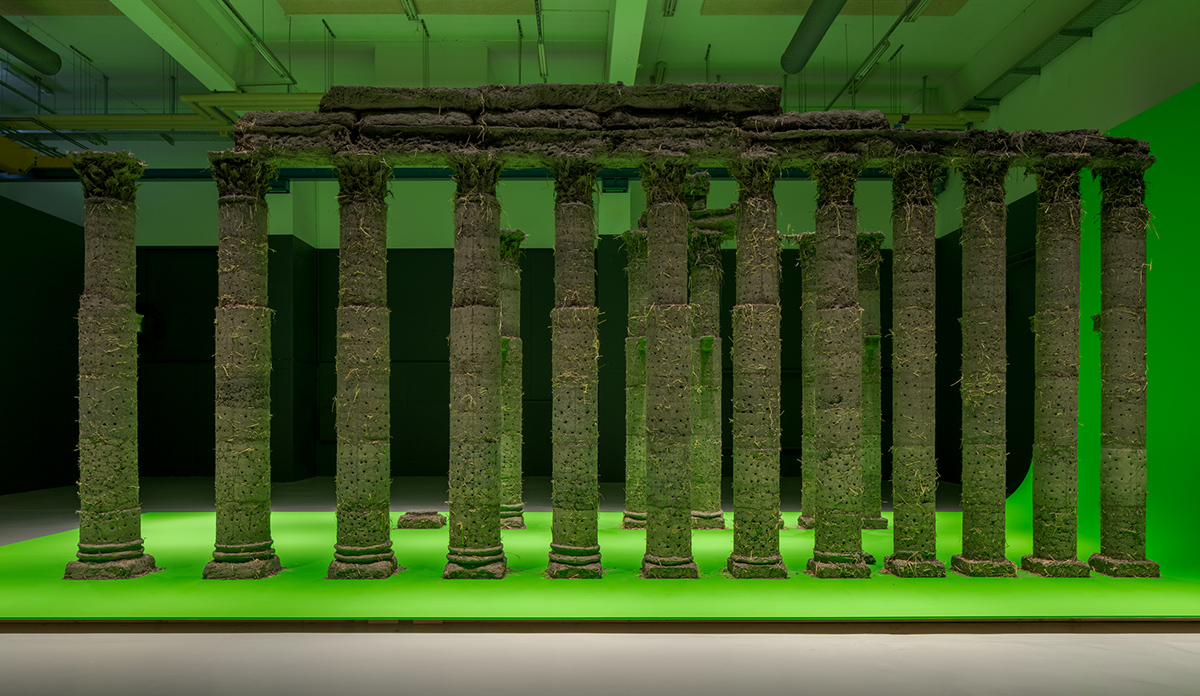
The Great Outdoors presents the remnants and symptoms of the world lingering beyond any possible forms of perception. La Poussière de Soleils (2022) will be a living sculpture that merges the artificial and natural. It is made from a novel material created by Kim, that combines ground vermiculite and water to create a kaleidoscope of colour that is only visible through specially fabricated lens. Discreetly connected to devices, microcomputers and software, the installation will control the wavelength and conviction of light in relation to its own density. It draws inspiration from French poet Raymond Roussel’s play ‘Dust of Suns’.
Gyre is commissioned by Arts Council Korea, in partnership with Hyundai Motor Company. An accompanying catalogue for the exhibition is due to launch in September 2022.
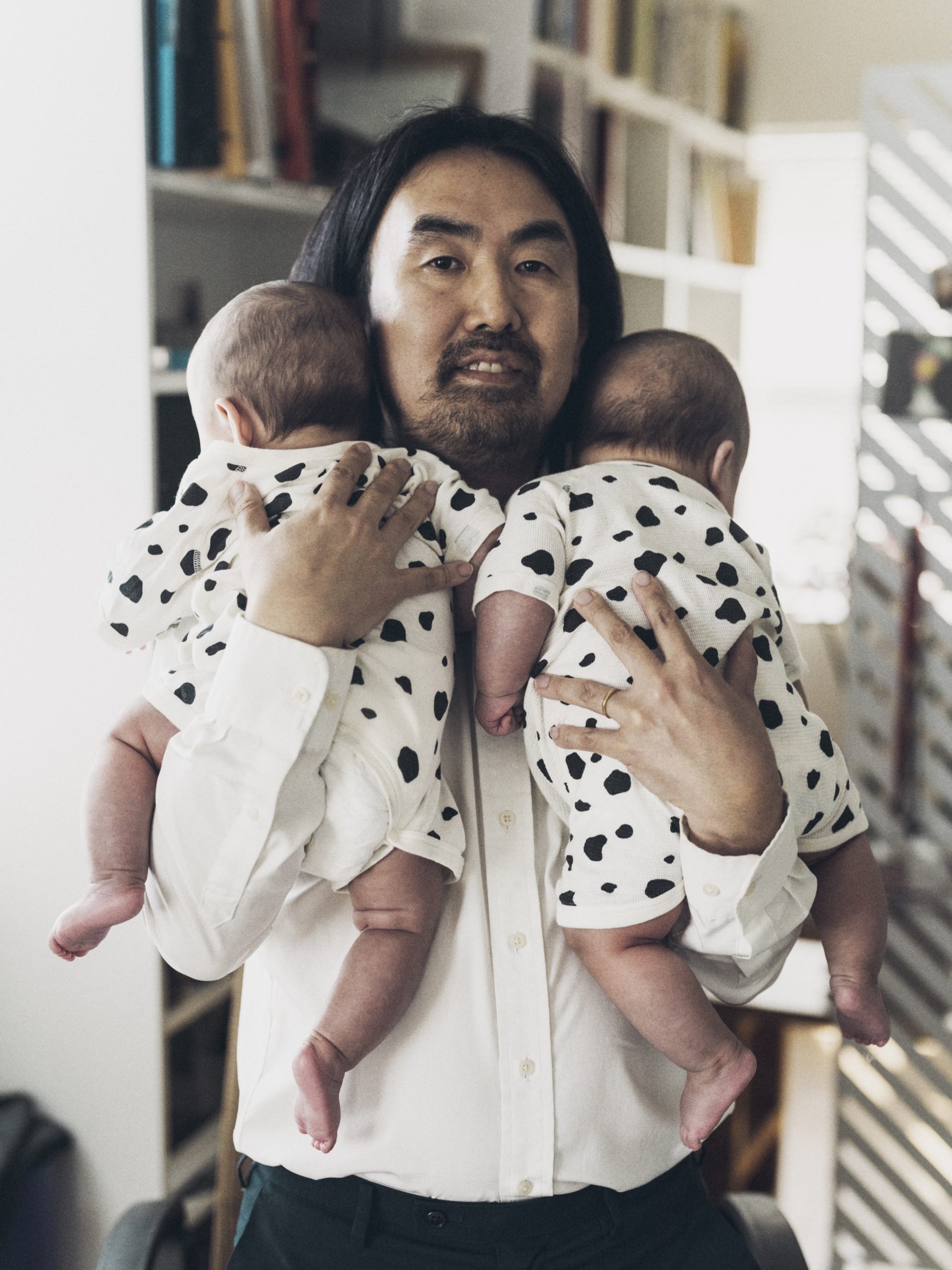
Yunchul Kim (b. 1970, South Korea) is an artist and an electronic music composer whose practice focuses on the artistic potential and the reality of matter through installation, drawings, writing, and music. Informed by his transdisciplinary research combining philosophy, chemistry, physics, mathematics, cosmology, anthropology, and mythology he considers the complex entanglement of beings between human, non-human, and things by examining the ‘world of materials’. He led the research group Mattereality at the Korea Institute for Advanced Study. He was a member of the artistic research project group Liquid Things at University of Applied Arts Vienna, and the art and science project team Fluid Skies. He is the winner of the 2016 Collide International Award at CERN, and has been awarded by VIDA 15.0, Arts Electronica, and Transmediale. In 2014, he founded Studio Locus Solus in Seoul. His recent presentations include Yokohama Triennale, Japan (2020); KUMU, Estonia (2020); National Taiwan Museum of Fine Arts, Taiwan (2020); iMAL, Belgium (2020); CCCB, Spain (2019); and ZKM, Germany (2018).
Young-chul Lee (b.1957, South Korea) is a curator, an art critic, an expert in urban public design, and was formerly a professor at Kaywon University of Arts and Design, Korea. Lee began his curatorial career in 1993 with the co-curation of Across the Pacific at the Queens Museum of Art in New York City, United States. He was the first director of the Nam June Paik Art Center, the artistic director of the second Gwangju Biennale (1997), and the founder of the Anyang Public Art Project (2005). Lee co-curated the second Busan International Contemporary Art Festival (2000) and was the president of the preparatory project for the opening of the Asia Culture Center (2011-2015), Korea.
Arts Council Korea (ARKO), the commissioner of the Korean pavilion, has been responsible for the operation of the pavilion since its opening. ARKO, also known as Arts Council Korea, is an organization dedicated to supporting Korean arts and culture nationally and internationally. It was established with the aim of making the arts accessible to everyone, based on the belief that art has the power to transform lives. It promotes and subsidizes projects and activities that promote culture and the arts. ARKO, under the Ministry of Culture, Sports and Tourism, advocates for the creation and enjoyment of all forms of art.
Hyundai Motor Company has been supporting art initiatives driven by long-term partnerships with global museums - the National Museum of Modern and Contemporary Art, Korea (MMCA), Tate, and the Los Angeles County Museum of Art (LACMA) since 2013, along with major partnerships for the Korean Pavilion at the 56th, 57th, 58th, and 59th Venice Biennale and the 20th and 21st Biennale of Sydney. The newly established Hyundai Tate Research Centre: Transnational encourages innovative ways of thinking about art and global art histories, and in partnership with global media group Bloomberg, Hyundai Motor Company connects international audiences with artists exploring the convergence of art and technology.
Commissioner: Arts Council Korea
Curator: Youngchul Lee