

Exhibition · Buchholz
Jutta Koether
Songs of New York
Sep 8 – Oct 31
About the show
Jutta Koether's move from Cologne to New York at the beginning of the 1990s marks a decisive transformation in her practice. Looking back, she describes the relocation as a process of "self-displacement" - a conscious distancing from the encumbering Cologne art scene that allows her to reposition herself. More than a rupture, however, this displacement becomes the starting point for a transatlantic practice intertwining earlier influences with new contexts.
While the previous exhibition with Jutta Koether at Galerie Buchholz New York focused on her paintings and her experimental writing for Cologne's music magazine SPEX in the early 1980s, our new exhibition begins with works from 1995. These include a large-format copy of a painting Koether acquired with Tom Verlaine at the Chelsea Flea Market, depicting massive colorful spotlights illuminating an otherwise dark Madison Square Garden, and a smaller work made for the exhibition Warmer Stern at Galerie Buchholz Cologne in the following year, featuring a central field of abstract gestural marks, a floating record, face, and amplifier that burst out of a grid-like structure.
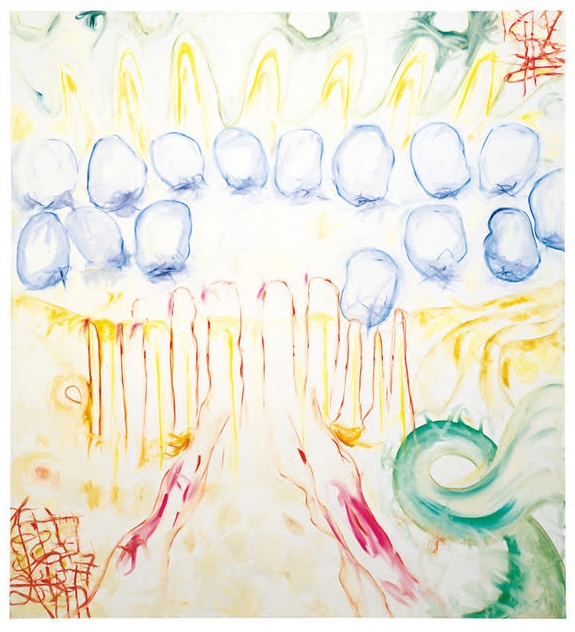
This dialogue between possibility and constraint continues into the 2000s through exhibitions such as Songs of New York &c (1997) at Pat Hearn Gallery and Extremes Europa (2002) at Galerie Buchholz. During these years, Koether's painting expands dramatically, embracing extremes of scale, surface, and gesture: large-format canvases alongside intimate works; pitch-black canvases marked by delicate lines in metallic pens alongside all-over compositions in vivid colors; formless gestural masses alongside grids of controlled painterly marks, smiley-faced heads, and exploding suns. Rather than resolving these oppositions, her paintings use them as simultaneous productive states.
For Koether, one important recurrent reference point is William Blake's early Romantic illuminated book Songs of Innocence and of Experience, in which poetry and painting converge to confront the conflicting but inseparable states that constitute human existence. Koether's engagement with Blake is not limited to her paintings: in 1996, she named her new SPEX column Songs of New York, in which she traces her transatlantic position in writing. The page and the canvas, again, become parallel spaces of production: the rectangular geometry of the journalist's office overlaps with that of the painter's studio, forming a multidimensional site of production.
While Koether's writing within these texts remains experimental in its perspectives and language, it gradually moves toward a more journalistic form, particularly in contrast to her earlier 1980s column written under the pseudonym Mrs. Benway. This transformation unfolds alongside the painterly expansion of the same period. Increasingly, writing migrates more freely into the paintings themselves, recalling Blake's illuminated landscapes: a complex construction in which image and text cannot be separated, and in which the dialectic of enclosure and openness brings forward a new way of working.