
Exhibition · Clearing
Marina Pinsky
Emergy
Jun 3 – Jul 9
About the show
Clearing presents Marina Pinsky’s solo exhibition, Emergy.
Marina Pinsky’s works emphasize systematics, revealing the bones beyond surface matter. Frictions and alliances coalesce as particularization and universality are placed in confrontation with one another. Local aspects are granted inroads with the global dimension as Pinsky integrates disparate loci within a singular context. She takes to modeling the world by careful arrangement of images and other devices, adjusting scales in order to structure understanding in a comprehensible scope. Macrocosms converted to microcosms.
The history of Los Angeles is embedded in her current exhibition. Baudrillard’s meditation on the spatialization of this city and its “incessant transurbanistic, tissue” can be taken as a poetic reflection on the state of America and the architectures which compose and reinforce its sociopolitical modality. In America he describes the Ventura Freeway as “coming from nowhere, going nowhere: an immense collective act, rolling along, ceaselessly unrolling, without aggression, without objectives - transferential sociality, doubtless the only kind in a hyperreal, technological, soft-mobile era, exhausting itself in surfaces, networks, and soft technologies.” Pinsky’s work aligns itself with these ruminations in order to investigate how systems of infrastructure contribute to a city’s basic functionality. Where are the tangles and fissures in practical application?
Pinsky’s consistent concern for space manifests in the context of this show as she refers to it being a “homecoming” of sorts. Having graduated from UCLA exactly ten years ago, she reflects on her first solo exhibition in 2011 (at the artist-run Workspace in Lincoln Heights), “even though my work has changed a great deal in the intervening time, I think the subject matter of this upcoming show is very related.” That exhibition, titled Department of Water and Power, invoked the “basic ingredients of a city,” though the materials were “held up with almost nothing. The specificity of the light was what kept everything propped in place.” The works in the current installation offer viewers another encounter with a city, yet, “rather than looking inwards to construct images, they take these units to expand outward into structures connecting different systems and flows.”
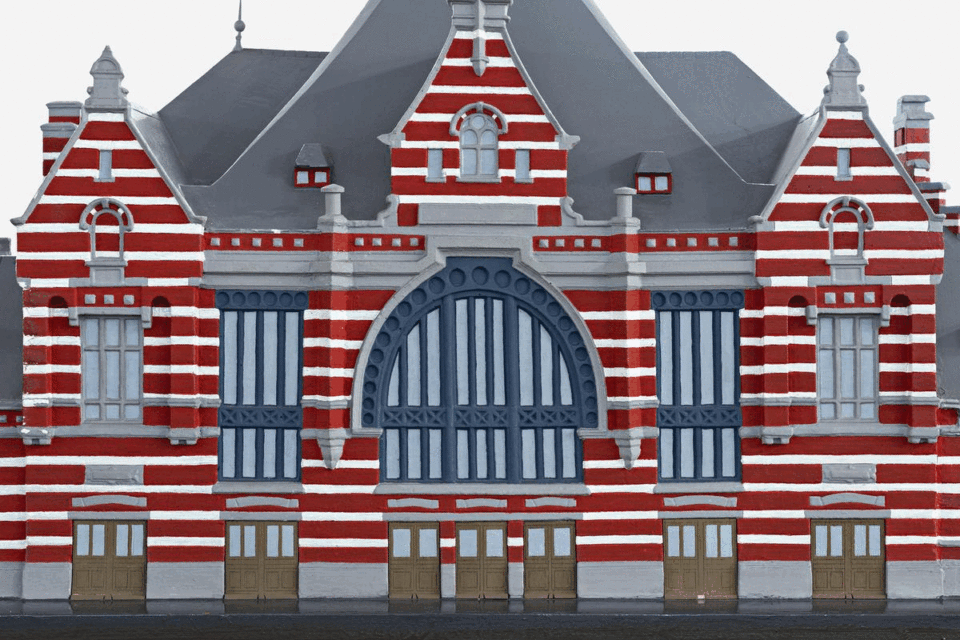
One room offers viewers close-ups of photographs that Pinsky took of railway station models sourced from the Belgian National Railway’s archives. The models were originally constructed by signalmen in training and were rehabilitated for an exhibition she organized in 2021 at the abandoned railway museum in Brussels-North Station. In order to connect these refurbished models, she fabricated an elevated train track from cardboard and wax. Those same tracks have been cast in bronze and rearranged in order to suit the present gallery space. Working without molds, each one of Pinsky’s tracks are entirely unique. The railroad here functions as a demonstration of connectivity amidst the limitations of built networks.
In the same room she has created a diagrammatic mural of the sewer system in Brussels. This subject is picked up elsewhere with digitally embroidered screenshots of software used to regulate sewage water flow. With diagrams and models as the basis of these artworks, Pinsky guides the viewer’s spatial awareness to direct an understanding of structural logics. In addition to the exhibition, Pinsky has amassed a collection of readings titled Abridged Sewer Reader. This booklet incorporates texts and images that are either vaguely or explicitly adjacent to the works on view. Excerpts from artists Mike Kelley and Robert Smithson meet the musings of thinkers like Bruno Latour and Jonathan Crary. Notes on urbanism and environmentalist concerns face historical accounts of transportation and communication networks.
Photography remains at the core of Pinsky’s practice. Her images contain the trace of a sculptor’s hand. By targeting photography’s material dimension, she uses the medium in order to activate and meter a space. How do we read a photographically produced image? How can that be leveraged in order to perceive spaces at large? She establishes new systems then subsumes viewers into those systems, incorporating relics of history to demonstrate her interests.
—Reilly Davidson
Marina Pinsky (born 1986 in Moscow, RU) lives and works in Brussels and Berlin.
She received her MFA from UCLA in 2012 and her BFA from SMFA/Tufts University in 2008.
Solo exhibitions of her work have been held at Kunsthalle Basel; Kunstverein Göttingen; De Vleeshal, Middelburg; LACMA, Los Angeles; White Columns, New York; Simian, Copenhagen; Gluck50, Milano, IT; The Downer, Berlin; Parallel, Oaxaca; 303 Gallery, New York; and Clearing Brussels.
Her work has been featured in group exhibitions at MoMA, New York; Hammer Museum, Los Angeles; S.M.A.K., Ghent; Wiels, Brussels; Kunstverein Düsseldorf; the National Gallery of Kosovo; the 13th edition of the Biennale de Lyon; and the 1st edition of the Riga International Biennale of Contemporary Art.
In 2022, Marina has a solo show at the Tail in Brussels; 303 Gallery in New York and at Clearing, Beverly Hills. In early 2023 she will present a permanent sculptural installation in the newly-built City Hall of Brussels.
Marina Pinsky’s work is part of the collection of the MoMA, New York; M Museum Leuven, Belgium (as part of the Flemish Community Collection), the Belgian National Bank, and the Belgian Ministry of Foreign Affairs.