
Ended
Anita Steckel
Lust
Nov 30, 2023 – Jan 13, 2024
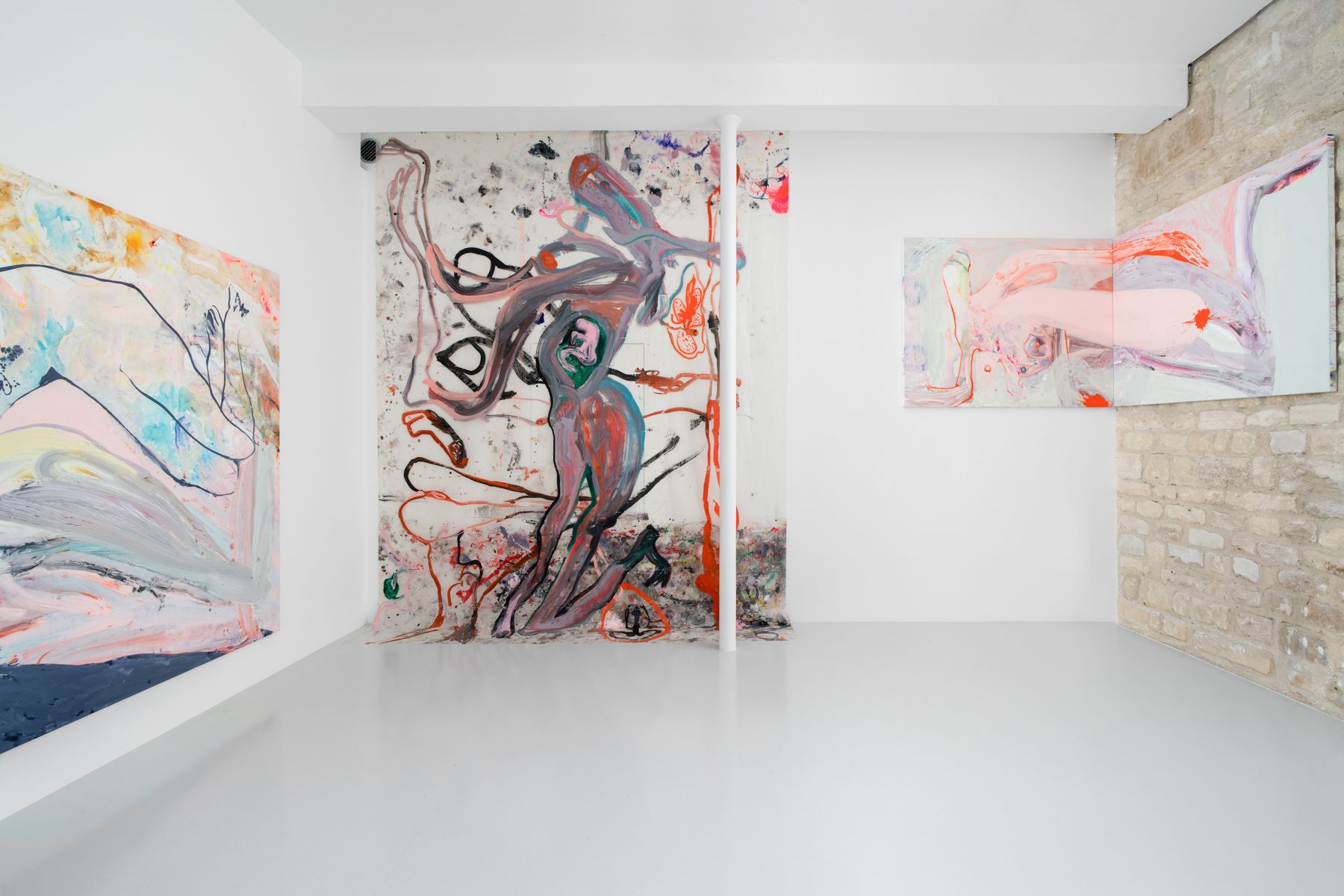
Fitzpatrick Gallery is thrilled to present Lust, a solo exhibition of works by American feminist artist and political activist Anita Steckel. Developed from an initial presentation at Wonnerth Dejaco Gallery, Vienna (2023), these exhibitions represent the first in Europe to focus on her rich oeuvre. Curated by Juliette Desorgues, Lust is accompanied by a series of readings by French writer Constance Debré and British artist, writer and political dominatrix Reba Maybury. As suggested by its title, the exhibition induces qualities of desire and playful transgression while situating three trans-generational and interdisciplinary figures in an associative dialogue to reflect on questions of power, gender and sexuality.
A key figure of the 1950s and 60s New York downtown scene, Anita Steckel developed a rich multimedia practice that included photography, collage, drawing and painting. Steckel’s singular body of work blossomed in the 1970s, developing in the context of the Western women’s liberation movement while challenging some of its primary assumptions. Her uncompromising work drew on sexual expression as a source for its visual content, using the space of the paper or canvas as a site for the liberation of the naked body and a challenging of the tradition of the nude at a time when pornography became a widespread phenomenon. Steckel’s employment of the naked body set herself apart from certain feminist circles, who considered such visual cues to be encased by the language of the patriarchy. It certainly provoked the conservative morals of a wider culture, which American feminist theorist Gayle Rubin describes as “treat[ing] sex with suspicion” and “constru[ing] and nudg[ing] almost any sexual practice in terms of its worst possible expression.” [1] In 1972, calls by the public and the media were indeed made to censor her exhibition at the Rockford Community College, NY due to the sexually explicit nature of some of the work on view.
Following this public scandal, Steckel co-founded the Fight Censorship collective in 1973 with fellow New York-based feminist artists Judith Bernstein, Louise Bourgeois, Joan Semmel and Hannah Wilke amongst others, who were brought together by their common practices that faced a prevailing sexist and puritanical art establishment. As outlined in the collective’s manifesto: “If the erect penis is not wholesome enough to go into museums it should not be considered wholesome enough to go into women. And if the erect penis is wholesome enough to go into women then it is more than wholesome enough to go into the greatest art museums.” [2] From this, a new form of feminist art was born, one which would be coined “sexualism”, a “phallic feminism” which denounced the instruments of patriarchal oppression while also seeing the possibility for women artists of the time to find a radical form of agency in eroticism. [3]
Drawn from Steckel’s archive and estate, the works presented in this exhibition span five decades from the 1960s to the 2000s. Throughout these works, phallic imagery is depicted as a cypher of systemic power, whose violent and dangerous ills are made subject to Steckel’s satirical view and critical dismantling; while the female body is positioned as an omnipotent, autonomous commander of its environment. Specific historical moments are given particular focus in this vein where visual cues to European fascism and Nazi Germany are treated with caustic sarcasm, an attitude that we might attribute to Steckel’s Jewish identity and her openly leftist politics; while the foreign policy of the second Bush administration and its involvement in the Iraq war appears as a conflation between American imperialism and phallocentrism. Steckel’s work suggests that the phallus can be read as a symbol of oppressive forces within the public sphere, where gender and power relations are played out and co-entwined. Steckel recurrently explores these dynamics with the imagery of urban space, for instance in the Giant Women series (1969-1974). New York City in particular is used as a backdrop against which the imposing bodies of women are deployed as signifiers of vulnerable unease. Such strategies reveal an underlying tension, one where the phallus is granted as an object of sexual desire while harbouring latent aggression. Its physical manifestation within the modern metropolis therein becoming a potential playground for emancipatory release.
On the occasion of the exhibition, Constance Debré and Reba Maybury are performing readings of new and recent texts for the opening and finissage events. While Debré’s style of writing piercingly chronicles her own personal life, her rejection of institutional bourgeois structures, and her explorations of queer sexuality; Maybury’s texts act as conceptual manifestos to her work as a political dominatrix which centres on subverting traditional gender dynamics through and within sex work.
Each of these three voices confronts the mechanisms of power, working to lay bare their structures and subverting their entrapments with humorous, raw and biting force. The self, as a lived and metaphorical entity, is deployed as a key trope to touch on wider questions of sexuality and gender, especially the role of women in contemporary society. Desire, both imagined and embodied, comes to act as a central cue, one which serves as a form of unabashed disruption to the hegemony of the normative patriarchal public sphere.
Underlying this, the exhibition asks what it means to consider the work of a second wave feminist figure such as Anita Steckel in a time of what the writer Asa Seresin calls ‘heteropessimism’, whose path is aimed toward ‘universal queerness and the abolition of gender’.[4] It is in the refusal of ambivalence as a political and embodied stance—which marks Steckel’s much overlooked life and work—that answers can be found. As with Steckel, the work of Debré and Maybury both reveal how a position may be taken, one which boldly asserts a self-determination that spits in the eye of conservative and repressive forces that continue to assert their claim on symbols and meaning.
1 - Gayle Rubin ‘Thinking Sex: Notes for a Radical Theory of the Politics of Sexuality’ in Pleasure and Danger: Exploring Female Sexuality, ed Carole S. Vance (London: Pandora, 1992), p. 150
2 - Fight Censorship Group Manifesto “Women Artists Join to Fight to Put Sex into Museums and Get Sexism and Puritanism Out”, 1973
3 - The term ‘phallic feminism’ is cited by Richard Meyer in ‘Hard Targets: Male Bodies, Feminist Art, and the Force of Censorship in the 1970s’, Whack! Art and the Feminist Revolution, ed. Cornelia Butler and Lisa Gabrielle Mark (Cambridge, MA: MIT Press, 2007), p. 368
4 - ‘On Heteropessimism: Heterosexuality is nobody’s personal problem’, The New Inquiry, 9/10/2019, accessed https://thenewinquiry.com/on-heteropessimism/ 28/07/2023. See also Wendy Vogel’s reading of Steckel’s work in light of today’s debates: ‘Reconsidering Anita Steckel in the Age of Heteropessimism’, Mousse Magazine, Issue 82, February 2023.
Constance Debré is a French writer living in Paris. She is the author of several novels: Playboy, Love Me Tender, Nom and Offenses. Love Me Tender was recently published by Semiotext(e) in English. Her books have also been translated into Italian, German, Danish and Swedish.
Reba Maybury is an artist, writer and political dominatrix sometimes working under the name Mistress Rebecca. She lives and works in Jutland, Denmark and London, UK. Her work explores the tension between her perceived strength as an object of transactional fantasy and how, through the reality of sex work and gender, she attempts to turn this power into something tangible. She is the author of Dining with Humpty Dumpty (Wet Satin Press, 2017) and Faster than an erection (Macro, 2021).
Anita Steckel (1930-2012) studied at Cooper Union and Alfred University, as well as the Art Students League of New York, where she taught from 1984 until her death. From the early 1970s, she lived at Westbeth Artists’ Housing in the West Village. She was recently the subject of solo exhibitions at the Stanford Art Gallery, Stanford (2022), curated by art historians Rachel Middleman and Richard Meyer, and at Hannah Hoffman Gallery, Los Angeles (2021). Previous exhibitions include Legal Gender: The Irreverent Art of Anita Steckel, Jacki Headley Art Gallery, California State University, Chico and Verge Center for the Arts, Sacramento (2018); Anita of New York, The Suzanne Geiss Company, New York (2013); Anita Steckel and Friends, Westbeth Gallery, New York (2012); and Mom Art: 1963–1965, Mitchell Algus Gallery, New York (2008). Her work featured in the recent institutional exhibitions Maskulinitäten, Bonner Kunstverein, Germany (2019); Cock, Paper, Scissors, One National Gay & Lesbian Archives, Los Angeles (2016); Black Sheep Feminism: The Art of Sexual Politics, Dallas Contemporary (2016); and Identity Crisis: Authenticity, Attribution and Appropriation, The Heckscher Museum of Art, Huntington, NY (2011). She was the recipient of a Pollock-Krasner Foundation Grant (2005), a National Endowment for the Arts grant (1983), and a MacDowell Fellowship (1966). Her work is in the permanent collections of the Brooklyn Museum, New York; Bryn Mawr College, Pennsylvania; Edwin A. Ulrich Museum of Art, Wichita State University, Kansas; Smith College Museum of Art, Northampton, Massachusetts; and Verbund Collection, Vienna, among others.
Juliette Desorgues is a curator and writer based in Paris. She was previously Curator at Mostyn, Wales and Associate Curator at the Institute of Contemporary Arts, London. She has also held curatorial positions at the Barbican Art Gallery, London and Generali Foundation, Vienna. She studied at the University of Edinburgh, the University of Vienna and University College London.