
Ended
Jochen Lempert
Feb 27 – May 19, 2017
"With feeling, waves and violent, bumpy thinking."
—Schmelzdahin
"It is raining."
—Louis Althusser
In July 1982, Althusser is writing about the rain. He quotes the French Cartesian Nicolas Malebranche, who asks "why it rains upon sands, upon highways and seas" since the water from the sky "adds nothing to the water of the sea" and "goes to waste on the roads and beaches." It is raining now. The second Sunday in February (in 2017). But it's never just the rain. It's also (re: Althusser) a kind of encounter.
In July 1982, Hamburg-based photographer Jochen Lempert is studying entomology and ornithology at the Friedrich-Wilhelms University, Bonn. At the time of matriculation, he's already an experimental filmmaker. He's been collaborating with Jochen Müller and Jürgen Reble under the name Schmelzdahin (melt-away) since 1979. Their first films have a lot of costumes. Ecstasy. But, by 1982, they make films to work through film's un-making or 'melting' point. They have their own cameras, but produce camera-less films. They all agree about this. They go outside, submerge film strips in ponds (Aus den Algen (From algae), 1986) or bury them in a garden (Stadt in Flammen (City on Fire), 1984). They produce a diagram linking the brain to ants and reptiles.
...and try to make an emulsion. Film-making is a scientific expedition with "occasional intense thinking, feeling and accidents." And the results (films) are abstract. In principle, Schmelzdahin want to test the resistance of material against natural processes. They do not make works. Critic Emilie Vergé has noted, if these actions seek to reclaim an aspect of the natural world, it's in their 'naturing' (natura naturans). Perhaps the 'naturing' Decartes had in mind when he wrote of continued creation. But, for Lempert, "...it's a wave" (he doesn't have an English word for it). "It means coincidence. ...You don't have to think about it, like making breakfast."
In 2017, Lempert is still outside. But, he's alone. In the field. Taking pictures.
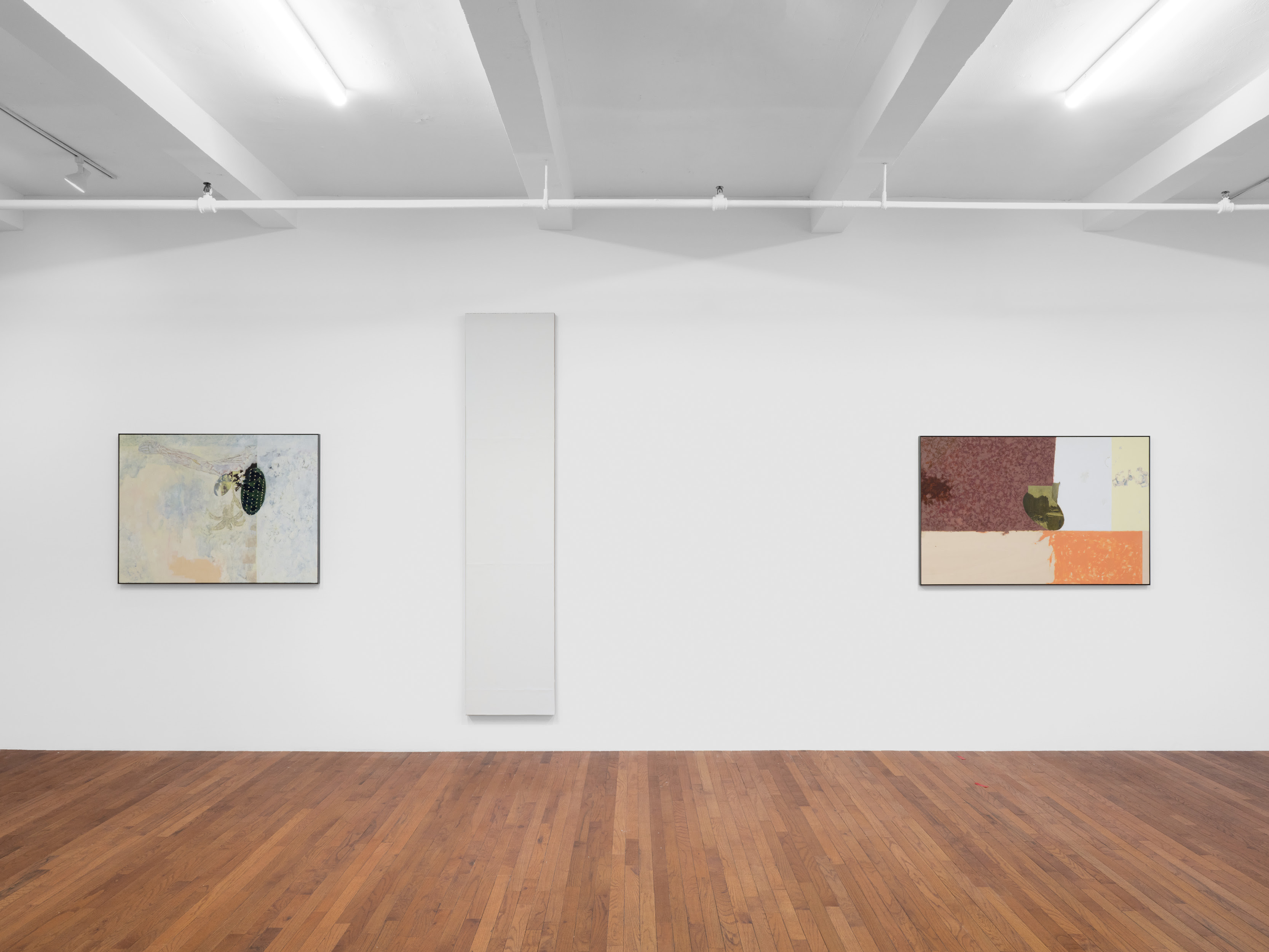
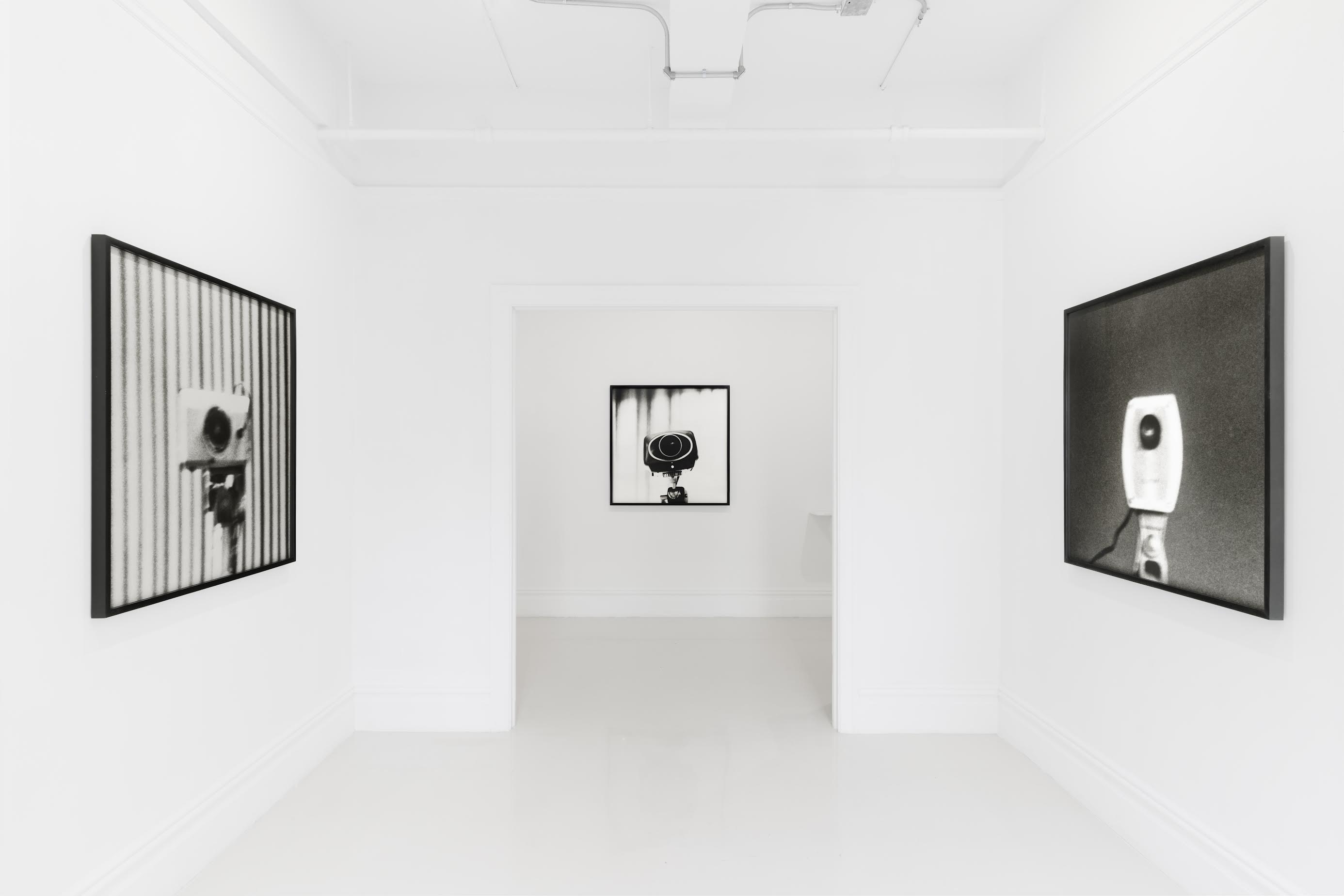
Until May, Front Desk Apparatus will have a selection of Lempert's photographs installed at the office (his first solo exhibition in New York). The exhibition consists of over 20 photographs drawn from Lempert's decades-long attempt to reconcile scientific investigation with analog photography. His work (always black-and-white and shot exclusively on 35mm) often documents natural and social phenomena at their point of intervention and mutual disclosure. The photographs are unframed and overtly material, often taped to the wall in nonhierarchical aggregates or constellations (an integrative aspect to his own approach to fieldwork and exhibition-making) that relationally permute each into the other. They are part of the world. And, like a Zukofsky poem, beautiful and polyvalent:
Heart us invisibly thyme time
round rose bud fire downland
bird tread quagmire dry gill-over-the-ground
stem-square leaves-cordate earth race horsethyme
breath neighbors a mace nays
sorrow of harness pulses pent
thus fruit pod split four
one-fourth ripens unwithering gaping.
Collectively, Lempert's work gestures to an old idea: "if man is shaped by his surroundings, his surroundings must be made human." And if there is a clear relationship to scientific inquiry it's found in Lempert's insistence on the materialism of encounter. One that empirically underscores the 'natural' aspect of the surrounding environment as a kind of social penumbra or 'field' (re: Bourdieu), where structures egress into air or hang like spider webs in the wind. Here, photography isn't simply a means to capture the overlap (or coincidence) of the natural and social, but to enfold this imbrication, like a wave, into what we see.
Now, through the window, cloud cover. Rain. Hepatica. The same stem.
Jochen Lempert (Born in Moers, Germany, 1958) lives and works in Hamburg, Germany. Recent solo exhibitions include Izu Photomuseum, (Japan 2016-2017), Vancouver Contemporary Art Gallery (Canada, 2016), Between Bridges (Berlin, 2016) Cincinnati Art Museum (USA, 2015), Hamburger Kunsthalle (Germany, 2013), Lulu (Mexico City, 2013), Midway Contemporary Art (USA, 2012), Rochester Art Center (USA, 2012), Museum Ludwig (Germany, 2010), Culturgest (Portugal, 2009). His works are included in public collections, such as Museum Folkwang (Germany), Museum Ludwig (Germany), Sammlung zeitgenössischer Kunst der Bundesrepublik Deutschland (Germany), La Caixa Collection (Spain), Centre national des arts plastiques (France), and Huis Marseille, Museum voor Fotografie (Netherlands). In 2014, he was nominated for the Deutsche Börse Photography Foundation Prize.
The exhibition has been organized by Front Desk Apparatus with the generous support of Silvia Dauder and ProjecteSD, Barcelona.