
Exhibition · Kulturstiftung Basel H. Geiger
Irène Zurkinden
Love, Life
Jun 12 – Sep 7
About the show
The exhibition Irène Zurkinden: Love, Life, aims to revive attention for an artist whose oeuvre is as multifaceted as it is current. Central to the exhibition is the first publication and presentation of a small number of Zurkinden’s sketchbooks. The exhibition further provides an intimate window into her creative process, revealing her honest and unfiltered view on society, her unwavering and powerful gaze upon the world around her.
Zurkinden’s pioneering portrayal of her female companions beginning in the 1930s show women with strength and agency at a time when nudes were predominantly made by men. Zurkinden depicts women standing up, rather than passively lying down. Figures appear in control of their surroundings, at times with their back turned to the viewer, or with a foot planted on the furniture. Zurkinden’s work has gained traction as her erotically charged portraits slowly became acknowledged as rigorous subject matter for a female artist and women in the Surrealist movement garnered recognition for their contributions.
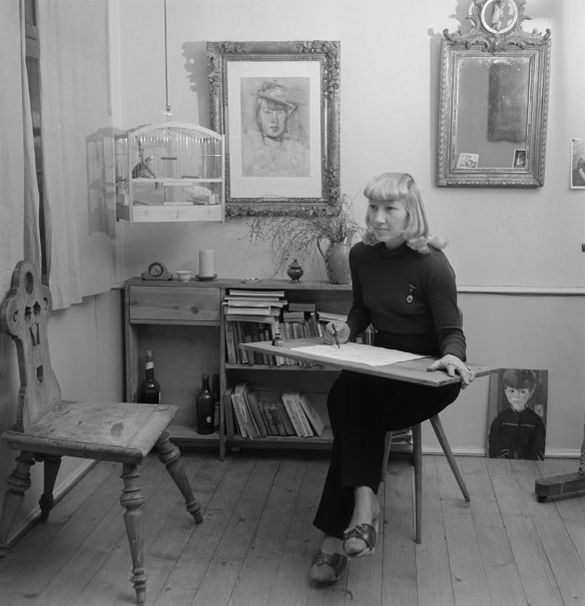
Born in 1909 in Basel, Zurkinden moved to Paris with Meret Oppenheim in 1929 to enroll at the Académie Grande Chaumière. In Paris, she became immersed in the avant-garde artistic communities revolutionizing gender, sexuality and artistic production. Zurkinden and Oppenheim developed a close romantic relationship and artistic dialogue that shaped both artists’ work for the duration of their careers. In the 1930s Zurkinden became involved in the Surrealist group, one of few artistic movements of the time period that included women. Zurkinden lived between Paris and Basel throughout the 1930s and later had two children with jazz musician Kurt Fenster. She returned to Basel in 1942 and was one of two women to become part of the anti-fascist activist Gruppe 33 which shifted her focus to the political realities of postwar Europe.
In 1930-1955 the specter of Surrealism is felt through the subconscious churning beneath the façade of daily life. The twelve drawings on view delve deeper into the body as a sexualized object, transforming bodies into furniture and rendering shoes and wigs with an uncanny sense of interiority. Working during a moment of profound cultural change, Zurkinden’s paintings and drawings encompass the tension between her private life in Basel and artistic and sexual freedom in Paris. Moving between the two cities allowed her to forge a singular path which incorporated both the symbolic figures of the subconscious mind and the political gravity of representation.
Irène Zurkinden’s (1909-1987) solo exhibitions include a retrospective at Kunstmuseum Basel (1985); Galerie Beyeler, Basel (1979); Galerie Riehentor, Basel (1974). Group presentations include Kunsthalle Basel (1983); Galerie Wolfensberger, Zürich (1959); Galerie Kléber, Paris (1950); and Galerie Bettie Thommen, Basel (1930). Her work is held in the collections of the Basel Public Art Collection; Kunstmuseum Basel, Art Credit Basel-Stadt; Swiss National Insurance Company; and the Swiss National Library, Graphic Collection. She received the Prize of the Regio Basiliensis for visual arts in 1982. In 2014, the city of Basel named a public square “Irène Zurkinden-Platz”. Meredith Rosen Gallery staged the first solo presentation of Irène Zurkinden in the United States in 2023 and then exhibited the work in a solo presentation at Art Basel: Feature.