Ended Aug 1
Francis Picabia
Eternal Beginning
May 1 – Aug 1, 2025
More from Francis Picabia on Gallop
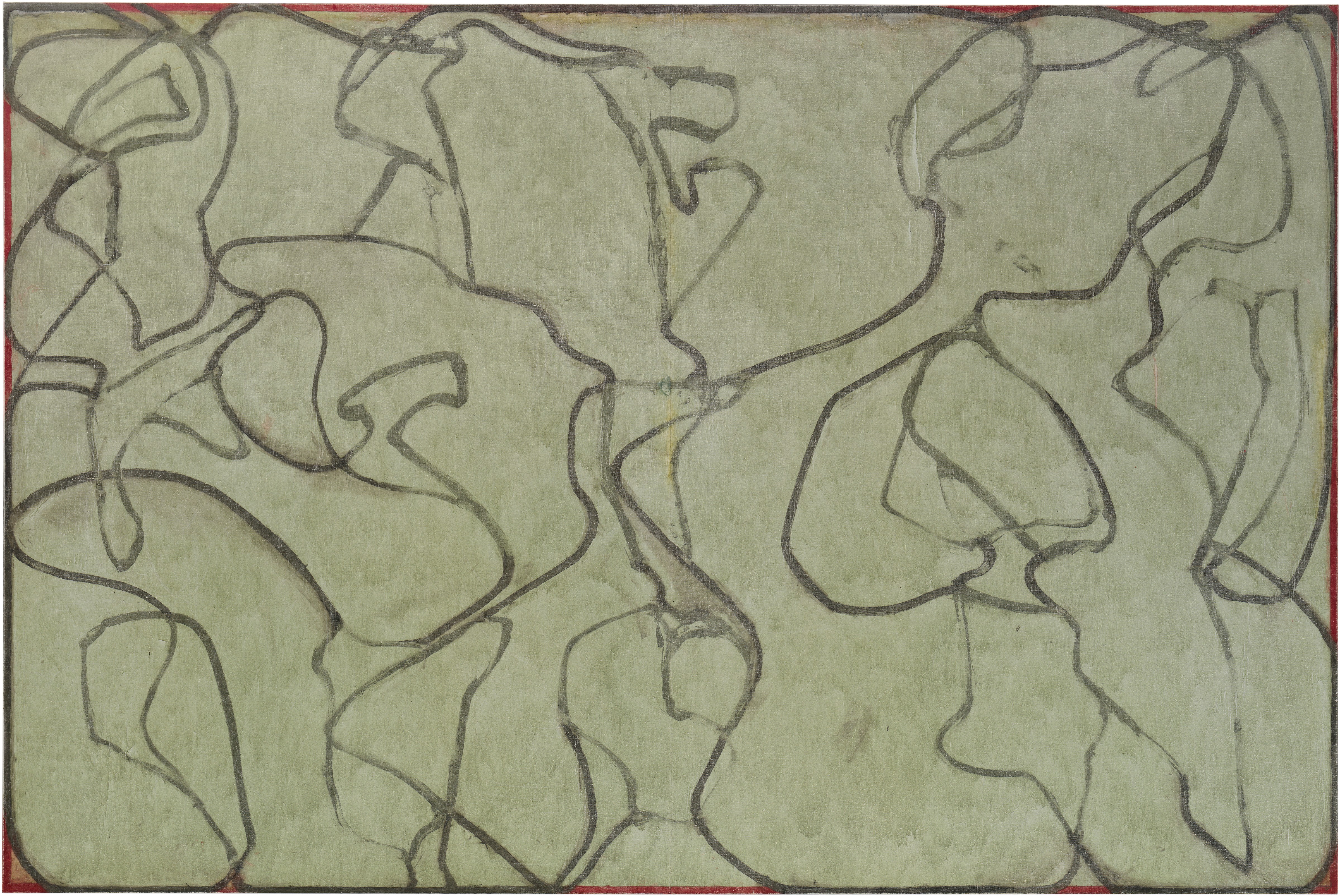
Organized in collaboration with the Comité Picabia, and co-curated by its President, Beverley Calté, with art historian Arnauld Pierre, Francis Picabia. Eternal Beginning is the first major exhibition to focus on the compelling final years of the French avant-garde artist's prolific career. Traveling to New York, this presentation features over 20 paintings created by Picabia between 1945 and 1952. Representative of Picabia's restless artistic spirit, the works on view highlight his singular approach to abstraction, his iconoclastic tendency to repaint earlier works, and his enduring attention to both surface texture and novel sources of inspiration.
The first 30 years of Picabia's practice were defined by his rapid progression through different styles and techniques, and his experimentation with a succession of artistic movements that included impressionism, fauvism, dadaism, and cubism. In 1925, Picabia retreated from Paris, where he produced his ‘Transparencies'—beguiling compositions that layer motifs from ancient artworks and old master paintings—as well as more realistic works, such as landscapes. His infamous naturalistic nudes followed; lurid depictions of female figures excerpted from mass-produced erotica.
In 1945, facing challenging economic circumstances and seeking a fresh start, Picabia returned to Paris. There, he announced in an interview that he was searching for a ‘third path' forward between surrealism and abstraction, the two dominant forces in postwar European art. Even as he rejected surrealism's emphasis on elaborate figuration, Picabia aspired to continue—through abstraction—the movement's engagement with the artist's unconscious and innermost sensibilities. While Picabia resisted being confined to group labels throughout his life, he was willingly associated with the growing art informel movement during this time, and opened his studio ‘almost every Sunday' to younger artists.
During this period, Picabia likewise solidified his commitment to a core method that had persisted through all his previous stylistic transformations. He continued to extract and repurpose pre-existing visual material from a vast collection of images, and from his own earlier paintings. Extensive archival research and recent X-ray imaging have revealed that Picabia would frequently paint over existing works, concealing mechanomorphic designs, ‘Transparencies' from the late 1920s, and even his latest abstractions beneath new compositions.
By merging discrete references and artistic traditions, Picabia developed visual and symbolic languages that were entirely novel. Art historians have directly attributed motifs in various paintings on view in this exhibition to Picabia's frequent use of a catalogue documenting Romanesque art from Catalonia, published by Barcelona's municipal museum in 1926. In Picabia's rendition, various forms adapt key shapes from historical sources. Picabia also appropriated from text, often drawing on Nietzsche for his titles.
Energized by neo-dadaist tendencies and an interest in prehistoric European cave art, Picabia became increasingly attentive to the materiality and surface texture of his late paintings. Indeterminate matter was thought to reveal the limits of descriptive language. It was under the aegis of dadaism, too, that Picabia debuted his infamous ‘point' or ‘dot' paintings. With these works, Picabia reduced painting to its barest elements (figure and ground), dispersing autonomous circles of color across turbulent and chasmic monochrome surfaces. Though Picabia's ‘dot' paintings were decried by some for being repetitious, the art critic and painter Michel Seuphor praised them as a resounding ‘end point' in the history of painting. For Picabia, they represented another departure, one more new beginning.
As a complement to this exhibition, Hauser & Wirth Publishers has released a fully illustrated catalogue with fresh scholarship in both English and French on Picabia's late work. The publication features an introductory preface by Beverley Calté, and essays by art historians Arnauld Pierre and Candace Clements. It contextualizes Picabia's position within a vibrant postwar Parisian art scene and among a group of gestural abstract painters who were collectively identified as the art informel movement.
Francis Picabia was born François Martinez Picabia in Paris, to a Spanish father and a French mother. After initially painting in an impressionist manner, elements of fauvism and neo-impressionism as well as cubism and other forms of abstraction began to appear in his painting in 1908. By 1912 he had evolved a personal amalgam of cubism and fauvism. In 1915, which marked the beginning of Picabia's machinist or mechanomorphic period, he and Marcel Duchamp, among others, instigated and participated in dada manifestations in New York. For the next few years, Picabia remained involved with the dadaists in Zurich and Paris but finally denounced dada in 1921 for no longer being ‘new.' The following year, he returned to figurative art but resumed painting in an abstract style by the end of World War II.