Ended Oct 5
Kaoru Arima
Faust in Marienbad by Paris 2019
Sep 7 – Oct 5, 2019
More from Kaoru Arima on Gallop
[Scroll down for French version / Veuillez trouver ci-dessous la version française]
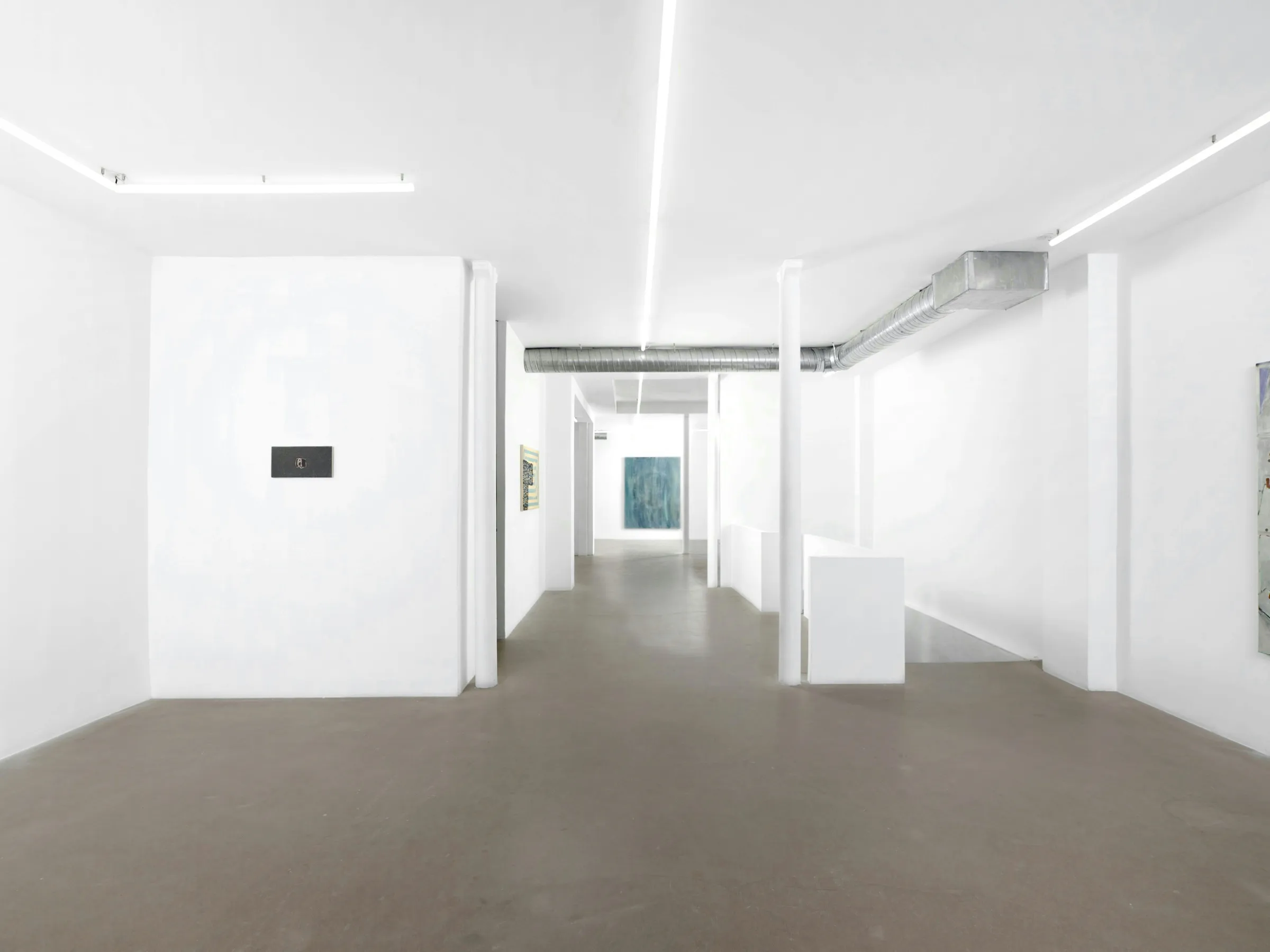
Kaoru Arima makes small impressionistic portraits. The coloured paint is dabbed onto a black painted background whose square shape is reminiscent of a Polaroid. Sometimes the painting bleeds over the edges of the black background, giving the face a blobby, intrusive cool look while reminding us that portraits, an academic form par excellence, are historically linked to the invention of the background. Each portrait has a title: a forename such as “Pokan” or “Po”, a notion such as “Over There” or “The Last Person”, or a comment such as “Nasty Looking” or “Dirty Blonde”.
Kaoru Arima’s close-up portraits are unrecognisable. They are dark—but devoid of pathos. The black background they are painted on gives no indication of the context, and modern illusionist machinery, to which their fluidity might have invited comparison, is absent. They seem to have been taken with a flash, as if they were going to disappear or shatter immediately afterwards; these portraits are pictorially unstable. They are unusual in that they are taken from two viewpoints simultaneously: from the viewpoint of the selfie, and from the other side of what is shown. Amalgamated in Arima’s little portraits, these two viewpoints raise the question of the interdependency between images we take of ourselves and the image we have of ourselves: a question that lies a heart of profile management on social media. The fact that in Arima’s paintings the eyes are all burnt out / gouged out suggests that the subject of this interdependency moves towards the expropriation of one’s self by the image of oneself—beginning with the loss of one’s eyes.
Arima’s portraits invent a place where the face is lost, and they create a space where this absence can become effective. Each of Arima’s paintings attests to this movement and crystallises it. The effectiveness of Arima’s portraits comes from their rapid execution, which gives them great intensity, and from the removal of the eyes, which makes the surface and the background interchangeable and suggest that, today, all self-images are in the process of turning themselves into self-compost.
Several small “feeling sculptures” punctuate the exhibition and are presented between the portraits. Titled “Sprout of Empty set”, these fist marks made on white paper clay (a mixture of clay, fibres, cellulose and water) are small haptic wall sculptures that represent our desire to see what we want to see in them as we touch them. A slightly swollen mask-portrait of Faust / child size, also made of white paper clay, has two eye sockets and a mouth which appear to be either wide empty or gouged out according to whether one is in front of or behind it.
- Alexis Vaillant
Kaoru Arima (1969, Japan) lives and works in Ishinomaki, Myiagi, Japan. Recent solo and group shows: Aichi Prefectual Museum of Art, Japan, 2019; Edouard Montassut, Paris, 2019; Queer Thoughts, New York, 2018 (solo); Misako & Rosen, Tokyo, 2015 (solo); Kunsthal Kade, Amersfoort, Netherlands, 2013; Queer Thoughts, New York, 2013 (solo); Misako & Rosen, Tokyo, 2012 (solo); Shane Campbell Gallery, Chicago, 2012; Bortolami, New York, 2011; XYZ Collective, Tokyo, 2011. In the early 2000s Arima took part in important international exhibitions including The Age or Micropop: The New Generation of Japanese Artists, curated by Midori Matsui, Art Tower Mito, Mito (2007); The 54th Carnegie International, Carnegie Museum, Pittsburgh (2004) and How Latitudes Become Forms, Walker Art Center, Minneapolis (2003). In 2019 he was guest curator at the Re-Born Art Festival, Japan. His work features in the collections of the Walker Art Center, Minneapolis; Kadist Collection, Paris-San Francisco; Japigozzi Collection, Geneva; Watari-um Museum, Tokyo; Iwata-senshinkan Gallery, Inuyama.
*****
Kaoru Arima réalise des portraits impressionnistes de petite taille. La peinture colorée est appliquée par touches sur un fond peint en noir dont la forme carrée rappelle le Polaroid. Il arrive que la peinture déborde un peu du fond ce qui donne à au visage un côté blobby intrusif cool, et rappelle que le portrait, forme académique par excellence, est historiquement liée à l’invention du fond. Les portraits peints de Arima ont des titres qui touchent à la personne : des prénoms comme « Pokan » ou « Po », des notions comme « Over There » ou « The Last Person », ou encore des commentaires genre « Nasty Looking » ou « Dirty Blonde ».
Les visages peints en close-up de Kaoru Arima sont méconnaissables. Ils sont dark—mais sans pathos. Le fond noir sur lequel ils sont peints donne aucune indication de contexte, et évacue la machinerie des mirages contemporains auxquels, éventuellement, leur fluidité aurait pu les rattacher. Exécutés dans l’éclair du flash comme s’ils allaient disparaître ou se fragmenter l’instant d’après, ces portraits sont picturalement instables. Ils ont la particularité d’être réalisés depuis deux points de vue simultanément : autant depuis le selfie que depuis l’autre côté de ce qu’il paraît. Amalgamés dans les petits portraits de Arima, ces deux points de vue évoquent la question de l’interdépendance entre l’image de soi et l’image à soi qui est au coeur de l’économie de la gestion de son profil sur les réseaux sociaux. Le fait que dans les peintures de Arima les yeux soient tous carbonisés ou crevés laissent entendre que le sujet de cette interdépendance entre l’image de soi et l’image à soi va vers l’expropriation de soi qui commence par la perte des yeux.
Les portraits de Arima inventent un lieu pour la perte du visage, et ils ménagent un lieu pour que cette absence devienne efficace. Chaque peinture de Arima atteste de ce mouvement et le cristallise. L’efficacité picturale de ces portraits tient d’une part, dans la rapidité d’exécution qui donne à ces visages une coriace intensité, et, d’autre part, à l’ablation des yeux qui rend interchangeable la surface et le fond, et laisse entendre que toute image de soi est aujourd’hui en instance d’autocompost.
Plusieurs petites sculptures de sensation ponctuent l’exposition en s’intercalant entre les portraits. Intitulées « Sprout of Empty set », ces traces de pressions du poing dans de l’argile à papier blanche (mélange d’argile, de fibres, de cellulose et d’eau) sont des sculptures murales haptiques qui représentent la volonté que nous avons, à voir dans elles, ce que nous voulons y voir, en les touchant. Enfin, un portrait-masque légèrement boursouflé de Faust / taille enfant, lui aussi réalisé en argile à papier blanche, exhibe deux orbites et une bouche vides ou dépouillés, selon qu’on se place devant ou dedans.
- Alexis Vaillant