
Ended
Philipp Fürhofer
Idyll and Apocalypse
Sep 11 – Oct 25, 2025
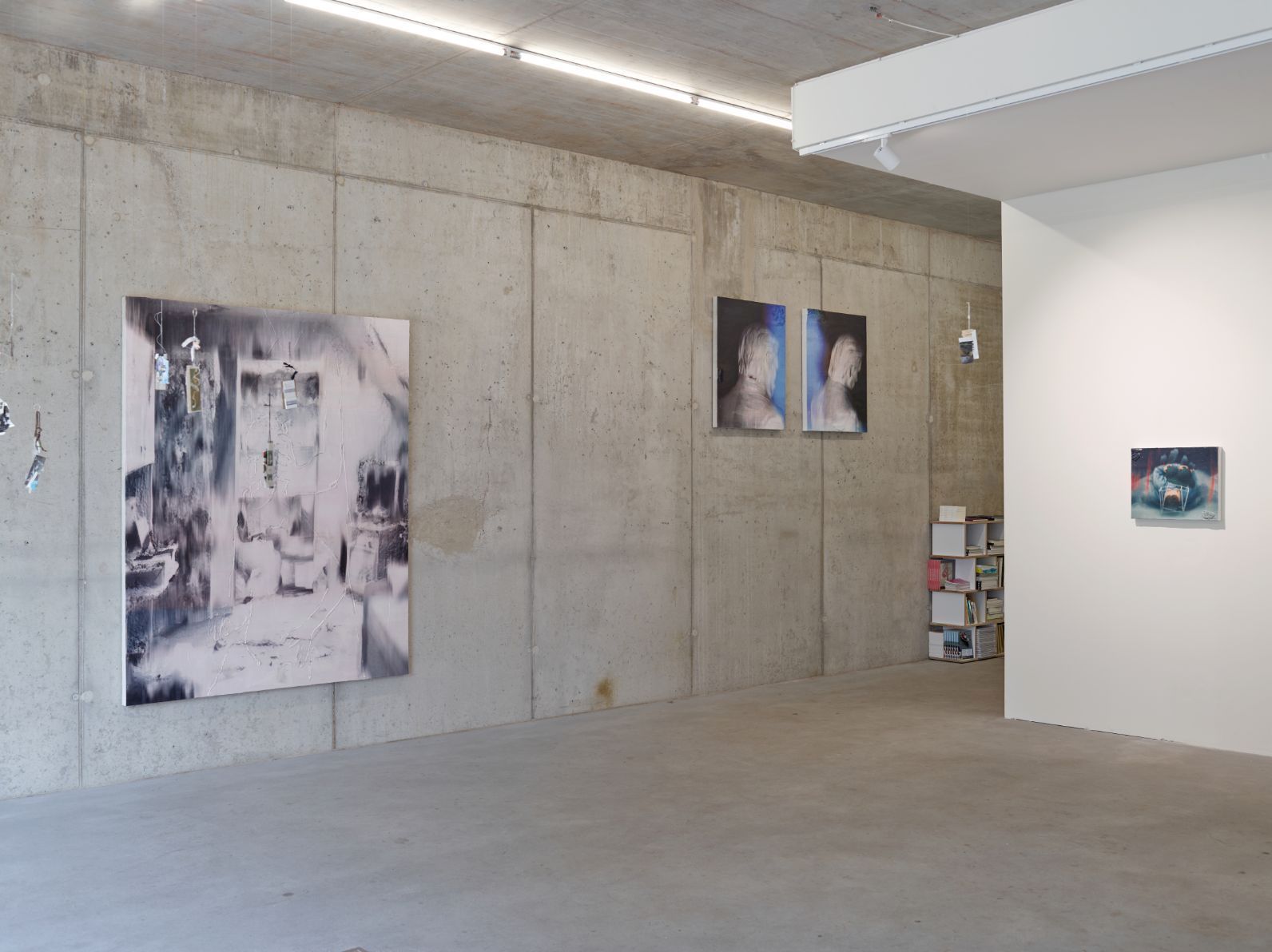
Two tall fir trees crown a steep cliff. A cheerful blue sky breaks through the clouds, and the reflection of the waning sun shimmers across the mountain range. But it has cracked in two, with rubble lying deep below. The sublime natural scenery is tragically divided, and with it the fragment of an image of a kissing couple, woven into the turbulent landscape. Idyll and apocalypse merge in Philipp Fürhofer’s painting Breakup. The title also reflects this ambivalence, as in German, it can be translated as both “departure” and “rupture.”
Creation and decay: The work of German artist and stage designer Philipp Fürhofer, born in Augsburg in 1982, revolves around the contemplation of the eternal cycle of genesis and mortality that shapes humans, creatures, and nature. His visual hand is unique, combining painting and stage design, the creative spheres of the experimental and the theatrical. In 2002, he began studying painting at the Berlin University of the Arts under Hans-Jürgen Diehl, becoming his master student in 2008. Through theater director Hans Neuenfels, he came to opera, his second great passion, initially as an assistant for set design.
He has since enjoyed an international career in both fields. He designs stage sets for opera productions in Salzburg, Bayreuth, and Copenhagen. One of the major works in this exhibition, the triptych Untitled, was previously shown in the acclaimed show “Eccentric. Aesthetics of Freedom” at Munich’s Pinakothek der Moderne. A new, monumental installation, Phantom Island, will be on view in September at the Kunstmuseum Wolfsburg in an exhibition entitled “Utopia. Right to Hope”. Fürhofer has also designed institutional exhibitions – such as a travelling retrospective on the legendary couturier Thierry Mugler.
“What is real, what is illusion? That’s the question that preoccupies me,” he says. “There is not just one reality, but many. In that sense, illusion is also a reality.” The artist treats realities, be they physical, emotional, intellectual, spiritual, or imagined, as equals: an elementary insight, since we constantly move between them in order to survive. Through his use of glass as a medium and his painting process, Fürhofer renders the interplay between, and the juggling of, our multidimensional existence literally transparent. He layers and blends his motifs, allowing them to flow into one another and interpenetrate. This results in micro-macro-cosms “in which the individual unfolds as part of the whole. All is in everything.”
Thus, in paintings such as Overlap, Fade, and Cross-Fading II, the viewer’s gaze oscillates between natural and artificial elements – tree trunks, branches, leaves – and intercepts the words that are tattooed onto them, mounted next to or behind them – sexy, love, f*ck – much the way they constantly bombard the retina and brain as triggers for consumption. Nature seems perceptible only as a cliché, as a marketing backdrop for the commercialization that absorbs everything, including our bodies and souls.
Philipp Fürhofer conveys our entanglement in our projections of nature and (consumer) culture even more intensely with his luminescent acrylic light boxes, which he calls “illusion machines.” In the aforementioned triptych Untitled, light pulsates from LED tubes mounted to the back of the light box in “on-off” mode, controlled by a switchbox. The effect is hypnotizing, captivating the viewer’s perception and drawing the gaze to a lovely forest clearing with a pond. In rhythm with the light, collaged elements of human body parts and organs appear in the landscape, as well as the fragment of a sensuous mouth.
An effect of infinity is created – until slowly, the light fades out. Utopia turns into dystopia, like a pendulum, again and again, because one presupposes the other. We must learn to break free from promises of every kind, as they remain stuck in ideological, divisive frameworks of either-or and argue in terms of enemy images of good and evil. Instead, we need to come to a balanced way of thinking within structures of both/and. It is never static, but in floating motion, a balance of the coming-into-being based on empathy. Philipp Fürhofer’s oeuvre brings this balance to mind. It offers us images in which nature and culture are constantly reconciled in a healing process that continually renews itself.
—Eva Karcher