Ended May 28
Chino Amobi
Sextant
Apr 9 – May 28, 2022
More from Chino Amobi on Gallop
Fitzpatrick Gallery is pleased to present the first solo exhibition of Chino Amobi in Paris.
Born to parents of Nigerian descent in the American south (b.1984, Tuscaloosa, Alabama), Chino Amobi bridges the fields of contemporary art, electronic music, literature, film and fashion with experimental ease. Working across these platforms enhances the richness of each medium; indistinguishable, they dissolve together in unity within the exhibition space.
Amobi’s science fiction narrative, Eroica, a thriller in the Epic tradition, situated between history and myth, unfolds as a cinematic Gesamtkunstwerk within an immersive maximalist stage. Written in the style of a cyberpunk genre, with references to historical nonfiction, folklore, and urban fiction, Eroica opens with a missing person’s report detailing a disappearance under unusual circumstances in New Tibet. In light of the evidence, Amobi’s disappearance is alleged to be a case of onticide — an act of de-subjectification. With sections of the book written entirely in Mandarin, Sanskrit and graphic codes, Amobi situates the reader in a time and place beyond the comfort of an accessible Western vantage point.
The pilot for the first volume of Eroica, directed by Nathan de Paz Habib, introduces the audience to the novel. The opening scene is set in a nondescript basement with an investigator receiving a report for a missing person. Through his investigation, he discovers archives that confirm Amobi’s death from onticide. What follows are a series of flashbacks held within an atmosphere of tension and suspense, revealing the protagonist’s journey.
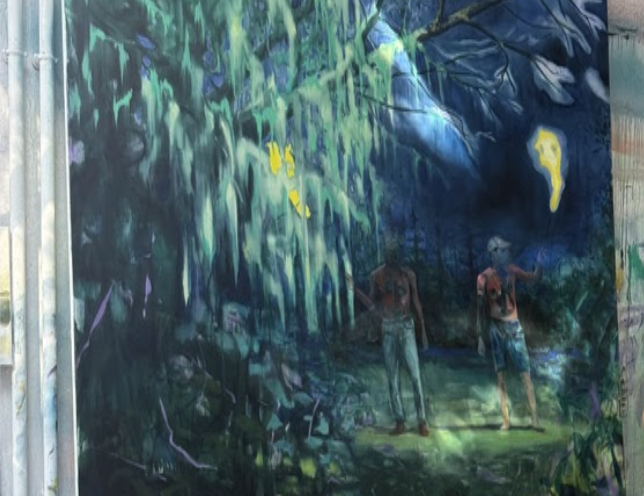
Drawing from his personal experiences and encounters, Amobi’s phantasmagoric portraits and landscapes dissipate onto his nocturnal canvases, hovering over planes of light, technology, nature, and the cosmos. This metamorphosis evolves within a sanctuary where the awakening of new bodily sensations unfolds. Through the myth of Eroica, Amobi reevaluates our ontological relationship with habitable space as a place of cosmogonic immersion; breaking with the subjective isolation of the body and attempting to reconnect to the cosmos through the geography of the intimate.
"In the firmament that we observe at night, the stars shine brightly, surrounded by a thick darkness. [...] What we perceive as the darkness of the heavens is this light that, though traveling toward us, can not reach us, since the galaxies from which the light originates move away from us at a velocity greater than the speed of light. To perceive, in the darkness of the present, this light that strives to reach us but can not- this is what it means to be contemporary."
—Agamben, G. (2009). What is an apparatus?: And other essays. Stanford, California: Stanford University Press.
Underscoring the collaborative scope of the Eroica project, Amobi conceived new garments in partnership with designer Karolina Widecka, and photographed for the exhibition by Marc Asekhame.
The scenography was designed under the direction of Maria Fontenele-Reis, with the generous support of the Milan-based furniture collective NM3’s loan of custom-designed pieces, and loans from the collection of Yves Marbrier and Liyu Yeo.
The artist would like to additionally thank Dan Demarre, Chichi Amobi, and Lilian Amobi.
—
Video Credits
Written and directed by
Nathan de Paz Habib
Photos in the exhibition are made by
Giovanni de Mojana
Starring
Chino Amobi
Shi Yang Shi
Delma Pompeo
Kal dos Santos
Benit Alagbe
Produced by
Fitzpatrick Gallery
Basement HQ
Executive Producer
Robert Okuda Fitzpatrick
Francesco Crespi
Cinematography
Andrea Munafò
Editor
Jacopo Ramella Pajrin
Music
Chino Amobi
John Utterback
Production Manager
Alice Bergamin
Visual VFX
0608
Sound Design
Andrea Sabbatini
Set Designer
Marco Monto
Set Designer Assistant
Adelaide Balsari
Costume Designer
Sara Pamio