
Exhibition · Jocelyn Wolff
Imre Pan
A European Artistic and Publishing History in Paris in the 1960s
Mar 3 – Apr 20
About the show
Arcay, Geneviève Asse, René Bertholo, Juhana Blomstedt, Paolo Boni, Christine Boumeester, Colette Brunschwig, Camille Bryen, Marcelle Cahn, Lourdes Castro, Serge Charchoune, Corneille, André Cottavoz, Sonia Delaunay, Yves Deloule, René Dérieux, Jacques Doucet, Gonçalo Duarte, Georges Foissy, Marc Giai-Miniet, Henry Goetz, Etienne Hajdu, Maurice Henry, Harold Hooper, Marcel Jean, François Jousselin, Ida Karskaya, Peter Klasen, Eva Landori, Jean-Etienne Legros, Milvia Maglione, Jacques Mandelbrojt, André Marfaing, Roberto Matta, Richard Mortensen, Aurelie Nemours, Imre Pán, Armand Petitjean, Nono Reinhold, Judit Reigl, Pierre Skira, Árpád Szenes, Victor Vasarely, Jacques Villon, Hugh Weiss
"We will show the unknown avant-garde."
—Imre Pán
“Looking back on my life from the platform at Gare de l’Est, I realise that it has been one of constant preparation and anticipation. I waited for the day to come, which in the country I come from is always tomorrow, until suddenly yesterday was no longer an option [...]. I have arrived in Paris, in the present. It is Monday morning, May 5th, 1957: the first day of today,”[1] wrote Imre Pán at the beginning of his “Paris Journal”.
May 5th, 1957... A train from Budapest, where Imre Pán was born in 1904, entered Gare de l’Est under the great glass Art Deco roof. It was a definitive departure and a new beginning, which he had waited for, desired and intended. The suppression of the student and worker uprising of October 1956 against the Hungarian Stalinist regime, violently crushed by the intervention of Soviet tanks, had once again left Imre Pán facing State coercion[2] and a ban on practising his “profession”: writing. Freedom was not an option, in fact, it was a vital necessity for this poet and intellectual who, since the early 1920s, had been one of the leading figures of Hungarian modernity and of the active circles of Budapest’s liberal and avant-garde intelligentsia, closely linked to Dada and the European surrealist movement in Vienna, Berlin and Paris.
Pán was the creator of literary and artistic magazines and journals linked to the Dadaist and surrealist avant-gardes in the 1920s and 1930s (IS, in 1924, of which Jean Arp was one of the contributors; Index, in 1931), a contributor to the famous Dada magazine of the MA group, founded in 1916 by the Hungarian expressionist writer and painter Lajos Kassák (1887-1967), and then to the magazines Munka (1926) and Dokumentum (1927), also edited by Kassák. Pán pursued multiple activities, becoming a film critic as well as an art and literary critic, an exhibition curator, and the director of a bookshop-gallery from 1935 onwards, which became one of the main artistic and intellectual centres of the Hungarian capital until the outbreak of the war, and again between 1945 and 1948.
It was in the reopened space of this gallery, teeming with projects and debates, that Imre Pán invited Jacques Doucet, an unknown young French surrealist painter, to exhibit his work in July 1947, followed in September of the same year by a presentation of works on paper by the equally young Dutch painter Corneille. In 1948, both artists were co-founders of the short-lived but effervescent CoBrA group in Paris. Imre Pán’s choices underscored his desire for new expressive forms using unusual materials and for artistic discoveries which nevertheless did not radically break with the previous generation, and which initiated his links with France. During the same period (1945-1948), Pán founded the European School in Budapest with a number of intellectuals, writers and artists, including the philosopher and art theorist Árpád Mezei – his older brother.
As a place of encounters and exchanges, the European School welcomed the diversity of the avant-garde movements of the first half of the twentieth century, from abstraction to surrealism, from expressionism to constructivism. It would also organise major exhibitions (including one devoted to Paul Klee in May 1947), publish theoretical books about art, engaged in dialogue with all cultural forms and practices, and was open to the new aesthetic influences emerging in post-war Western Europe. The European School was dissolved in 1948 and the gallery closed when a Stalinist cultural policy was put in place by the literary theorist and Marxist philosopher Georg Lukàcs, who accused Pán of championing “Western formalism[3].”
As an immigrant in Paris, Imre Pán had a hard time making a living but he tirelessly criss-crossed the city, visiting studios, artists and galleries, (re)weaving an artistic, poetic and critical network. The witness accounts converge, in particular the one given in 1996 by his future wife Mireille, an art enthusiast who met him in September 1957 in the company of the Russian-born painter Karskaya, who had emigrated to Paris in 1924: “As soon as he had settled into a modest hotel on the rue de Crimée, Pán set off in search of his peers, long- time friends such as Jacques Doucet, Corneille and Marcel Jean, or people he knew through their works (surrealists in particular). As a universalist, he never limited his relationships to the Hungarian colony in Paris. His passion for poetry and above all for painting, which was ‘in the making,’ drove him to walk the streets of the capital and its suburbs, climbing stairs, visiting studios and attics, often sharing what little he had (he himself lived on less than nothing) with the most destitute artists [...]. At night, in his room, he wrote: in addition to his Paris journal, letters, poems, short stories, studies and prefaces for the exhibitions he organised at the Galerie La Main Gauche, run by Otto Hahn[4]”.
In February 1958, Pán presented his first exhibition in Paris – Miroirs de papier – at the Galerie La Main Gauche, run by the Hungarian-born art critic Otto Hahn, who had fled to Paris in 1937. Hahn was an advocate of the Nouveaux Réalisme, Conceptual Art, Pop Art and Figuration Libre. Although the four exhibitions that Imre Pán organised in this gallery enabled him to quickly establish himself at the heart of one of the Parisian art scenes, his choices paradoxically revealed a singularity that took little account of emerging trends and movements. Miroirs de papier celebrated drawing and its surfaces of inscription, bringing together artists of different generations and aesthetic commitments spanning the arc of modern art from the 1910s to the 1950s, whilst preserving a formal continuity: on the one hand, Jean Arp, Hans Bellmer, Georges Braque, Fernand Léger, Max Ernst, Natalia Goncharova, Mikhail F. Larionov, André Masson, Francis Picabia, Yves Tanguy; on the other, Corneille, Jacques Doucet, Karskaya, Árpád Szenes, Maria Helena Vieira da Silva; as well as Hungarian artists such as Étienne Hajdu and Margit Anna. Plurality was asserted. The collective was asserted. The influence of abstraction and surrealism was reasserted. To look at a work, was to look through the infinite possibility of connections and disconnections, discordances and correspondences. For Imre Pán, showing also meant, in an expression that marked this historic period, “raising the question of the coexistence” of positions, practices, “styles” and artistic gestures. In June 1958, when he opened the thematic exhibition Les Partenaires artistiques, he knowingly[5] broke new ground by showing pairs of artists and the reciprocal influences that might – or might not – be revealed in their respective works. The same names were featured, with a large number of women artists: Jean Arp and Sophie Taeuber-Arp, Sonia and Robert Delaunay, Christine Boumeester and Henri Goetz, Hans Bellmer and Unica Zurn, Loïs Frederik and Gérard Schneider, Picasso and Françoise Gilot, Hajdu and Luce Ferry, Árpád Szenes and Maria Helena Vieira da Silva. Imre Pán looked at everything, with a form of humanist indistinction.
Pán continued his work as a curator throughout the decade, in the form of occasional collaborations: with the Galerie Denise René in 1960 (for the first French retrospective devoted to Lajos Kassák), with the Le Point Cardinal gallery (1961-1963) where he presented collages and works on paper by Victor Vasarely, prints by André Marfaing, drawings and washes by Corneille, and the work of Roberto Matta. In June 1962, he exhibited drawings and collages by Marcelle Cahn at the Galerie Mesure, which was associated with geometric abstraction. He began a long collaboration with Cahn as part of the publishing programme he had begun in 1960. In spring 1963, he published an article on “Les collages de Marcelle Cahn” in the poet Henri Chopin’s magazine Cinquième Saison, devoted to experimental poetry and a contemporary rediscovery of the early avant-garde. The magazine also featured Aurelie Nemours, who, with Pán, produced her first and – almost – only collages, in 1965 and 1968, as well as artists such as Lourdes Castro and René Bertholo, friends of Imre Pán with whom he worked regularly having collaborated on the magazine KWY that had been created by the two Portuguese painters in 1958.
From the early 1960s onwards, Imre Pán was part of an artistic scene that combined visual and poetic experimentation, strove to break down the boundaries between the arts and reconnected with the Dada and abstract movements of the first half of the twentieth century.
Like many European and non-European artists who settled in Paris at the end of the Second World War, and “nowhere else[6]”, for political and/or artistic reasons, Imre Pán saw the city in the early 1960s as the “cosmopolitan capital of the arts” and a transnational laboratory for the modernist avant-garde. New York was not on the horizon.
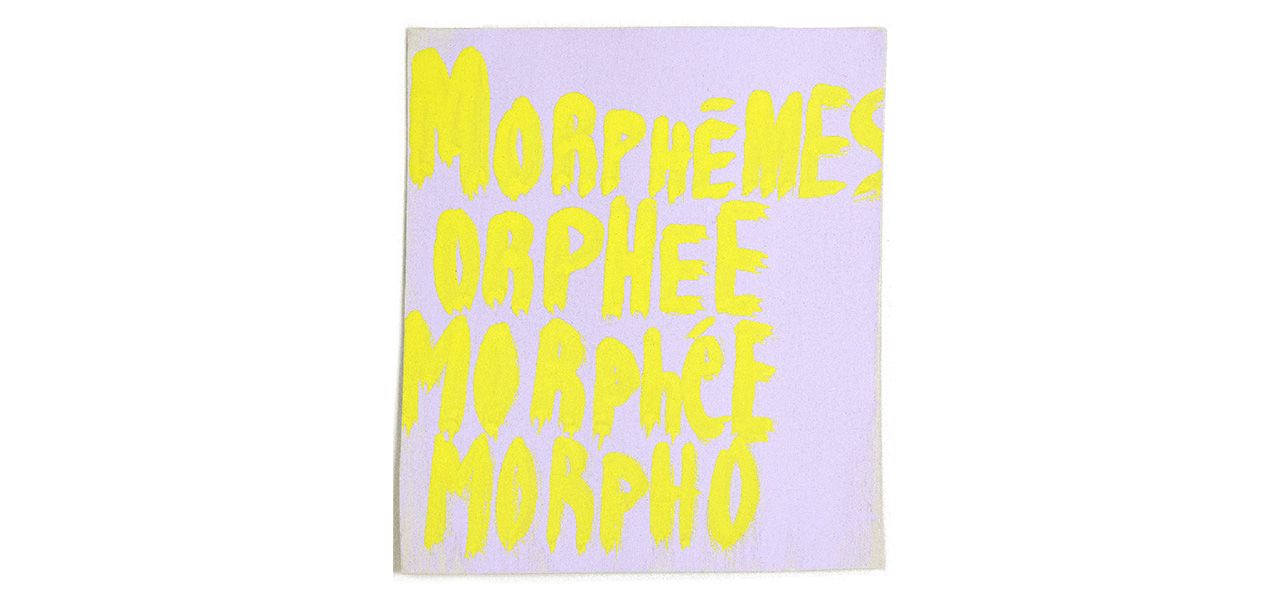
Paris was the home of “contemporary artists”, and Imre Pán made himself the conduit, the messenger and the poet of these aesthetic and formal singularities through what can be considered his “great work,” which he continued until his death on March 4th, 1972: the Signe editions (1960-1964), then the Morphèmes editions (1963-1970), which gave rise in 1971 and 1972 to the Mini-Musée, then Préverbes, the last review imagined by Imre Pán. Over a period of ten years, around 150 publications were designed, produced and published. For the first time, almost all of them will be shown together at the Galerie Jocelyn Wolff.
The editions – Signe, Morphèmes and Mini-Musée – take the form of notebooks on Arches wove paper, in different formats depending on the series and sub-series they comprise, containing a printed text (a study by Imre Pán in the majority of cases, but also texts or poems by artists, including Vasarely, Robert Delaunay, Aurelie Nemours and Colette Brunschwig) and an original work by the artist on a loose page, usually numbered and signed: drawings, etchings, collages, watercolours, inks, gouaches, screen prints... These editions were real and ongoing collaborations with artists whose work Pán appreciated and accompanied as closely as possible. Within them, he allowed a wide range of visual choices to “coexist”: geometric and concrete abstractions – with Marcelle Cahn, Aurelie Nemours, and Sonia Delaunay –, optical abstractions – with Vasarely or Juhana Blomstedt –, “vibratory” and monochrome works – with Geneviève Asse –, or informal ones – with Karskaya, André Marfaing, Colette Brunschwig, Harold Hooper, Charchoune – as well as post-Surrealist figurations, narrative figurations or ones connected to the Nouveaux Réalistes – with Camille Bryen, Lourdes Castro, René Bertholo, Gonçalo Duarte, Milvia Maglione, Lucio del Pezzo...
These editions, whose titles seem to resonate like “manifestos” referring either to the linguistic or the visual element, to presence and alertness (for Signe), or to the constitutive and primary form, to poetry, and more distantly, to the indeterminate orphism of Apollinaire and the Delaunays (for Morphèmes), established a visual cartography, unfolding in a rhizome-like morphology. They were both visual and textual labyrinths, based perhaps on the experience and practice of collage, in the memory of Kurt Schwitters[7], and a profuse and repetitive surface-place within which Imre Pàn invites us to read as closely as possible into the typeset text and the materiality of the work. They reveal the geography of Parisian art scene that was rich, plural, active and committed – but which sank into oblivion from 1975- 1980 onwards – interweaving gestures and materials.
The central notion of the small format, which Imre Pàn was to develop in the same way in his group exhibitions Zéro-Point I, II, III, IV at the Galerie La Roue between 1966 and 1970, was not simply a resistance to what he perceived as the new monumentality of contemporary works, but also the perpetuated possibility of the manoeuvrability and flexibility of the gaze in relation to a drawing, a collage, a painting, an etching... It was about seeing what happens inside a drawn or engraved line, a blur, a coloured or black-saturated shadow, a white relief form, a cut-out, a colour.
Imre Pàn’s work is an infinite proposition, open to a modern sensibility and a desire for philosophical and poetic knowledge. Imre Pàn was also an artist.
—Marjorie Micucci
1 - The Hungarian parts of the typescript of the “Paris Journal” have not been published or translated. The journal covers the years 1957-1972. See Julia Cserba, “Life in the Service of Art: a Portrait of Imre Pán (1904-1972),” in Always Hungarian. Hungarian Jewry through the Vicissitudes of the Modern Era, edited by Guy Miron, Shlomo Spitzer, Anna Szalai, Bar-Ilan University Press, Ramat Gan, 2021, p. 175.
2 - A victim of the numerus clausus introduced in 1920 by Miklòs Horthy’s authoritarian and nationalist government, which limited access to university for students of Jewish origin, Imre Pàn was forced to earn his living as an office worker, unable to pursue university studies.
3 - From 1948 to 1956, at the height of the Stalinist period, Imre Pán was banned from working as a writer and was forced to work as a stock clerk in a state-owned bookshop and write tourist guides.
4 - Mireille Pán, catalogue of the exhibition Imre Pán. Portrait d’un poète-éditeur d’art, Musée-bibliothèque Pierre-André Benoît, Alès, March 22nd – June 9th, 1996.
5 - “(...) The works of these artistic partners constitute an as yet unstudied aspect of the history of modern art. The sole aim of our exhibition is to highlight this fact.” Imre Pán, presentation text for the exhibition Les Partenaires artistiques, Galerie La Main Gauche, Paris, June 13th – July 1st, 1958.
6 - In reference to the exhibition Paris et nulle part ailleurs. 24 artistes étrangers à Paris. 1945-1972, Musée national de l’histoire de l’immigration, Paris, September 27th, 2022 – January 22nd, 2023. Curated by Jean-Paul Ameline.
7 - In his presentation of the Morphèmes editions, Imre Pán quoted Kurt Schwitters: “We have no style, but we do have a training principle, said Kurt Schwitters. The pages of Morphemes are devoted to the elabroation of this principle"
About Jocelyn Wolff
Based in Paris, Galerie Jocelyn Wolff has been promoting a rigorous and committed vision of contemporary art for over twenty years, supporting emerging artists while fostering the recognition of historical figures. The gallery has developed an artistic program guided by progressive aesthetic values, encouraging the circulation of both artworks and ideas.
More about Jocelyn Wolff →