
On view
Herman Cherry
How the River Flows
Sep 10 – Oct 10, 2026
"I do not know much about gods; but I think that the river
Is a strong brown god — sullen, untamed and intractable,
Patient to some degree, at first recognised as a frontier;
Useful, untrustworthy, as a conveyor of commerce;
Then only a problem confronting the builder of bridges."
—T.S. Eliot, The Dry Salvages, 1941
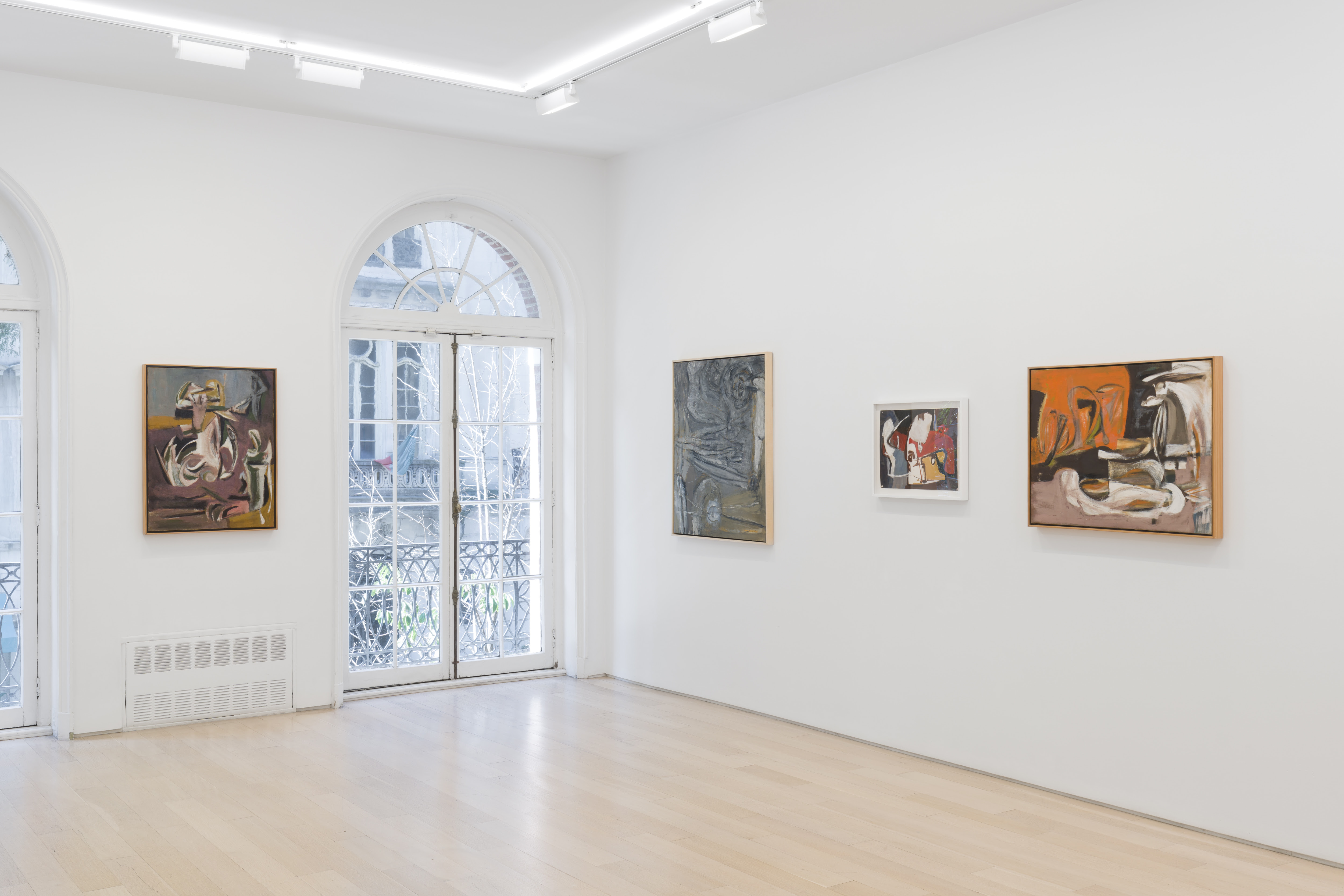
Herman Cherry’s River Series, produced in East Hampton in 1970, reveals through color the roads, frontiers, and sinuous paths life unfolds and undertakes. Now exhibited for the first time at Shamnoski Gallery in New York City, in parallel with Sebastian Gladstone in Tribeca, this singular series finally brings to light Herman Cherry’s decades-long bicoastal oeuvre. These paintings come as a sublimation of Cherry’s travels, discoveries, and networks — the connections he made between movements, forms, colors and people — through the years which saw abstract art evolve from being an imported idea to becoming a flagship of American identity.
A lesser-known survivor of the New York School, Herman Cherry (1909-1992), whose career first began in Los Angeles, was an enthusiastic contributor to the blossoming of abstract art in America. Born in Atlantic City to Russian-Jewish immigrants, he grew up in LA and snuck his way into art classes, joining the Otis Art Institute where he studied under Synchromist Stanton MacDonald-Wright and later at the Arts Students League. To escape poverty as a young man he worked odd jobs: as a seaman on ships to Europe where he caught a glimpse of its impending fall, and also at the Stanley Rose bookstore where he created a space for his fellow artists — namely Philip Guston, Fletcher Martin, Reuben Kadish — to convene and exhibit. He later worked as a mural assistant to Thomas Hart Benton in New York and under the WPA program during the Great Depression. He was a true artist of that time, a “malcontent,” as he later said, “which was partly [the artist’s] role… [not] because he was a cynic or unhappy… just that he refused to accept anything until he discovered it for himself. And when he discovered it, it usually was quite different than anybody else's discovery.”
Cherry’s sense of adventure, a common trait in these mavericks of the American avant-garde, is marked by his elaborate use of color. Under his mentors MacDonald-Wright and Benton, who had both studied among the Cubists and Orphists in France, Cherry began experimenting with abstract forms in the 1940s and with notable success — shown at the Weyhe Gallery, the Stable Gallery and participating in several Whitney Annuals in the 1950s. His earlier works inform the matured shapes we see in the River Series. His early paintings were still about something, they used abstraction as a medium, an experimental method. When asked about the title for this series, Cherry answered it “has nothing to do with the river; I don’t know where I got the image,” that the paintings “seemed to have a free flowing thing.” Though these works may look like something — rivers, islands, frontiers — they are immediate, direct, they feel unconscious, primordial, pure, and hence are truly abstract.
Like the river itself, the paintings flow; they reflect geographic dimensions that are internalized and external to us; they meditate. During his travels in France in the 1940s, Cherry met Abbé Breuil who brought him to the Lascaux Caves, which inspired a series of “Black” paintings in the following decade. This experience seems to find its way through the River Series as well.
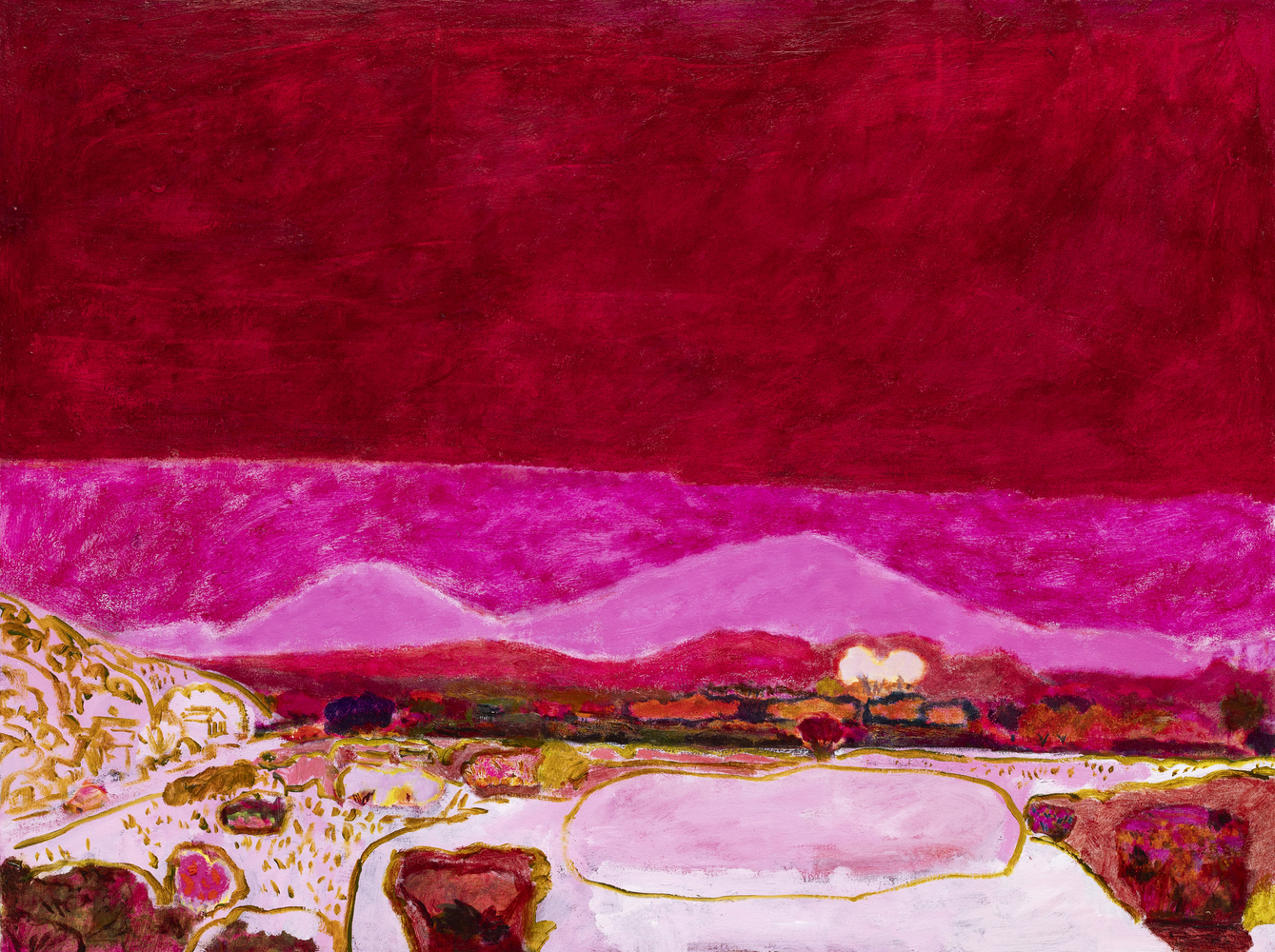
Though the series is in no way figurative, the curved lines, sometimes connecting one corner of the canvas to another or looping within itself, reflect in their simplicity these awkward, developing, primal shapes one can visualize in pre-historic art. There is something very innocent about these lines, drawn against white space, almost schematically, like islands reaching for each other or lakes forming in an empty plain. They seem to dance at their own accord, winding to and fro organically. The drawings in felt pen and wax crayon are more rugged, the strokes visibly filling in the negative space with a rhythmic frenzy in rustic colors — brown, green, gray or blue. They echo the organic ripple that takes place in his smaller watercolors, which let the fluidity of its material take charge.
The paintings flow and yet, unlike most action paintings of his generation, they are contained, controlled, limited. With visible mastery, Cherry integrates these wild patterns into a sensitive standard, repeated and adapted to its medium — oil paint, watercolor, wax crayon — and size. In Watercolors #9 and #10, the trio of lines is omitted for a stark contrast of color that cracks open, revealing a core; together, the paintings exist almost like verses to a villanelle of color and contrast. An avid poet who wondered why, with all his travels and stories he hadn’t become an author, Cherry finds more rhythm and words in these paintings that reflect a devised impromptu, a thoughtful trance.
The River Series may reflect those roads, cliffs, oxbrows and frontiers that Cherry traversed, by sea and air, seeing the paths that were naturally formed by humankind’s interaction with its environment. In The Dry Salvages, T.S. Eliot differentiates the river people, those who are mindful of nature, “sullen, untamed, intractable” from the “builder[s] of bridges” who, focused on industry, have forgotten the river and only perceive it when it is thrust upon their consciousness. Cherry’s series, which came fatefully before a self-imposed break from painting, serves as a reminder. The poetic dance of these colored shapes, delimited by their twice or three-times emphasized lines, unobstructed by reason and utility, are free, and conjure the river within us. For, “the river is within us, the sea is all about us” and as life goes on so does the river flow — our imprint on nature, the borders we build, are as changing as nature itself.