
Ended
Adam Lupton
Too Sure of the Sun
May 1 – Jun 14, 2026
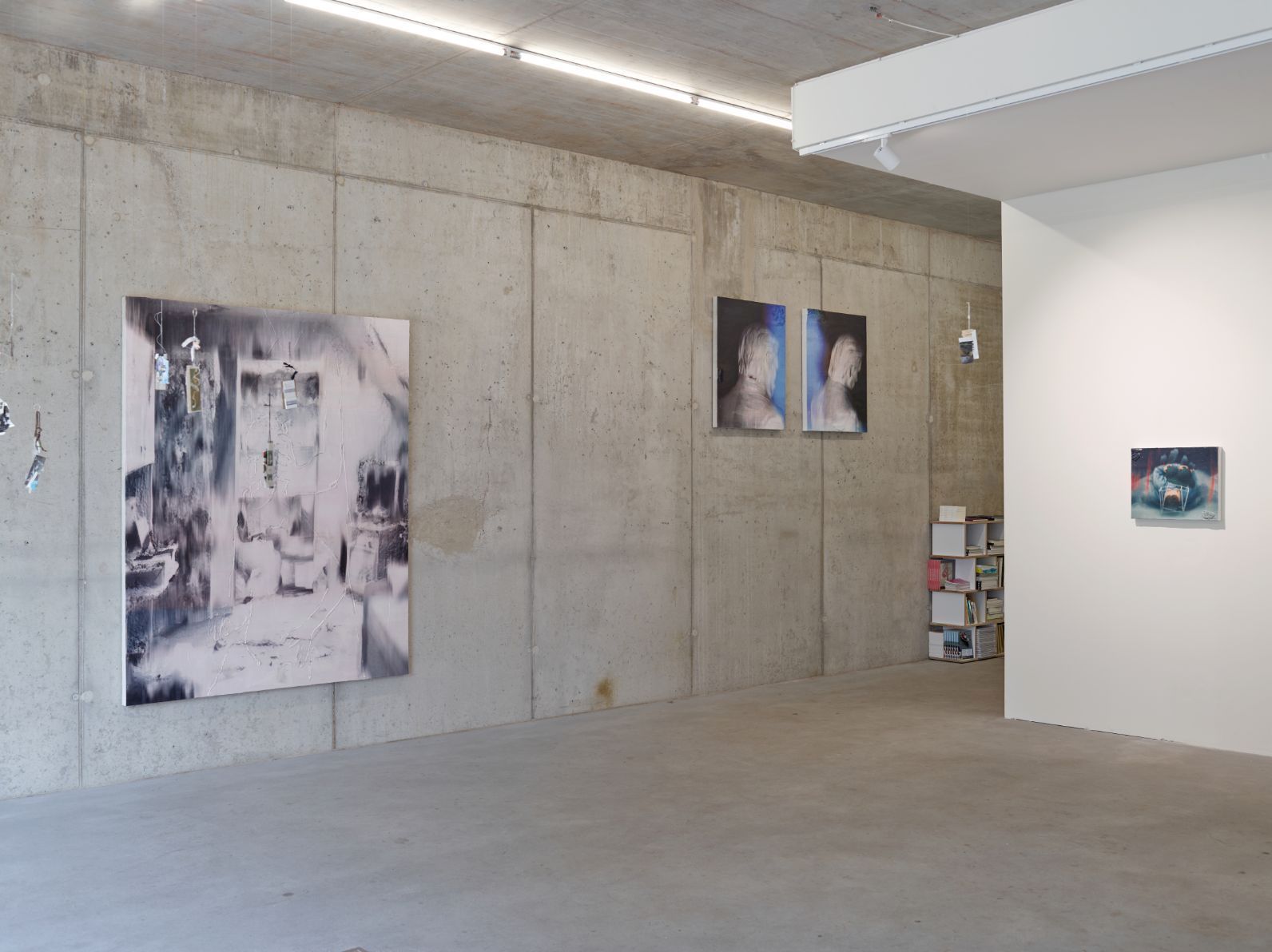
When working in his studio, Adam Lupton wears blue coveralls on which he wipes his brushes and hands. Over time, it gradually assumes the same palette as the paintings he creates. Were he to stand before one of them, he would at first glance almost disappear—only his head would remain visible.
This merging with his own paintings reveals much about his practice. His work frequently engages with his inner life, which in turn is shaped by his obsessive-compulsive disorder (OCD). On the surface, this concerns people who feel an overwhelming urge to check five to fifteen times that the stove is switched off before leaving home, who must rigorously follow rituals and rules to function in daily life. Internally, however, it concerns far more: uncertainty, control, and the perception of the self. Themes of isolation, anxiety, and the simple negotiation of everyday existence flow through the work. What we encounter in Lupton is the quiet thrownness of the human being into the world—an experience shared even by those without compulsive disorders.
Lupton’s paintings are expressions of a collective zeitgeist. The present moment is marked by anxiety and a steady loss of control, often countered by retreat into the private sphere. Accordingly, his works depict domestic scenes. As viewers, we are granted glimpses into bedrooms and bathrooms; we find ourselves seated at kitchen tables and on the edges of beds.
Formally, the figures depicted are variations of Lupton himself, yet one instinctively identifies with the body, often shown lying prone. They appear reading on the floor, on the sofa, or in the bathtub, surrounded by painted tiles on which one wrestler carries another across his shoulders (Unmoor, 2025). The nude male body in the bath automatically enters into tension with performative representations of masculinity. The protagonist lies relaxed, one leg slightly bent, seemingly studying the tiles closely—grappling with the muscular physiques he himself does not possess, and reflecting on an idea of male intimacy expressed only through combat.
Although the protagonist in Lupton’s work is formally always himself, the paintings extend far beyond the genre of self-portraiture. What these images allow is the recognition of the universal within the particular. Previously, Lupton worked with models, until during the pandemic he began to question why he was using other people to articulate his own concerns.
Since arriving in Berlin, Lupton has moved to work exclusively with two colors: blue and red. Within this self-imposed limitation lies his true freedom. For him, the real beauty resides in the challenge of working with only these two colors and discovering all that can be achieved through them.
This voluntary restriction and the intimate depiction of living spaces may be interpreted further. Our era is characterized by excess and by the continual accumulation of more, even when there is already more than enough. The objects that surround life must be organized, sorted, and maintained; one easily becomes the full-time administrator of one’s own possessions. As early as 1965, George Perec addressed this condition in his novel “Things,” and in 2022, Vincenzo Latronico revisited it in “The Perfections.” Both novels explore how consumption determines who we are, and how the objects we own come to define us.
Lupton’s paintings align with this narrative. He does not merely paint them; one might say he furnishes them. The domestic scenarios he depicts show not only a person in a familiar environment, but also aesthetic decisions shaped by advertising, by notions of belonging, and by consumption. In Roses are Red (2025), a young man rests his head in his hands, seated at the far left of the composition, while an enormous bouquet of flowers dominates the foreground. The young man is almost indistinguishable, blending heavily into the background.