
Ended
Single Channel
Jan 7 – Mar 1, 2025
Felipe Romero Beltrán, Paul Stephen Benjamin, Cristine Brache, Jen DeNike, Max de Esteban, Kim Gordon, Anuar Maauad, Emeka Ogboh
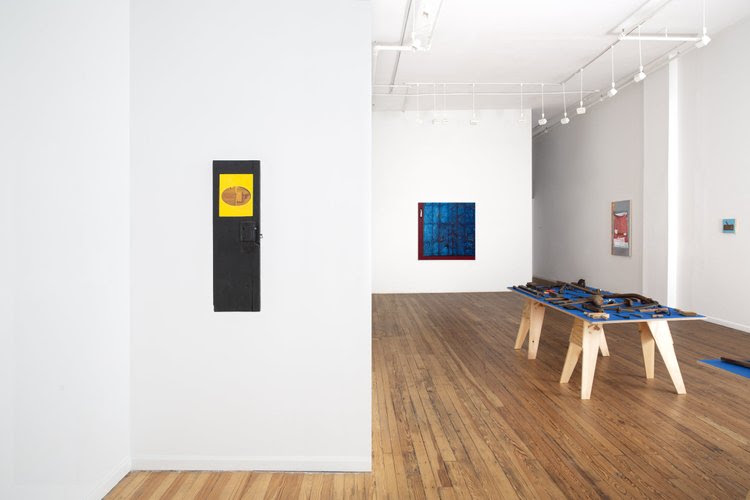
Efraín López is proud to present Single Channel, an intergenerational group exhibition featuring video works by the artists Felipe Romero Beltrán, Paul Stephen Benjamin, Cristine Brache, Jen DeNike, Max de Esteban, Kim Gordon, Anuar Maauad, and Emeka Ogboh. A satellite presentation in collaboration with O-Town House takes place in Los Angeles, coinciding with Frieze week. Single Channel is accompanied by an exhibition text authored by Lauren DeLand.
Time itself is the substance of video. The immediacy of video recording collapses imperceptibly into historicity, and the human impulse to perceive the moving image as a faithful reflection of real-world referents powerfully endures, even as we witness their unprecedented decoupling. Algorithmically generated counterfeits of nature and culture compel us to reflexively search for the differences between videorecorded referents and digital hallucinations, or to surrender to our inability to parse them, rendering us exhausted by doubt or indifferent to truth.
Nostalgia for a time when faith in the correlation between filmic images and the real seemed warranted may account for the plethora of effects that dress modern digital media in the visual hallmarks of outmoded technologies. This affinity for the aesthetics of degraded celluloid, magnetized videotape, and corrupted digital files manifests video as a ruin: a remnant of a past pinnacle of human achievement, romanticized by decay. Over the course of eight weekly rotations, Single Channel presents work by eight international artists who demonstrate how our understanding of both history and contemporaneity is shaped through period-specific technologies of the moving image.
Through the grainy, stuttering medium of Super 8, Cristine Brache's Bermuda Triangle (2022) appears to present vintage footage of a couple taking turns performing mouth-to-mouth at the edge and in the waters of a cobalt-blue indoor pool. Yet the repetition of these gestures of passion and resuscitation reveals their artificiality, just as the performer's tattoos expose their contemporaneity. The film is, in fact, a historical reenactment, bringing to life an image that for Brache crystallizes a moment before her parents' love for one another was lost.
The non-identical reproduction of reenactment is likewise the subject of Paul Stephen Benjamin's Oh Say (2016), a dissonant audio-visual collage of several renditions of "The Star-Spangled Banner" performed by several Black artists across time. Multiple, overlapping versions of the national anthem in different time signatures emit from figures rendered in chunky, pixelated greyscale, whirling across the screen in a queasy rotation. By isolating the anthem's first two words, Benjamin accentuates their ambiguity: does the song begin with a question about whether freedom still reigns in America, or does it demand allegiance to a historical narrative that omits those to whom freedom was denied? Do the iconic performances that make up this unharmonious composition destabilize, or perpetuate the dissimulations of the American origin myth?
The love story is the lynchpin of narrative cinema, and in the first half of the video dyad I LOVE YOU-FUCK ME (2024), Anuar Maauad neutralizes the genre's power to invoke desire and dedication by skipping straight to what we came to see, cycling rapidly through seconds-long declarations of love spanning decades of film, television, and children's entertainment. Devoid of context and dulled by repetition, these moments carry no emotional charge, though they represent the narrative apex of their respective stories. The verbal ejaculation of "fuck" marks a series of similarly climactic anti-climaxes that punctuate the video's second half, as penetration scenes from a wide sample of pornographic videos follow one another in rapid succession. Obscenity, according to the notoriously murky definition established in U.S. constitutional law, is defined by a total lack of redeeming cultural value: porn, in other words, is presumed incapable of communicating ideas. Maauad's pairing, however, demonstrates how easily the supposedly benign cultural texts that instruct us in romantic love are rendered meaningless in isolation. The sweaty bodies that populate Maauad's appropriated footage are often accompanied by logos exhibiting the sheer variety of channels and stimuli now available as porn is perused almost exclusively online. They also attest to pornography's uniqueness as a filmic genre dominated at every level of production by amateurs who have actively shaped the consumer landscape of moving image technologies according to the needs of their makers, and their audiences.
Jen DeNike's Girls Like Me (2006) returns us to a peculiar pre-streaming, pre-social media era of video technology, when the tools to realize a particular erotic vision were obtainable, but the channels through which such works could be distributed were few and determined by powerful commercial entities. DeNike presents three young women clad in plain white undergarments, sprawled upon a rumpled bed in an inverted triangle formation and nursing one another's toes to the bubbly strains of Bonnie Hayes's new wave track "Girls Like Me." Hovering at an intimate distance, the artist traces the contours of this ouroboros of suckling female flesh, rendered in the quintessentially sterile palette of early-aughts camcorder footage. As a relic of a time when producing and sharing noncommercial video works hinged on shared affinities, Girls Like Me poses an uneasy question to the viewer who screens it in public: do the women's repetitive ministrations "count" as sex? If indeed they do, what does it mean for the viewer to be seen while seeing these acts unfurl?
DeNike's video emerged from a moment when technologies of vision were heavily consolidated in the service of the post-9/11 state; this burgeoning culture of surveillance is in full bloom in Max de Esteban's 7 Minutes (2022), a work that exposes the modern museum as an arm of the surveillance state. Inspired by actual A.I. technologies used by an Italian museum to gauge visitors' engagement with individual works, 7 Minutes features a redheaded woman who pleads with the viewer to linger with her for the titular duration, lest she be judged as counterproductive to the institution's interests and deaccessioned. In eliciting our pity, the difference between the speaker (addressing an audience she cannot perceive) and the insentient recording disappears, proving tech-worship to be merely the latest manifestation of our primitive tendency to anthropomorphize inert objects. Meanwhile, arts institutions are so alienated from the publics they ostensibly serve that they would rather spy on them than engage in conversation, even at the cost of ceding curatorial decisions to algorithmic equations incapable of understanding the conclusions they produce.
In El Cruce (2022-2024), Felipe Romero Beltrán turns his camera on one of the most heavily surveilled sites in North America: the U.S.-Mexico border, delineated by the Rio Bravo/Rio Grande. The white nationalist rhetoric currently dominating American politics propagates itself through repeated invocations of a border overflowing with criminal migrants. Yet for Beltrán's subjects, the act of crossing, though fraught with real danger, is mundane, even routine. A man collecting clothes discarded by transients washes them in the shallows of the river, describing his process of crossing multiple times a day to gather and sell the garments. In the dispatches of mainstream American media, the border exists in a state of perpetual urgency, yet Beltrán's subjects are obliged to endure long stretches of empty time as they seek passage from one nation to the next. In a scene where believers wait idly in line to be baptized in the muddy river, even the purification of individual souls is rendered banal through repetition.
While it is tempting to interpret the Rio Bravo/Rio Grande Valley as a site where the fluidity of water overlaps the rigid fictions of national borders, Beltrán depicts a sun-scorched landscape made artificially barren through human manipulation of the waterway. Ephemeral concepts of nationhood extend into extractive policies that irreversibly reorder the natural world, as Emeka Ogboh's Àlà (2014) also illustrates. Ogboh presents the Nigerian metropolis of Lagos as a hypnotic series of mirrored images that divide like cells and collapse back into one another, vanishing at the center of the screen. We observe some of these sights over the shoulder of a driver piloting a miniature cab through the city streets, as blaring car horns and voices calling out in different languages provide a lilting soundtrack. A double portrait of an oil rig standing sentinel against a grey sky reminds us that the industry fueling the vehicles that transport us through these scenes is the very same that reshaped the economic and environmental landscapes of Nigeria through 20th-century campaigns of European conquest, with reverberating effects today.
Kim Gordon's 12341 Branford St. Sun Valley, (2022) opens with a view of a barren landscape, the atmosphere thick with blowing dust, partially framed by hedgerows of junked cars stacked three deep. Gordon emerges from the labyrinth of twisted metal with an electric guitar, which she brings screeching to life by bowing the instrument against the wreckage, prodding the vehicles' interiors through busted windows and rocking the body of the guitar against their dented exteriors with the force of her pelvis. Gordon thus establishes herself within a long tradition of noise musicians who draw from the soundscapes of urban life and its disasters, beginning with the intonarumori crafted by the Italian Futurist Luigi Russolo to imitate the shattering sounds of traffic collisions. In this hot, dry wasteland on the sprawling outskirts Los Angeles, a city of cars, the relationship between this lifestyle and climate catastrophe is inescapable. Gordon, however, finds generative potential in these apocalyptic environs, as the ruin's decay proves as fecund as ever.
Through their unflinching engagement with forms of video that are either marginalized, maligned, or malignant, the artists of Single Channel reveal how moving images fundamentally inform our collective notions of what constitutes "real" sex, citizenship, and history—and who and what is excluded from consideration.