Ended
Flesh & Flowers: Made In America
Oct 15, 2023 – Jan 19, 2024
Patricia Ayres, Justin Chance, King Cobra, Karon Davis, Dana DeGiulio, Louis Eisner, Sable Elyse Smith, Rubén Esparza, Nash Glynn, Sayre Gomez, Alfonso Gonzalez Jr, Dan Herschlein, Elliott Jamal Robbins, Dominique Knowles, Brandon Ndife, Celeste Rapone, Paris Reid, Rachel Rossin, Hiba Schahbaz, Diamond Stingily, Willa Wasserman, Chloe Wise, Nicole Wittenberg, Coco Young
Curated by Lauren Taschen
Il était une fois, if you wanted to epitomize all 50 of the United States with one, you might condense them down to something like Illinois or Ohio — one state somewhere in the middle that could symbolize the liberal city and conservative country.
But in today’s topsy-turvy Etats Désunis, where red and blue coagulate instead of bleeding into purple, where little lies can grow up and become the truth, only one state can truly represent.
Lovely, sunny Florida — the pistol-shaped paradox. Home of suntanned sybarites and conservative Christians. Where coral flamingos and ivory storks tiptoe past green-black alligators (and now caramel-brown pythons). Where the flowers are big as Texas and bright as Vegas — three-meter water lilies, orange-pink hibiscus, red-purple bougainvillea, orange-blue birds of paradise. Beautiful to the eye but sharp to the touch —in in this yin-yang of heaven and hell, even the lush carpets of emerald grass are prickly underfoot. Here, the moral high ground is in a dangerous flood zone. Books and abortions are banned by politicians waving the flag for freedom. Sexual and racial identity is silenced, so religion can turn up the volume, so no one can hear the gunfire.
Nowhere else in America are flesh and flowers and feelings so florid, and nowhere else can the color red mean so much. Beauty. Violence. Blood. Anger. Youth. Love. War. Heart. Wealth. Passion. Liberal. Poverty. Conservative. Death. Indulgence. Religion. Meat. Sex. Fruit. Flowers.
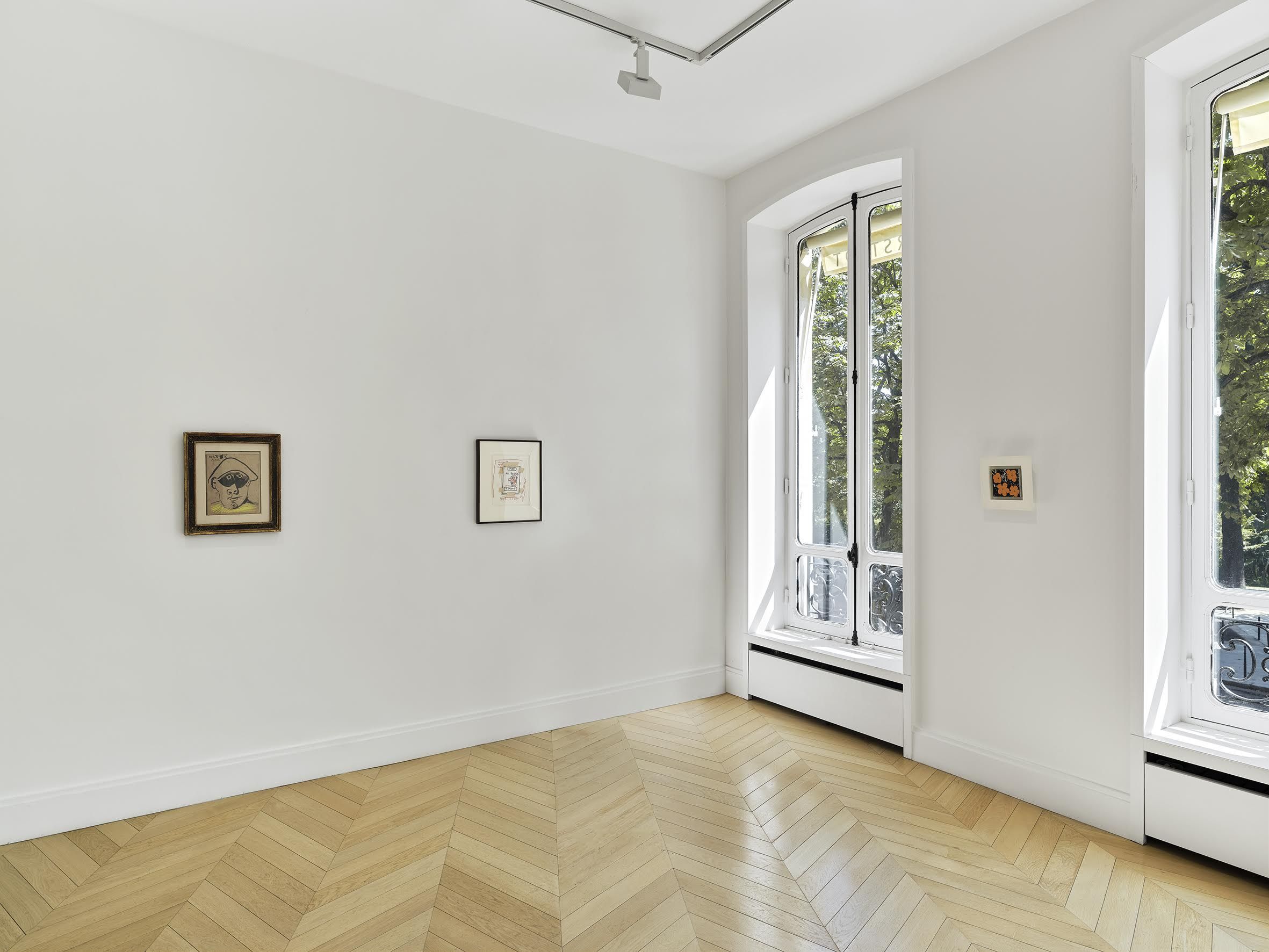
And these cultural clashes are all represented at Flesh & Flowers, Made in America, a subtly inflammatory show of 24 America artists at the innovative No Name Creative Projects, the year-old alternative art space at 3 Place de d’Alma in Paris’ 8th arrondissement.
It would take a native to really understand Florida’s full spectrum down to the bone — you won’t get it from a sunny weekend escape there once a winter. So it makes sense that the show’s curator, the Los Angeles-based collector and curator Lauren Taschen, a native Miamian who worked on the 2001 inception of Art Basel Miami Beach and knows full well everything the state holds and how it reverberates in states throughout the country.
Taschen’s thoughtful bridging of cultured sensibilities with cultural sensitivities is immediately apparent in one of the show’s focal points: a grotesquely beautiful hanging carcass of fleshy whites, pinks and reds. Made by the Brooklyn artist King Cobra, the piece is nothing if not complicated. It is made of silicone and urethane foam, streaked with red hair, colored with tattoo ink and bedizened with crystals, beads, pearls and cameos. It’s clashing with meanings, summoning both the dehumanization of Black bodies and the white bodies responsible for it, from the horror of butchery to the careful, costly gentility of self-presentation; it’s a representation of the art of the denial that lives in all of us.
Justin Chance, another young Black New York artist who warps the traditional crafts of quilting and hooking to his own comfortably disturbing ends, contributed a deeply sanguine piece: a scarlet handsewn quilt made of old-school materials like felted wool, silk and cotton. At first glance, the wall piece suggests a lost evening dress or a pleasant old bed, but a second glance suggests a mass of blood-soaked bandages. Chance’s nostalgia cuts deep.
Chance made another bittersweet totem: an electric box fan whose grill he lovingly hand-knotted a kind of yarn rug of retro- abstract flowers, making the fan generate more sound than wind and creating a form-vs-function impasse. (He pointedly titled this constitutional blockage “Small War.”)
The deadlocked spirit of “Flesh and Flowers” is represented by many other colors, as exemplified by the off-white wall sculpture by Sable Elyse Smith. Over two meters high and made of powder-coated ivory aluminum, a hanging martyr-sized cross has been sourced from the floor-mounted stools in prison visiting rooms, where they are fixed to the floor to constrain movement and hamper interaction. Stark and elegant, the cross also trades freedom for obedience, while Smith’s work quietly and pointedly asks what Christian virtue is served by today’s prison system’s capitalist core.
In another tonal twilight dreamland, a palette of off-white ages and yellows into something unsettling and surreal; this is where the sculptures of Patricia Ayres come from. Constructed from of a host of materials like padding, elastic, old military hardware, ink, paint and even “gunk,” Ayres works are disturbingly suggestive of many things —anthropomorphic rock formations, toppled statues and prosthetic limbs foremost among them — without ever resolving into one. Just like a nightmare never does.
A refreshing counterpoint to these complexities lies in the less layered statement in by Karon Davis — the famous middle finger send-off, rendered in gold on a white ground with bracing candor. Art often talks of gestures, while dancing around this one, which is often the fire at the heart of creativity.
Multi-colored gestures are represented too. From the multi-media practice of the Los Angeles-based Latinx queer artist Ruben Esparza are a pair of flags made not from the old stripes and the stars, but from the colorful oilcloth textiles used everywhere in Mexican restaurants as tablecloths. By recutting the familiar flag in party stripes or colorful flowers, Esparza opens America’s chilly locked red-white-and-blue bars to all colors and people. And by using an everyday domestic textile, Esparza makes the sly point that all the colors and people are already inside the gates, at the dinner table, and the red, white and blue gates are just a delusion.
In a similar vein, another Angeleno, Alfonso Gonzales, Jr., holds a mirror up to the multifarious visual culture of Los Angeles’ Latinx world, sometimes literally. The son of a commercial sign painter, Gonzales grew up acutely aware of the myriad forms of his culture’s signage, what they communicated culturally and how and why. As an artist, he recombines that vocabulary to make his own visual messaging system, one that rightly asserts itself as complex and equal to America’s dominant corporate-messaging pop culture and asserts Gonzales as a forceful yet sensitive contemporary painter of signs. Embodying a similar paradox in a very different way are the paintings of Nash Glynn, a New York painter who takes the term trans not just as a word of identity but as a jumping off point for the exploration of ideas, spaces and definitions to be transgressed, transcended, transmuted and transformed. Turning the negative term “neither here nor there” into a positive, Glynn not only depicts but glorifies the often-uncomfortable gray areas that exist in time, life, gender and art. One of their paintings in the show, “Posterior,” positions a naked trans figure, halfway down a hallway that is half inside, half out. Those seeking the middle ground to be rendered in surreal splendor need only look for Glynn’s flags planted there.
Built-in contradictions are central to many other works in the show. The underworldly paintings by Paris Reid, a Los Angeles artist who dropped out of studying quantum mechanics to paint, depict a kind of Limbo where quantum paradoxes are expressed in subject and form — like all of us, her subjects are trapped being and doing, just as each of her works is balanced between painting (as a verb) and painting (as a noun), between finished and unfinished.
The wall sculptures of the New York artist Brandon Ndife channel the beautiful organic decay known in Japanese culture as wabi- sabi, where manmade objects are taken over by nature. But Ndife takes the twist several turns further by handmaking sculptures that mimic the decay process from scratch, co-opting and arresting this natural degradation of artifice and remaking it as a naturally artificial process, the perfect expression of a dystopian art practice.
—David Colman