Ended Feb 19
Claude Rutault
A Proposal to Peter Nadin, 1979; realized 2022
Jan 13 – Feb 19, 2022
More from Claude Rutault on Gallop
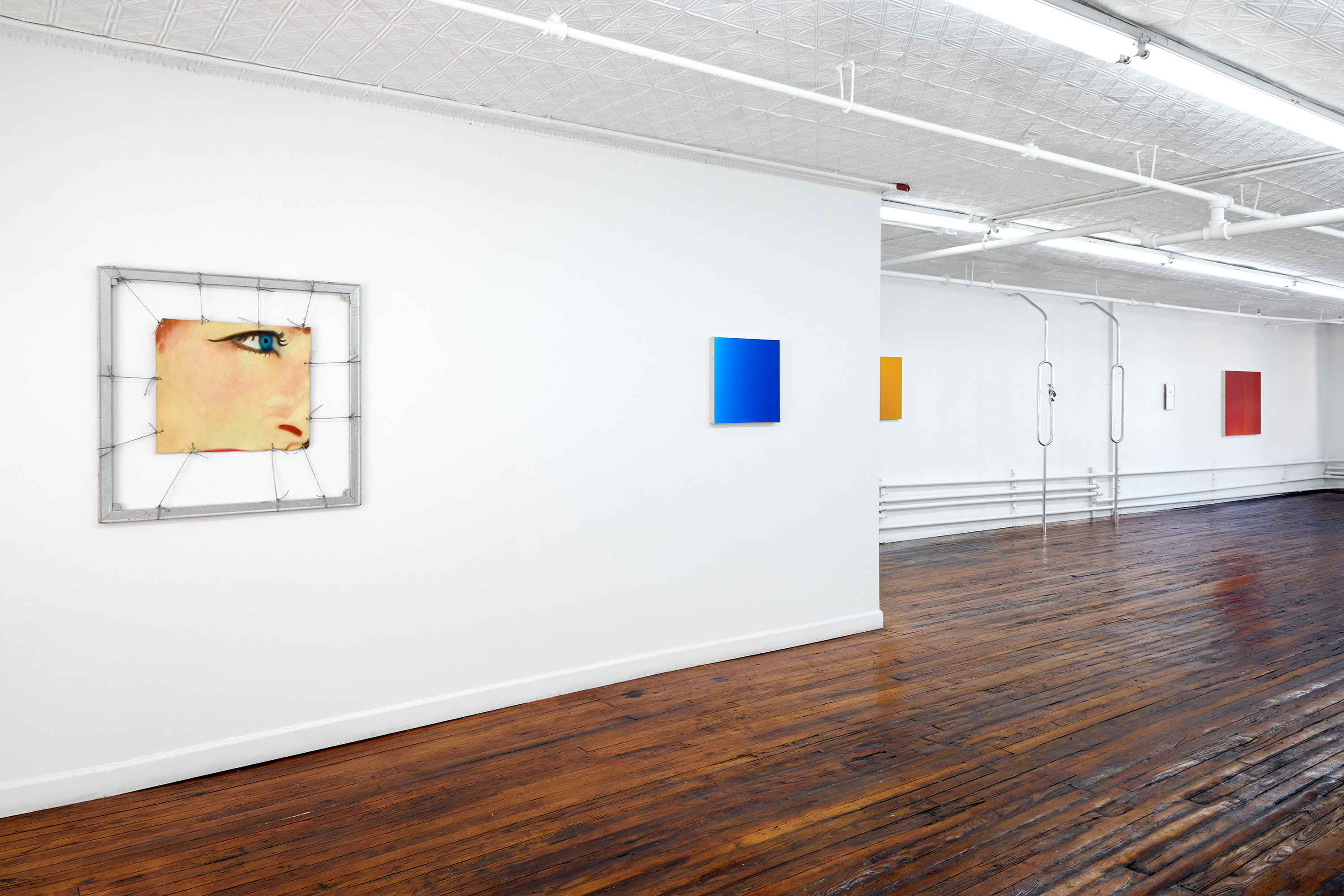
Off Paradise is delighted to present Claude Rutault, A Proposal to Peter Nadin, a project forty-three years in the making, based on a proposal, or “protocol,” given by Rutault, one of the most important French artists of his generation and a pioneer of Conceptualism, to fellow artist Nadin in June 1979.
A Proposal to Peter Nadin is one of the rare, if not unique, occurrences in Rutault’s oeuvre of a protocol being addressed to a specific individual instead of to a nameless “charge-taker.” The protocol begins, “As the person in charge of a space, Peter Nadin, will have, as for each exhibition, to take a certain number of decisions.”
The proposal was never realized and has remained a text in Rutault’s archive to this day, more than four decades later.
In a nod to that passage of time, Nadin has made the decision to realize the protocol by painting a single canvas 42 times over, plus one.
Starting at the far left of the longest wall opposite the entrance and moving to the right along its 60 feet, 42 coats of lemon-yellow color are applied to the canvas, with the paint purposefully extending beyond the edges, creating 42 “ghost” outlines, signaling the 42 years since the 1979 proposal. The canvas continues its travel to the opposite wall and is painted a final time, making 43 coats in total. The full wall is painted the same color, realizing Rutault’s foundational protocol: de-finition/method #1 (1973): “canvas per unit. a canvas braced on a stretcher must be painted the same color as the wall on which it is hung. any standard format available in the trade can be used, rectangular, square, round or oval. hanging arrangement is traditional.”
Claude Rutault (b. 1941) is a painter who does not touch paint or canvas.
Instead, over a career of more than half a century, he has issued sets of painting instructions to others — curators, collectors or institutions — who become his “charge-takers.” These protocols, or “de-finitions/methods,” as he has called them since 1973, guide his works, without themselves being works.
“I write paintings,” Rutault says.
While Rutault has exhibited widely in Europe, including at Centre Pompidou, Musée Picasso, Musée d’Art Moderne de la Ville de Paris, MAMCO Genève, and documenta in 1977 and 1982, his presence in the United States has been less prominent. Yet he was the first French artist invited to a residency at PS1 in Long Island City, Queens, in the winter of 1978-79.
During that brief time, Rutault — who had turned his Paris studio into a project space, 11 rue Clavel — sought out fellow artist Nadin (b. 1954), who was running the experimental artist space 84 West Broadway in TriBeCa with Christopher D’Arcangelo, a non-commercial collective project that included the work of Daniel Buren, Louise Lawler, Dan Graham, Lawrence Weiner, Sean Scully and others.
Rutault’s and Nadin’s spaces were part of a broader, vital movement toward the end of the 1970s in which artists, critics and theorists in New York, Paris, Brussels and Berlin banded together to create their own spaces outside of the confines and expectations of the commercial art world.
Inspired by Nadin’s space, in June 1979 Rutault wrote his proposal, entirely in French, to Nadin. The protocol begins, “As the person in charge of a space, Peter Nadin, will have, as for each exhibition, to take a certain number of decisions.”
In 1992, Nadin left the commercial art world, while continuing to paint mostly on a farm in an isolated part of the Catskill Mountains, working closely with the land and showing only occasionally in unlikely settings such as The Museum of Modern Art, Cuenca, Ecuador, 2008 and The Museum of Modern Art, Santiago de Cuba, Cuba, 2009. Over many years, Nadin worked on a cycle of conceptual paintings, known as the Mark Series, in which he sought to break down his previous conceptions of the genre.
In 2014, as Rutault was preparing for his first-ever solo exhibition in America at age 73, Natacha Polaert formed a friendship with the artist and, in his archives, came across the 1979 proposal. Intrigued, she made a promise to Rutault that she would seek out Nadin with the hope that the text could become at long last a work.
Thus, starting January 13, 2022, Off Paradise is pleased to present a double project spanning more than four decades:
1. Claude Rutault, A Proposal to Peter Nadin, 1979; realized 2022
January 13 – February 19, 2022
The exhibition will be followed directly by:
2. Peter Nadin, The Distance From A Lemon to Murder
March 3 – May 8, 2022
A solo exhibition of recent paintings by Peter Nadin, marking his return to painting “from life” for the first time since 1992.
—
Claude Rutault (b. 1941 in Trois Moutiers, France) describes himself as a painter; and indeed, viewing one of his pieces is undoubtedly an encounter with paint on canvas. Rutault, however, does not paint his pieces himself; nor is he in the business of overseeing their production. Instead, the mainspring of his practice is the writing and issuing of a set of rules, caveats, instructions, and procedures, which he calls “de-finition/methods,” according to which a gallery, collector, or institution—known as the “charge-taker”— agrees to “actualize” a given work.
The first of these de-finition/methods, created in 1973, provided the germ for about six hundred unique works to follow. definition/method #1, “canvas per unit,” reads: “A stretched canvas painted the same color as the wall on which it’s hung. All commercially available formats can be used, be they rectangular, square, round or oval.” With this initial, relatively spare prescription, the characteristic features of Rutault’s work are evident: open-ended, ongoing, participatory, contractual, and mutually contingent with the conditions and environment in which it is to be actualized. The parameters, shape, color, and placement of the painting are constrained only by the ingenuity of its charge-taker in applying the rules established by its de-finition/method, the permutations and specific consequences of which cannot be controlled and could not have been wholly predicted by Rutault. If the charge-taker wishes to change the color of his painting, he must change the color of the wall as well. If the charge-taker wishes to repaint his wall, he must repaint the canvas to match. If he wishes to relocate the work, the wall, the painting, or both must be repainted according to the de-finition/method. Unforeseen varieties of works ensue, and report of their vagaries must be filed with Rutault—to his surprise, amusement, satisfaction, or, conceivably, displeasure. Whatever the case, he must live apart from his paintings if they are to continue living on their own; and at this juncture his role in relation to the work might be described, equally and alternately, as a referee of a game he has set into motion, as a parent watching his child sink or swim, or as a kind of cataloguer of the changes to and consequences of his own hard work.
Peter Nadin (b. 1954, Bromborough, U.K.), a key figure of the downtown art world in the late 1970s and 1980s, is a painter, sculptor and poet whose work explores the practice of mark- and image-making as fundamental, evolutionary human functions. The son of a sea captain, Nadin grew up near Liverpool in a close-knit family. He attended art school at the University of Newcastle and moved to New York City in 1972, becoming involved with a group of artists that included Jenny Holzer, Daniel Buren, Richard Prince, Sean Scully, Lawrence Weiner and Chris d'Arcangelo. In 1978, with d’Arcangelo, he founded the experimental art space 84 West Broadway. With Holzer, he published three collaborative books of poetry and images. In 1980, with Peter Fend, Colleen Fitzgibbon, Holzer, Prince and Robin Winters, he founded the collective known as The Offices of Fend, Fitzgibbon, Holzer, Nadin, Prince and Winters, which offered “practical esthetic services, adaptable to client situation,” including “suggestions for realistic action.” Nadin’s work has been included in numerous exhibitions, including ones at the Institute of Contemporary Art in Boston, the Yale Center for British Art, Brooke Alexander Gallery, Gavin Brown’s Enterprise and James Fuentes Gallery. His work is in the collection of the Metropolitan Museum of Art and was included in the 1988 Venice Biennale.
Off Paradise is a gallery on Walker Street founded by Natacha Polaert in the fall of 2019. The name evokes the old neighborhood of Five Points, at the center of which was a small, triangular park, full of hope and grime, called Paradise Square. It also invokes Paradise Alley, the artists’ and poets’ colony on the then godforsaken corner of Avenue A and East 11th Street that is referenced in Jack Kerouac’s novel The Subterraneans. Off Paradise is a fictional place, right off Paradise, adjacent to it, but not exactly it.
I would like to express my sincere gratitude to Emmanuel Perrotin, Peggy Leboeuf and Julie Morhange for introducing me to Claude Rutault back in 2014; to Randy Kennedy for making a long-desired connection to Peter Nadin possible earlier this year; to Ninon Rutault, Quentin Lefranc and Marine Moulin for being so supportive of this project, many years in the making; and to Anne Kennedy and Gina Nanni for being so wonderful.