Ended Oct 8
Sophie Reinhold
Aporia
Sep 8 – Oct 8, 2022
More from Sophie Reinhold on Gallop
[Scroll down for French version / Veuillez trouver ci-dessous la version française]
In one of his famed fables, the ancient Greek writer Aesop details how Herakles stumbles across an apple lying on the ground of a narrow pass and tries, unsuccessfully, to strike it with his club. As he attempts in vain to strike it again, the apple grows larger, blocking his way. In a state of confusion, he is reminded by a passing Athena, that this could only have arisen from his continued willingness to fight it. She explains how his conundrum is the work of Aporia, the divine personification of difficulty and powerlessness. [1]
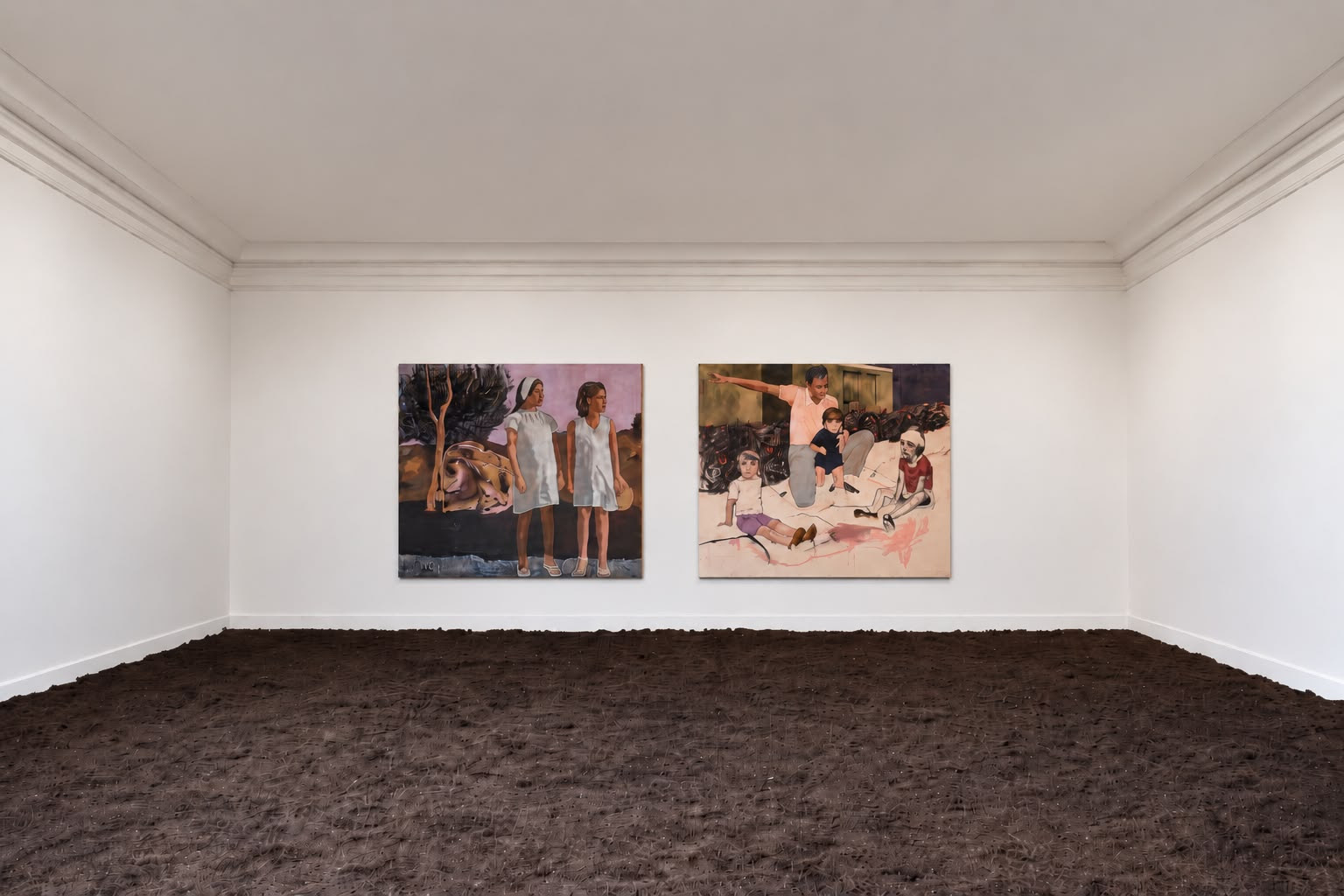
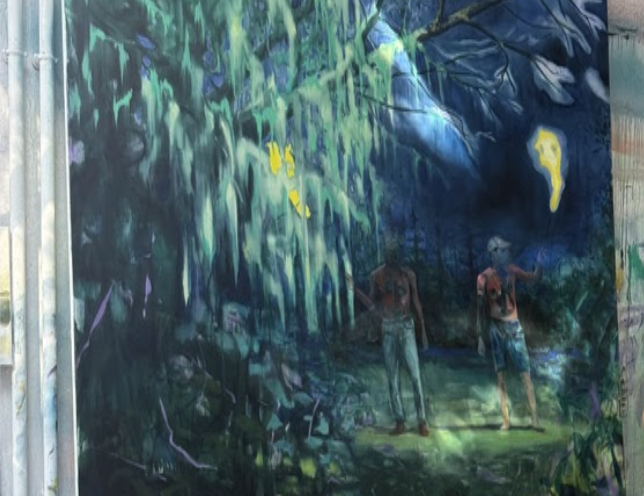
Sophie Reinhold’s distinct aesthetic language is one that stirs such perplexity. Upon entering the lower space of Fitzpatrick Gallery, the six letters that form the word aporia are each represented across six canvases, which, like Herakles’ own predicament, confront the visitor’s passage.
Using the style of old alphabets where letters are each given illustrative qualities, the paintings take on a plethora of historical artistic genres from the sentimentality of fairy tales, to the caricatural and burlesque worlds of post-war painting. Linguistic ciphers and symbolic imagery collapse into one another across the paintings. As they negate each other in their exuberant form, they serve as ominous symbols for the task of representation.
Spiraling forms provide a certain sense of direction and clarity, as implied by one of Reinhold’s work Untitled (spiral of pursuit). Indeed, in Plato's Meno dialogues, Socrates describes how in reaching a point of puzzlement or impasse, a sense of desire is ultimately brought on in the pursuit of resolution. [2] The spiraling form depicted lures us to a representation of Cupid and Psyche, both wedded in myth, and symbols of the ultimate form of desire.
Aporia becomes a tale about the challenge to surpass the entrapments of today’s world where a collective sense of social cohesion and moral judgment has been eroded. We are reminded of the challenge to seek forms of truth within our contemporary times and the spiraling sense of remorse that can ensue.
Perhaps it is in this toing and froing, in the search for one’s own subjectivity, that a sense of truth can be found in navigating today’s world. The medium of painting becomes the field of play for such a quest in Reinhold’s tale, rooted in ancient mythology. Layers of oil paint open up to a more abstract form of representation. Distinct aesthetic tropes belonging to the (male) artistic canon have been abandoned. And so, Herakles’ apple has been left on the ground, retaining its original shape and allowing, as Reinhold’s painting describes, for ‘the escapology of the game of life’ to thrive in its stead.
—Juliette Desorgues
Sophie Reinhold (b. 1981, Berlin) lives and works in Berlin, Germany. Recent solo and duo exhibitions include: Menace, Sophie Tappeiner, Vienna; Y Galerie Philipp Zollinger, Zurich; Das kann das Leben kosten, CFA, Berlin; Kein Witz, No Joke, Kunstverein Reutlingen, The Ballad of the Lost Hops, Sundogs, Paris; Dear Hannes, Schiefe Zähne, Berlin; Why talk of love at a time like this?!, Galerie Rüdiger Schöttle, Munich; What if everything was the same? Exchange of Vacuums, Sophie Tappeiner, Vienna; Can I change my mind?, Galerie Tobias Nähring, Leipzig; NODC2015, with Linda Spjut at Liszt, Berlin.
Recent group shows include: La réforme de Pooky, Kunsthalle Friart, Fribourg (CH); Still Time, Fitzpatrick Gallery, Paris, ...oder kann das weg? Fallstudien zur Nachwende, nGfbK, Berlin; Neue Sachlichkeit, CFA, Berlin; Fifteen Painters, Andrew Kreps, New York; From Almora to Amrum, Efremidis, Berlin; Portraits, Galerie Rüdiger Schöttle, München; Studio Berlin, Berlin; Ein Pfund Orangen, Kunstverein Ingolstadt, There is Fiction in the Space between, Neuer Berliner Kunstverein, Berlin; The Weather Outside, Freedman Fitzpatrick, Paris; All’estero & Dr. K takes the waters at Riva. Version A, curated by Saim Demircan and Curatorial Studies Venice, A Plus A Gallery, Venice; Here Here – Das ich und alles andere, curated by Tenzing Barshee, Braunsfelder, Cologne.
1 - ‘Fable 534’, Aesop’s Fables, a new translation by Laura Gibbs (Oxford: Oxford University Press, 2002).
2 - ‘Meno (84a-c)’, Plato in Twelve Volumes, Vol. 3 translated by W.R.M. Lamb (Cambridge, MA, Harvard University Press; London, William Heinemann Ltd., 1967).
*****
Dans l’une de ses célèbres fables, Aésope raconte comment Héraklès tombe sur une pomme gisant sur le sol d’un col étroit et tente, sans succès, de la frapper avec sa massue. Alors qu’il tente en vain de la frapper à nouveau, la pomme grossit et lui barre la route. Dans un état de confusion, Athéna lui rappelle que cela n’a pu se produire que parce qu’il a continué à vouloir la frapper. Elle lui explique que son énigme est l’œuvre d’Aporia, la personnification divine de la difficulté et de l’impuissance. [1]
Le langage esthétique de Sophie Reinhold est de ceux qui suscitent une telle complexité. En entrant dans l’espace inférieur de la Fitzpatrick Gallery, les six lettres qui forment le mot aporia sont chacune représentées sur six toiles qui, comme la situation d’Héraklès, confrontent le passage du visiteur.
Utilisant le style des anciens alphabets où les lettres sont chacune dotées de qualités illustratives, les peintures reprennent une pléthore de genres artistiques historiques, de la sentimentalité des contes de fées aux univers caricaturaux et burlesques de la peinture d’après-guerre. Les codes linguistiques et l’imagerie symbolique s’effondrent les uns sur les autres. En se niant mutuellement dans leur forme exubérante, ils servent de symboles à la tâche de la représentation.
Les formes en spirale procurent un certain sens de la direction et de la clarté, comme le suggère l’une des œuvres de Reinhold, Untitled (Spiral in pursuit). En effet, dans les dialogues du Meno de Platon, Socrate décrit comment, lorsqu’on atteint un point de perplexité ou d’impasse, un sentiment de désir est finalement suscité dans la poursuite de sa résolution. [2] La forme en spirale représentée nous attire vers une représentation de Cupidon et Psyché, tous deux mariés dans le mythe, et symboles de la forme ultime du désir.
Aporia devient un conte sur le défi de dépasser les pièges du monde d’aujourd’hui où le sens collectif de la cohésion sociale et du jugement moral a été érodé. On nous rappelle le défi de rechercher des formes de vérité dans notre époque contemporaine, et la spirale des remords qui peut s’ensuivre.
C’est peut-être dans ce va-et-vient, dans la recherche de sa propre subjectivité, que l’on peut trouver un sens de la vérité en naviguant dans le monde d’aujourd’hui. Le médium de la peinture devient le terrain de jeu d’une telle quête dans le conte de Reinhold, enraciné dans la mythologie antique. Les couches de peinture à l’huile s’ouvrent sur une forme plus abstraite de représentation. Les tropes esthétiques distincts appartenant au canon artistique (masculin) sont désormais abandonnés. Ainsi, la pomme d’Héraklès a été laissée sur le sol, conservant sa forme originale et permettant, comme le décrit le tableau de Reinhold, à «l’escapologie du jeu de la vie» de prospérer à sa place.
—Juliette Desorgues
Sophie Reinhold (1981, Berlin) vit et travaille à Berlin, Allemagne. Son travail a été présenté lors d’expositions personnelles telles que : Menace, Sophie Tappeiner, Vienne; Y Galerie Philipp Zollinger, Zurich; Das kann das Leben kosten, CFA, Berlin; Kein Witz, No Joke, Kunstverein Reutlingen; The Ballad of the Lost Hops, Sundogs, Paris; Dear Hannes, Schiefe Zähne, Berlin; Why talk of love at a time like this?!, Galerie Rüdiger Schöttle, Munich; What if everything was the same? Exchange of Vacuums, Sophie Tappeiner, Vienne; Can I change my mind?, Galerie Tobias Nähring, Leipzig; NODC2015, with Linda Spjut at Liszt, Berlin.
Son travail a également été présenté lors d’expositions collectives : La réforme de Pooky, Kunsthalle Friart, Fribourg; Still Time, Fitzpatrick Gallery, Paris; ...oder kann das weg? Fallstudien zur Nachwende, nGfbK, Berlin; Neue Sachlichkeit, CFA, Berlin; Fifteen Painters, Andrew Kreps, New York; From Almora to Amrum, Efremidis, Berlin; Portraits, Galerie Rüdiger Schöttle, München; Studio Berlin, Berlin; Ein Pfund Orangen, Kunstverein Ingolstadt; There is Fiction in the Space between, Neuer Berliner Kunstverein, Berlin; The Weather Outside, Freedman Fitzpatrick, Paris; All’estero & Dr. K takes the waters at Riva. Version A, A Plus A Gallery, Venice; Here Here – Das ich und alles andere, curaté par Tenzing Barshee, Braunsfelder, Cologne.
1 - ‘Fable 534’, Aesop’s Fables, nouvelle traduction par Laura Gibbs (Oxford: Oxford University Press, 2002).
2 - ‘Meno (84a-c)’, Plato in Twelve Volumes, Vol. 3 traduit par W.R.M. Lamb (Cambridge, MA, Harvard University Press; London, William Heinemann Ltd., 1967).