Ended Jun 23
Michael Raedecker
Parade
May 3 – Jun 23, 2019
More from Michael Raedecker on Gallop
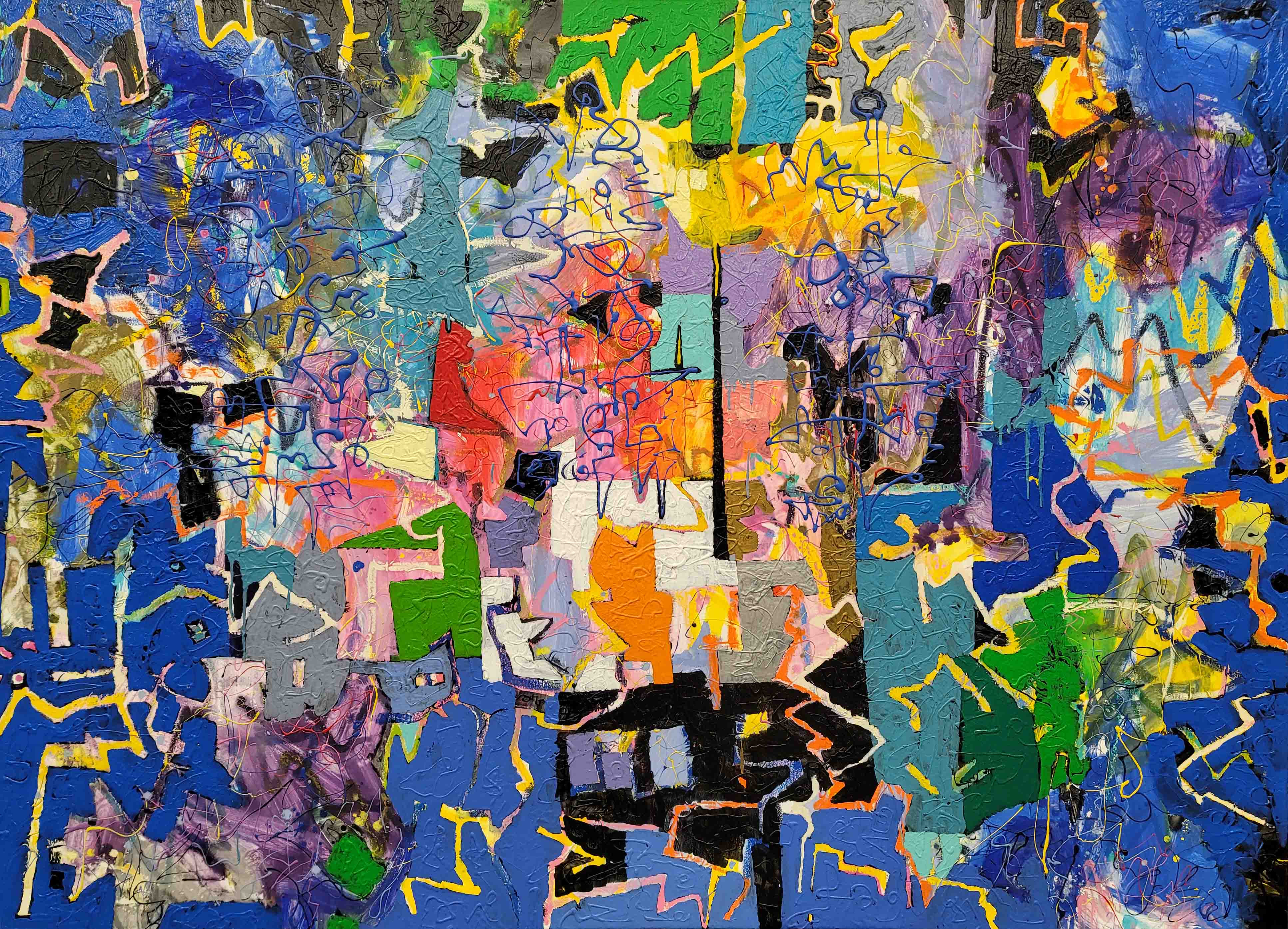
There are fields of blue and grey and orange. Glows of light that seem to linger and exhale. There are dense, pooled shadows. They create spliced, penumbral spaces. When an image enters the scene, the effect can be hesitantly theatrical, near to cinematic, sometimes phantasmatic, often perturbed, menacing or cute, but then menacingly cute. A provisional setting for a provisional story. A story catching its breath as it waits to be told. A page waiting to be turned.
Michael Raedecker’s new paintings remain – as the previous ones have been over more than two decades – complexly wrought performances that each simultaneously conjure up and interrupt an image. The work done by the paintings is a kind of dream work. Hence an image here is only partially the subject of its respective painting, which is as much about the desire for the image, or the flight from it, as it is about the ostensible content of the image.
A long-rehearsed shift in Raedecker’s paintings over recent years has tended to insinuate a duality of field and image, unlike his earlier works, which were more concerned to conceive images within spatially defined genres, like interiors of rooms, or forested landscapes. In Raedecker’s new work the elements that appear as nameable images – a tree house ripe for a child’s fantasy, a cheerfully blazing fire – feel less native to the fields of the paintings, and less securely or comfortably sited in them. It is this tension between image and field that drives the strangely anxious energy and nervy playfulness of the new work. In these paintings, ‘image’ can be many things: a diagram coaxed into a semblance, a logo massaged into a spectre, a fantasy, a memory, a hope, an anticipation, a blueprint, a decoy, a divination, a lure and a trap, a basketful of wounds and desires. But also, importantly, a thing seen that precedes our catching sight of it. Something we already knew before we saw it. An item latent in a prior psychic repertoire.
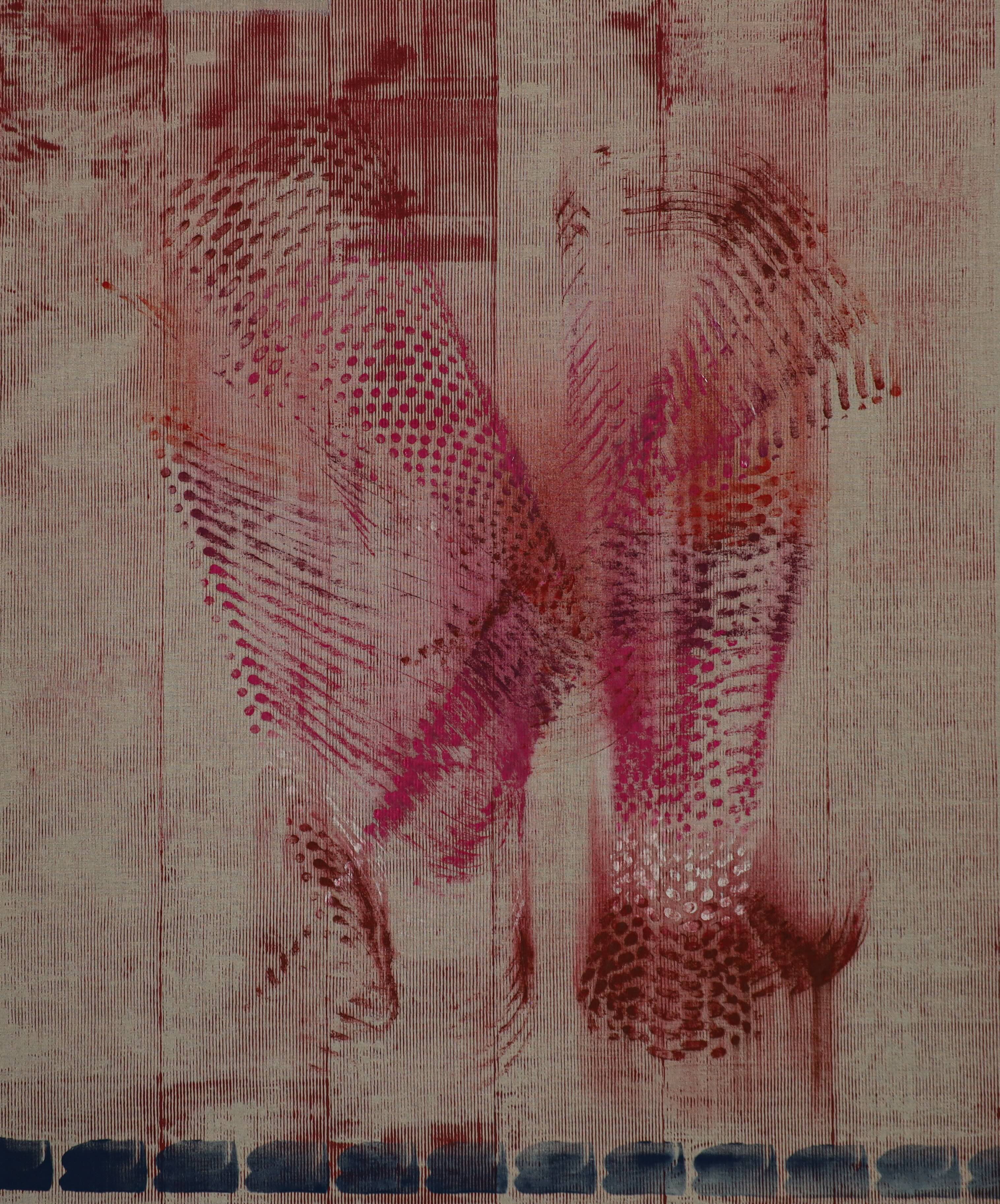
Raedecker has always made unconventional paintings. His early experience in fashion already lent him a fluency with material vocabularies unfamiliar to most painters. A Raedecker painting is a picture taking place in front of our eyes. But not so much as a fluid map of decision-making. More as an overlapping of shifting tactics recorded both literally and metaphorically as divergent seams. The stitches that propagate across the surfaces may float on them or may become embedded in the flow of material processes. The focal image of a Raedecker painting is nearly always described by stitches. These can function, like lines in an etching, as sharp, inscribed bounding edges or hatchings; or they can function, more as imitative hues and textures that flesh out the surface of the depicted thing. Added to this hybrid vocabulary in the newer work is Raedecker’s development of a transfer printing process. Adapting a variety of sources, such as photographs of horizontally banded tv screens, or tonal gradations of clouds, paper transfer prints are applied to the canvases to build up subtly modulated atmospheric grounds. These may or may not show evidence of their original sources. But they layer, section and map the lateral expanse of the canvas and when executed with deep blues and indigos create a distinctive feel: something akin to viewing a screen, or darkened stained glass, or the vision of a mind on the threshold of sleep.
The narrative fragments are unverifiable but loaded: a deserted street café, whose furniture is upended and whose parasols catch fire. The contemporary imaginary of public and private catastrophe is close at hand. But here Raedecker’s vocabulary of stitched drawing, which permits him to shrewdly side-step issues of painterly style and skill, means that this scene of implicit trauma is somehow depicted both bleakly and cheerfully, both naively and knowingly; as if envisioned simultaneously through the sanguine innocence of the child and the looming dread of the hardened and jaundiced adult. These are paintings told by an unreliable narrator.
- John Chilver
Michael Raedecker (1963 Amsterdam, NL) was born in Amsterdam and currently lives and works in London. He received his BA in Fashion Design from the Gerrit Rietveld Academy, Amsterdam (NL), continued his curriculum at the Rijksakademie van Beeldende Kunsten, Amsterdam (NL), and at Goldsmiths College, London (UK). In 2000, Raedecker was shortlisted for the Turner Prize and he received the John Moores Award in 1994.
Raedecker had his first solo exhibition at Galerie Nouvelles Images in The Hague (NL) in 1998. Recent solo exhibitions include Cntrl (2018) and camouflage (2016) at Grimm, Amsterdam (NL); record (2014) at Galerie Max Hetzler, Berlin (DE); tour (2013-2014) at Sprengel Museum, Hannover (DE) and Wilhelm-Hack-Museum, Ludwigshafen am Rhein (DE) and Andrea Rosen Gallery in New York (US); Volume (2012) at Hauser & Wirth, London (UK); Line-Up (2009-2010) at Musée d’Art Contemporain de Nîmes, Nîmes (FR), Camden Arts Center, London (UK) and Gemeentemuseum, The Hague (NL).
His work has also been shown at Museum of Contemporary Art, Chicago (US); Stedelijk Museum, Amsterdam (NL); the Museum für Gegenwartskunst, Basel (CH); Salzburger Kunstverein, Salzburg (AT); Istanbul Modern, Istanbul (TR); Knoxville Museum of Art, Knoxville (US); Singer Museum, Laren (NL); Centro Nazionale per le Arti Contemporanee, Rome (IT); Kunsthal, Rotterdam (NL); Sammlung Goetz, Munich (DE); Whitechapel Art Gallery, London (UK); Van Abbemuseum, Eindhoven (NL); Institute of Contemporary Art, Boston (US) and Sungkok Art Museum, Seoul (KR).
Michael Raedecker’s work is currently on view in the following group exhibitions: Where is the Madness You Promised Me?, Hudson Valley MOCA, Peekskill (US); Freedom, The Fifty Key Dutch Artworks Since 1968, curated by Hans Den Hartog Jager, Museum de Fundatie, Zwolle (NL) and Out of Office, Singer Laren, Laren (NL). He is also featured in Phaidon’s new publication of Vitamin T: Threads and Textiles in Contemporary Art.