
Exhibition · Eric Firestone Gallery | The Garage
Holy Water
Jul 2 – Jul 24
About the show
Shagha Ariannia, Radcliffe Bailey, Bhakti Baxter, Carlos Betancourt, Brandon Deener, Jen Denike, Raúl de Nieves, Martha Edelheit, Naomi Fisher, April Gornik, Armani Howard, Zhang Huan, Jillian Mayer, Nicolette Mishkan, Stephen Neidich, Ricardo Partida, Nereida Patricia, Bony Ramirez, Fawn Rogers, Sheena Rose, Gabriela Ruiz, Jamilah Sabur, Hiba Schahbaz, Jwan Yosef
Eric Firestone Gallery, The Garage is pleased to present Holy Water. Featuring over 20 contemporary artists who have been invited to create artwork responding to the concept of water and the foundational oceanic myths that populate our cultural imaginary. From fishing and surfing to baptism and migration, from quotidian marine life to fantastical sea gods and monsters, the works on view reflect diverse conceptual and formal interpretations on the theme and bring to the forefront a broad range of environmental, spiritual, feminist, and political perspectives.
Curated by Zoe Lukov, Holy Water features painting, sculpture, and photography by established artists such as Radcliffe Bailey, Raúl de Nieves, Zhang Huan, April Gornik, and Jwan Yosef, alongside rising stars like Bony Ramirez, Gabriela Ruiz, and Hiba Schahbaz, as well as emerging artists including Shagha Ariannia, Armani Howard, and Nereida Patricia. The exhibition will feature artists who have never before presented their work on Long Island, alongside those with long trajectories of practicing on the East End. Hailing from a diverse range of countries, including Barbados, Dominican Republic, Iran, Jamaica, Mexico, Pakistan, Puerto Rico, Syria, Sweden, and beyond, each artist has a profound relationship with bodies of water and the way that both the myths and histories of our relationships with water have deep cultural, spiritual, and political implications.
Radcliffe Bailey’s Nommo is a vessel adrift on sea which we cannot see, but which we remember—the bodiless head, a recurring figure in Bailey’s work, is afloat on the structure, a passenger in this interstitial zone, an ancestral spirit or deity-like figure caught in the in-between. The work speaks to diaspora and migration and our communal and shared histories across the waters. The sublime and otherworldly are also explored in new works by Brandon Deener, who depicts a haunting portrait of Black beauty that seems to be emerging from or perhaps sinking beneath the ocean’s surface, and by Armani Howard, who employs shadow and light to evoke spirit bodies thatemanate from and occupy the waters. Zhang Huan broaches the spirit realm by collecting incense ash from temples and other holy sites and utilizing the detritus from the burning, the remnants of countless individual prayers and wishes, to paint—the ash becomes the medium and the pigment to reveal monochromatic seascapes.
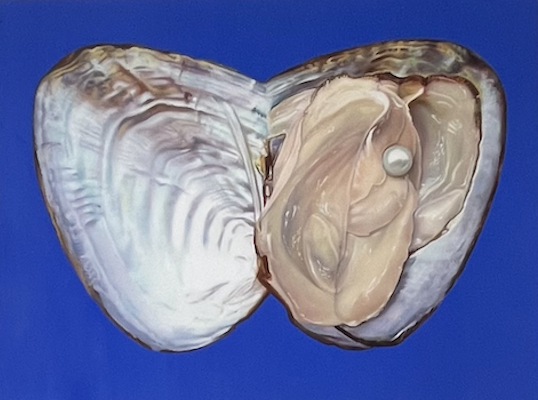
Artists like Fawn Rogers approach the subject matter from both a formal and environmentalist standpoint. Her works are portraits of oysters, bottom feeders responsible for cleaning the water and aphrodisiacs for consumption that are desirable and potentially toxic, uncanny in their resemblance to sexual organs, and harvested in increasingly unsustainable ways. Raúl de Nieves has created a jeweled treasure, a coral relic, a crystal cave, a gorgeously bedazzled work that feels like it comes from the currents of our underwater imaginings of what sea creatures could really be.
New works by Bony Ramirez and Ricardo Partida explore the figures of gods and monsters. Partida references mythological creatures, while addressing the sensuality and power of the representation of queer Brown figures—in this case reinventing the goddess Venus, who was famously birthed from the sea foam. Ramirez mines rich references of the Caribbean and the Dominican Republic, repurposing mundane utilitarian objects of the tropics to create new iconography and reliquary.
Nicolette Mishkan reimagines the ancient mermaid myths for our fantastical and surreal times. Her sensual, sometimes pregnant hybrid fish-women, who are often bound and tied, seem to be both sites of our sexual desire as well as anxiety about female power. Nereida Patricia created new concrete and glass beaded works that speak to both the trans body and the mythological and historical precedence for hybrid bodies that find nourishment within or are born from the water. Jwan Yosef’s white-on-white or white-on-gray minimal portraits of a man licking or guzzling ecstasy might just as easily allude to a last moment of gripping breath.
Martha Edelheit’s nude figures of men and women huddled around the seals at the Central Park Zoo seem to echo art historical bathers cavorting at a lake or beach. Sheena Rose paints bright and joyful representations of the Black female form in different states of repose and play in relationship to water as a site of healing, athleticism, and rest. Artists like April Gornik, a Sag Harbor-based landscape painter, on the other hand, capture the raw power of the sea and imagined waterscapes as they roil with weather—devoid of the human figure and monumental in their soaring portrayal of the environment.
Zoe Lukov is a curator, writer, and Emmy-nominated producer. Her more recent independent curatorial project Skin in the Game was a much-lauded monumental exhibition that featured over 40 artists and took place during Miami Art Week 2021 and in Chicago during Expo 2022. As chief curator of Faena Art in Miami Beach and Buenos Aires, she conceived and produced the first Faena Festival in 2018 and its follow up in 2019, in addition to organizing major solo exhibitions by internationally recognized artists. She is a founding board member of Desert X, the non-profit site-specific exhibition based in California, and recently produced a documentary about Desert X 2021.