
Ended
Seffa Klein
WEBs: Where Everything Belongs
Apr 12 – May 12, 2023
“I want to know how God created this world. I'm not interested in this or that phenomenon, in the spectrum of this or that element. I want to know His thoughts; the rest are just details.”
—Albert Einstein
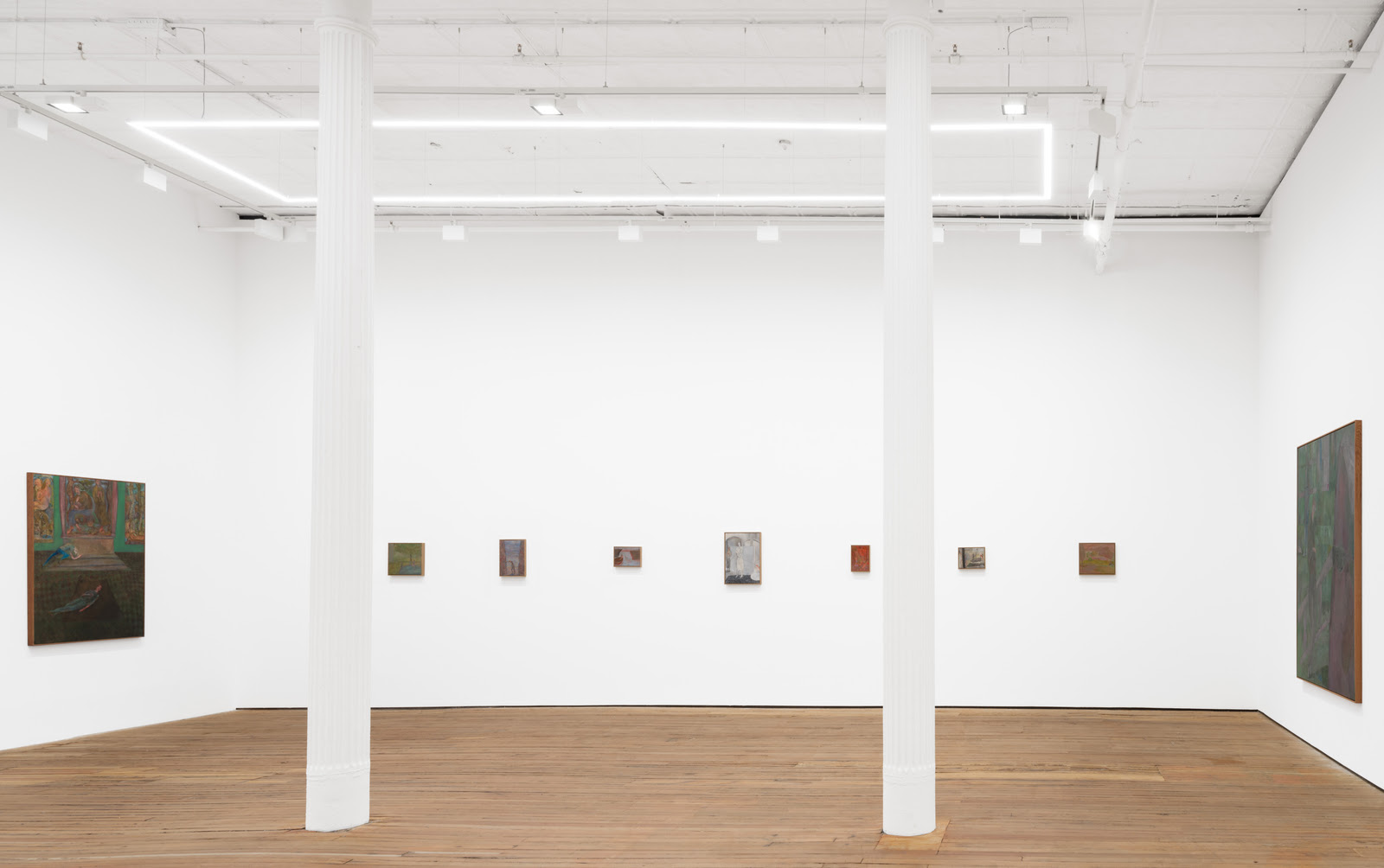
SFA Advisory is pleased the present the first solo exhibition in New York City by the Franco-American artist Seffa Klein. WEBs: Where Everything Belongs is a selection of eight abstract paintings depicting vortex-like webs made from molten bismuth and plaster applied to brightly painted glass-woven canvases, or fire blankets as she calls them, and six web drawings.
“Bismuth metal, element 83, is the flower of the elements; its colors pulse through blues and golds in the presence of a flame.”
—Seffa Klein
Bismuth is a non-toxic, heavy metal similar to lead. Materialistically, it is the heaviest metal we can interact with on a human level; anything heavier would be radioactive. In its solid form, bismuth has a spiral, stepped crystal structure and a silvery-white color. Once the element is melted down and oxidized, it becomes iridescent and changes hues. The process of melting it, creating form with it on a flat surface, and stabilizing it to control the texture and color through oxidation is a physically taxing process. It’s performative for Klein: she spins a cosmological web onto the flat surface.
Bismuth resonated for Klein not just for its formal properties but through its metaphysical associations.
“I feel that there are physical mysteries embedded in bismuth.”
—Seffa Klein
Historically, ancient alchemists called bismuth “tectum argenti” meaning “silver being made,” and the Incas used it as a special alloy in their knives. Furthermore, bismuth materialized sometime between the Big Bang, which birthed our universe almost 14 billion years ago and the formation of our Earth almost 5 billion years ago. Bismuth arose with heavier elements from merging neutron stars which result in black holes suggesting that element 83 has experienced an unknowable astrophysical phenomenon – one that no human or human-made recording device is capable of achieving for the foreseeable future. The explosive journey from a black hole to the Earth’s crust is laden with still yet-to-be-discovered universal knowledge. Klein replicates this in the images themselves which allude to stars, rays, eruptions, and blasts.
“There is a death of form that must be present in order to access what’s beyond it.”
—Seffa Klein
In addition to bismuth, Klein’s WEB paintings also incorporate plaster, a material which is absorbent and represents total softness and receptivity to her. She views it as having peaceful and neutralizing agents and uses it to balance the reflectivity and sharpness of the metal. Her material transformation of both plaster and bismuth performs the dance between absorption (plaster) and expression (bismuth), the freedom of formless infinity (liquid states), and the fixation of finite reality (solid states). While the bismuth and plaster operate more materialistically, the brightly painted subcutaneous layer performs in the arena of human imagination and desire. As such, the paintings offer a scaffolding for all states of matter and being to belong, resulting in universal images of connectivity.
“In this state of connectivity, we understand that chaos is just an illusion.”
—Seffa Klein
For Klein, the WEB paintings represent a “unified ontology” - a potential bridge for viewers to tap into the unseen or unknowable in our universe. Einstein dedicated his life to this unknowable by trying to “read the mind of god” by formulating a mathematic equation that could unify the forces of the universe in one Theory of Everything. WEBs are Klein’s way of picturing this unified theory. They offer a bridge to experience the connectivity of everything and everyone or the imperceptible.
“Sun gazing is a metaphor for gazing upon the original source; not just the source of biological life, but of consciousness itself, of everything.”
—Seffa Klein
These paintings of connectivity also derive from her own meditative practice of “sun gazing,” which she has been doing for 15 years. Every day, Klein stares into the rising or setting sun when the UV rays are not harmful. She tethers herself to the earth to create an electromagnetic circuit, and then she allows her eyes to “eat the sun,” gaining energy and vitality from it. For Klein this is a spiritual experience that connects her to the universe – something she hopes to impart to viewers through these works.
“While Seffa is not defined by any of her art royalty relatives, there is no denying she is advancing a four- generations-long artistic vocabulary based on ontology, spirituality and coloration that goes well beyond Yves’ signature blue.”
—Allison Berg
Klein was born into a world immersed in art and metaphysics. She is the granddaughter of the renowned French visual and performance artist Yves Klein best remembered for the transformative nature of his work. She is also the daughter of artists Kathy Klein and Yves Amu Klein, great-granddaughter of famed French Tachisme painter Marie Raymond, and the great-niece of Zero artist Günther Uecker.
“I hope to uplift humankind for the benefit and delight of any being who may stumble across us in the future, near or far.”
—Seffa Klein
Seffa Klein was born in Phoenix, Arizona in 1996. She grew up in Northern Arizona and splits her time between there and Los Angeles, where she got her BA in Fine Art from UCLA in 2017. She has been featured in group shows at the Huntington Art Center (Huntington Beach, CA), Berkshire Botanical Garden (Stockbridge, MA), domicile (n.) (Los Angeles, CA), and Wilding Cran (Los Angeles, CA), among others. Klein has had solo exhibitions at the Broad Art Center (Los Angeles, CA), Ochi Projects (Los Angeles, CA), and Amber Hills (Los Angeles, CA).