
Exhibition · Portuguese Pavilion
Alexandre Estrela
RedSkyFalls
May 3 – Nov 22
About the show
Opens Saturday, May 9
RedSkyFalls by Alexandre Estrela will represent Portugal at the 61st International Art Exhibition — La Biennale di Venezia.
The artist presents a new installation that expands the logic of a homonymous 2019 work, now working as an operating system for new digital beings. The project was selected for the Biennale Arte 2026, structured In Minor Keys, as it resonates with the piece’s quieter registers.
When the red sky falls, paradigms shift between divine providence, science as credo, data as oracle, and new obscurantist myths. Seismographs register these sideways movements, as humanity inscribes environmental and social fracture lines into the Earth’s crust. Tectonic manifestations open fissures, not only in the ground but also in thought.
RedSkyFalls proposes a way of experiencing these ruptures by observing a system that responds in real time to events of geophysical scale, both near and distant.
This attention to ruptures is inscribed in a genealogy of pre-digital seismic perception. In zones of tectonic instability, nature becomes a warning system. Frogs abandoning ponds, snakes and worms leaving their holes, bees swarming, and the sudden silence of cicadas are natural anomalies that have become the basis for seismic interpretation. During the Cold War, under nuclear threat, animal and human sensory networks were mobilized as bio-sentinels for seismological monitoring. Too permeable to the interpretation of phenomena as the exception, such a line of research lost momentum in the mid-1990s. The holistic view of earthquakes as a set of geophysical, socio-environmental, and sensory phenomena thus faded. RedSkyFalls recovers this sensitivity, shifting the point of view to an artificial ecosystem.
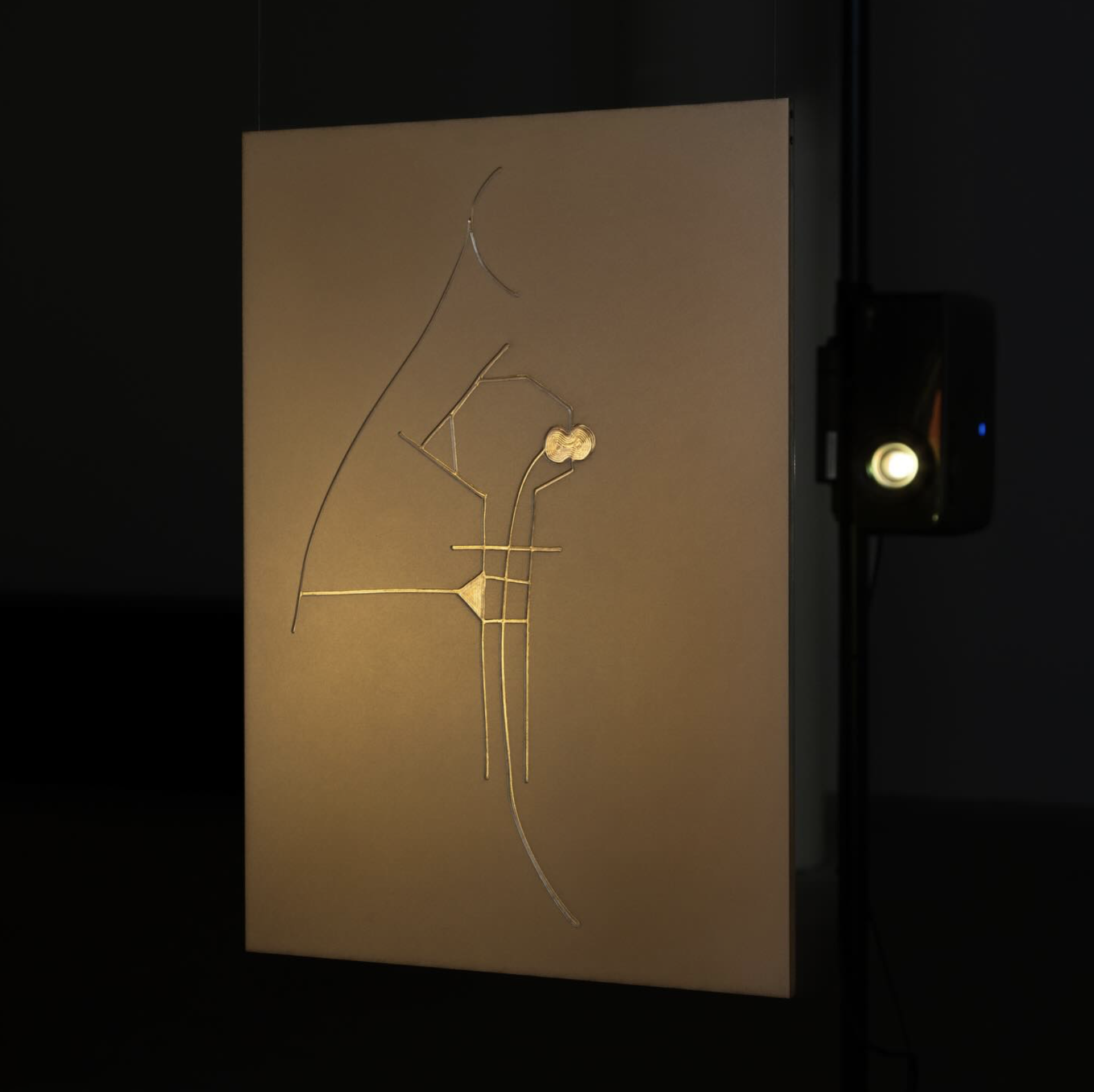
In RedSkyFalls, the mountainous landscape of a computer desktop serves as a habitat for aquatic plants and small luminous organisms, the Réplicas, nestled inside the grooves of aluminium plates.
Built from a calibrated mix of animal parts drawn from a dark cauldron, each Réplica borrows its vital pulse from the beat of a heart in a fly’s leg, the wave of a fish larva’s tail, and the quiver of a rat’s whisker. This patchwork of movement engraves onto the metal plate a linear fossil that inherits an animal, perhaps digital, intuition. Along this path, light generates figures that continuously fulfil a hollow-graphic fate. Just as catfish thrash their tails in Japan on the threshold of an earthquake, the Réplicas seem to foresee or even induce tremors, so that cause and effect begin to slip.
Under close observation, we can recognize in the behaviour of these artificial sentinels the infra- signals of underground disturbances that every so often erupt in this ecosystem, just as on Earth, in the form of a green piercing call that forces everything into synchronicity.
Through the study of fur, fin, and heart responses to seismic changes, RedSkyFalls rehearses a science of particulars. Perceptual recalibration makes attention shift away from a grand narrative to the observation of a quiet game of life played by beings — both natural and artificial — that survive extreme conditions through the laws of interdependence and cooperation.
Seismic energy connects RedSkyFalls to other seismically active geographies through a network of Réplicas, which respond to global seismic activity and nearby events in a perceptibly synchronous manner. In collaboration with the Portugal Pavilion, partner institutions — the Wattis Institute for Contemporary Arts, Redcat– Roy and Edna Disney CalArts Theater, the Museo de Arte de Lima (MALI), the Museo Universitario Arte Contemporáneo (MUAC) of UNAM, and Galeria Zé dos Bois — each host a reproduction of a Réplica of RedSkyFalls, presented in Venice at the Biennale Arte 2026.
During its seven-month exhibition in Venice, the installation is expanded by the programme Survey On An S Wave, organized by Marco Bene. A series of events — talks, concerts, happenings, screenings — proposes a reverberating reading of the piece. In his performative visits, Bene brings with him a Portable Seismic Archive, which temporarily introduces other works and artists into the exhibition, opening and bridging gaps in RedSkyFalls.
Across all its forms, RedSkyFalls proposes a poetic method of survival through the construction of a synchronized relational infrastructure.
Alexandre Estrela is an artist whose work explores the perception of still and moving images through the manipulation of objects and projections, in search of a poetic language. He is Portugal’s official representative at Biennale Arte 2026, with the multimedia installation RedSkyFalls. Recent solo exhibitions include A Natureza Aborrece o Monstro, Culturgest, Lisbon (2024); Flat Bells, MoMA, New York (2023); All And Everything, Museo Rufino Tamayo (2020); Roda Lume, MuHKA, Antwerp (2016); Pockets of Silence, Museo Reina Sofía, Madrid (2015); and Meio Concreto, Serralves Museum of Contemporary Art, Porto (2013). The artist is represented by Galería Travesía Cuatro (Madrid, CDMX, GDL).
Commissioner: Américo Rodrigues, Direção-Geral das Artes
Curators: Ana Baliza and Ricardo Nicolau