
Ended
Elisa Strada
Emerald Candy
Sep 12 – Nov 16, 2019
Gabo Ferro’s song Volver a volver is playing. Elisa moves back and forth scattering colors with each gesture. She sings in a high tone, aiming to laugh and cry at the same time, as if those waters were not the same. She seems not to be aware of the transforming energy that floods her and her urban being, her community, her map, her skin.
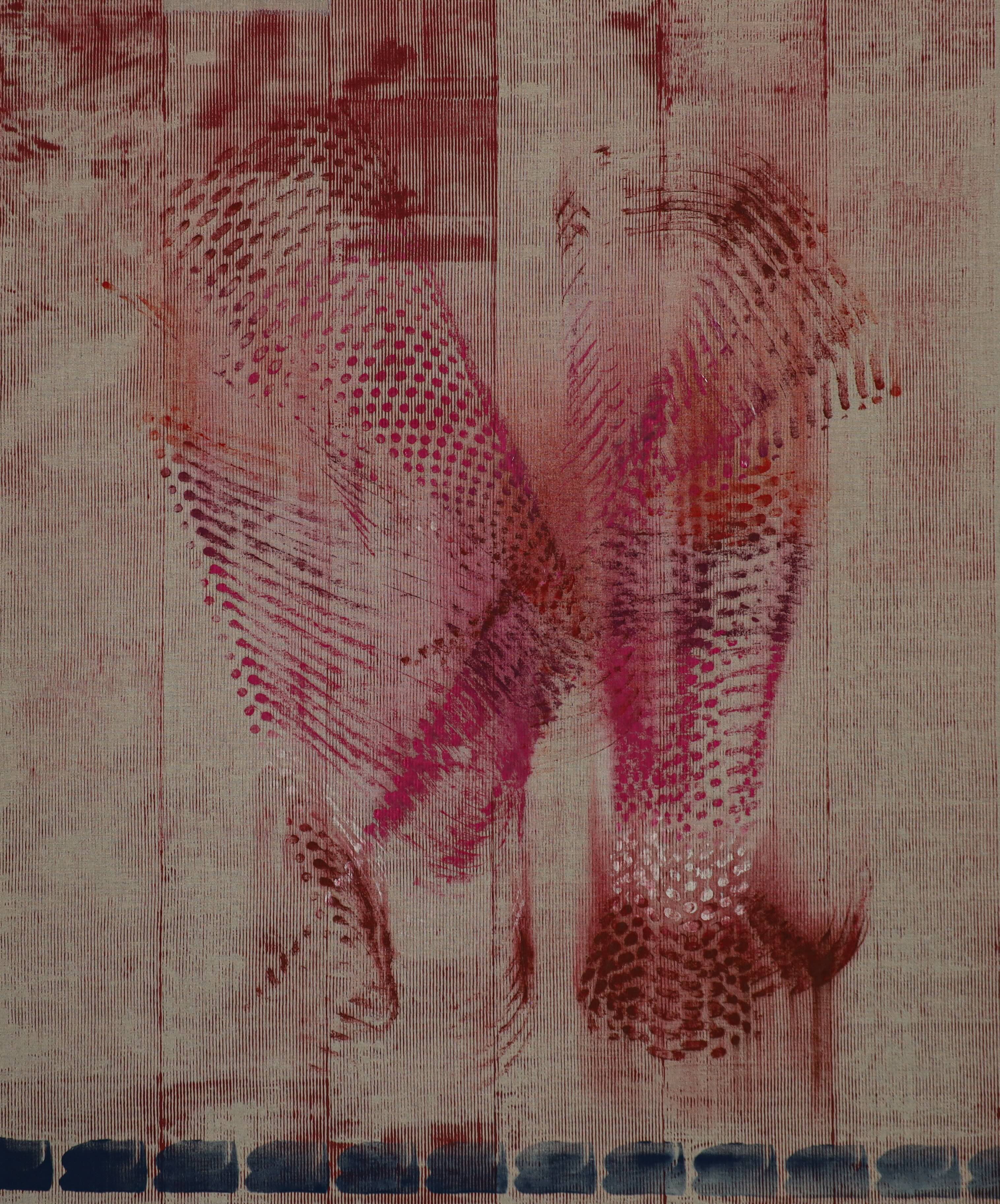
Elisa Strada bonds with collective memory. She empathizes with the streets and their production, which she picks up to create a new encounter with it. She re-finds it, now transmuted into a temple, shrines made out of remains that embellish the ways of being present in public space. Practicing memory is the only possible option of a society that seems destined to build itself up again, repeatedly. The street, public spaces, the act of inhabiting them and building community are decisive stimuli –and needs- in Elisa Strada’s life. It is there where she collects objects, pieces of paper, signs; it is there where she takes photographs, where she chases involuntary graphic compositions. She then comes back to her studio, to go out again. In between, there is the lab: the studio as temple and the work as mantra. Elisa traces maps and creates new territories with monastic preciseness. Color by color.
Before tracing the geographies of form and color, Elisa embodies land geographies in order to create a registry that she will later transfer on sheet metal, paper, posters, balloons, cardboard pieces and signs. In tune with chronos, her first paintings approached the city like the baudelairian flâneur of modernity, with the embellishing gaze of the poet who can grasp the fugacity and fragmentation present there. There is something central that defines life in society as a living phenomenon. These first works are mainly concerned in a topography supported by photographic record – for example, her series of reconstructions of city corners. This digital-pictorial landscape gradually evolved into the landscape of protests, following the rhythm of a germinal concern, that one where the city goes from being observed to being inhabited.
In her series Las calles son nuestras (The streets belong to us) and later in Volver a volver (Back again), the pictorial discourse feeds from protests as an input and as a subject matter. Photography (here both a participant and a documentalist) and images gathered from newspapers are the first map in the construction of a sequence that captures the body. In any case, we witness the suggestion of bodies and faces through continents and color patches whose sense of identity emerges from the
chromatic relation between them. In this sense, these paintings don’t come from a gesture. They are completely programmatic and they imply a method of passage between maps that is almost meditative. The visual signifier emerges from this union between territory and chromaticism.
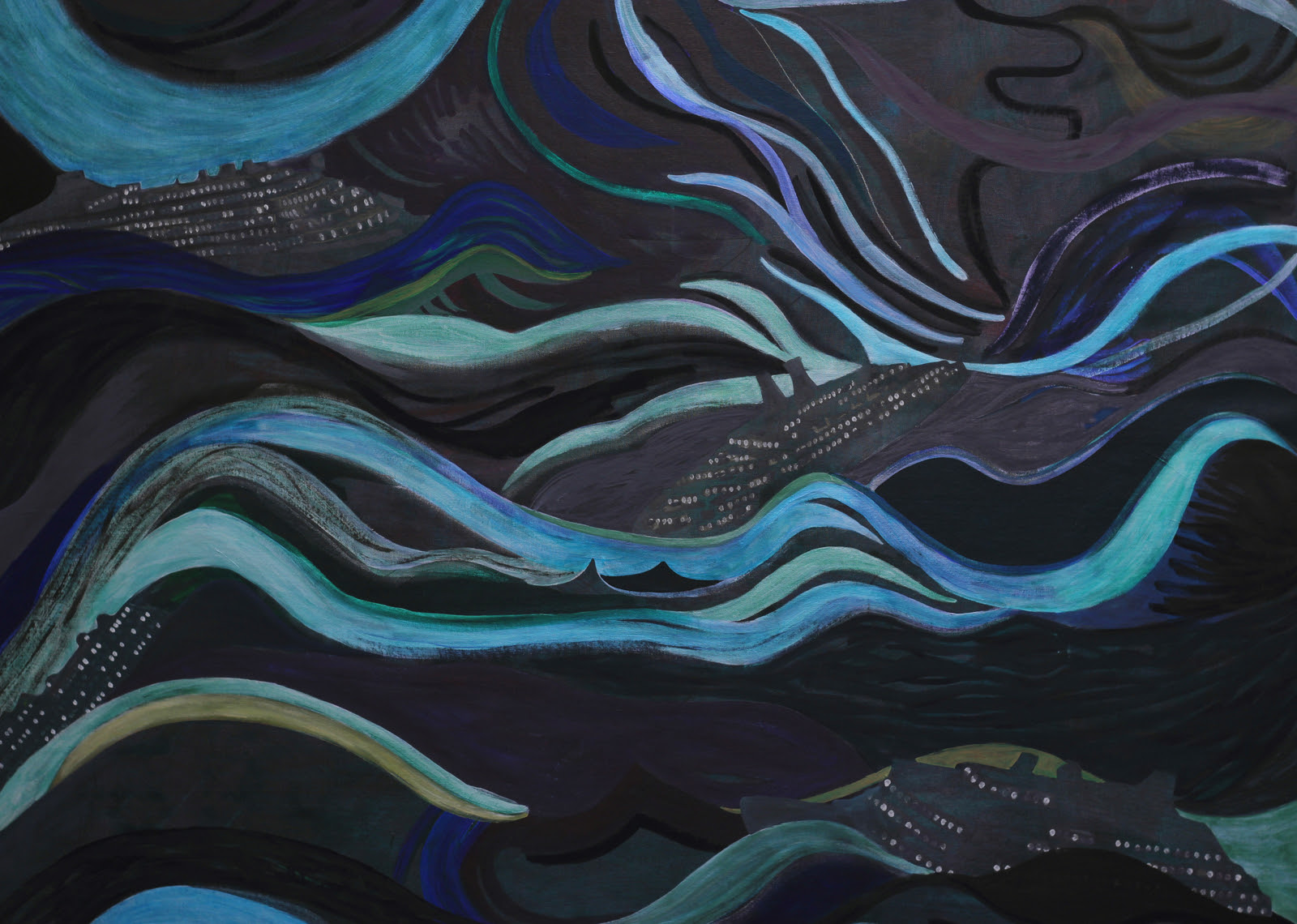
The decisions that drive to the emergence of Elisa Strada’s work assume a fundamental relevance in terms of poetics. In her series Mi Nube, my Cloud, Strada builds small collages from pieces of cardboard collected from the streets. There is something about this “going out on the streets” to collect materials: this action dialogues with the labor of the cartoneros of Buenos Aires, whose source of work is tied to the chain of production, consumption and waste (discard) of the city. There is a proximity in the gesture of collection, an immersion in the streets, because there is an outlined territory and the possibilities are limited. What will later happen in the studio-lab is the activation of a fragmentation and resignification operation, which works with signs and color planes in order to produce a new visual writing.
The suggestion caused by the sign aspect of the cardboard pieces and pamphlets creates an aesthetized residual image with a strong reference to its “place of origin” – this is, at the same time, its place of dismissal. In this functional displacement, Strada sublimates them in the urban poetry of a meta-city that doesn’t forget, but embellishes. Murals made out of flyers and posters will be the skin of that territory. “Rescue” as an act of appropriation is one of the artist’s favorite dynamics – especially because of the political implications of the gesture. Elisa Strada comes back again. That movement is spiraled and the resulting object is sugary and living, emerald candy.
- Camila Pose, Buenos Aires, August 2019
Epilogue
Detangling the sign.
In classical mythology, Elisa is the primitive name of queen Dido, founder of the city of Carthague in the IX century bc. Just arrived to the northern coast of Africa in search of land and hospitality, Jarbas, king of the getules, offered her as much land as she could cover with the skin of an ox. Elisa then cuts the skin in thin threads and covers the largest perimeter of territory she could. She raised there the Brisa fortress, which then became the city of Carthague or Qart-Hadašh: “New City” in Phoenician.
Strada, /strà·da/, from italian: street, road, way. Area of public use, delimited, destined to the passageway and transit of people and vehicles.
Elisa Strada
Santa fé, Argentina 1970.
Lives and works in Buenos Aires, Argentina.
Strada participated in the 9th Habana Biennal (2006) and was a fellow of the Guillermo Kuitca Fellowship in 2003.
She was awarded several prizes, amongst which: Premio Petrobras ArteBA (2012), Premio Regional Adquisición Fundación OSDE in Photography (2005), and the 1st Prize in Digital Art at the ICI Video Art Festival (2001).
Her work was exhibited in institutional solo and two-person shows at Centro Cultural Recoleta (Buenos Aires, 2011, 2008), Instituto de Cooperación Iberoamericana de Buenos Aires (2002), and Centro Cultural General San Martín (Buenos Aires, 2000).
She has a background in Graphic Design and teaches at Universidad de Buenos Aires since 1992.