
Exhibition · Gavlak
Vanessa German
$lang: Short Language in Soul
Mar 22 – May 25
About the show
Gavlak Los Angeles is pleased to present, $lang: Short Language in Soul, a solo exhibition of new sculptures by the Pittsburgh-based artist, poet, performer, and social activist, Vanessa German. $lang is German’s first solo exhibition in Los Angeles, the artist’s native city, and her first with Gavlak. The exhibition features a body of work created by German during her recent month long residency at Aguacate in Puerto Vallarta, Mexico. Though assembled in Mexico, many of the found objects incorporated in the sculptures were sourced from the artist’s current neighborhood of Homewood in Pittsburgh, Pennsylvania - the historic black neighborhood whose residents are often faced with systemic, institutionalized racism and violence in their daily lives.
As a “citizen artist,” German explores the power of art and love as a transformative force in the dynamic cultural ecosystem of communities and neighborhoods. German is the founder of the Art House, a community arts initiative for the children of the Homewood neighborhood. German's practice is both object and performance based. Her spoken-word poetry, influenced heavily by hip-hop and opera, calls attention to the ongoing epidemic of racially charged violence and advocates for compassion and empathy in daily life. Blending spirituality, beauty, and femininity, German’s sculptural works focuses on empowering black women and girls as well as on raising awareness of the racial injustices taking place in America. Her work showcases the power of the black female body and voice, and creates a platform for positive, inclusive, manifestations of love and awareness.
Born in Wisconsin, German moved to Mid-City Los Angeles at seven months old along with her five siblings and mother, Sandra German, a fiber artist and quilter. “We were makers as a way of life. We were raised by making something,” German explains about her formative years. The multi-media works she assembled for $lang explore her lived experience growing up black in Los Angeles and how the power of art kept her alive. German writes:
As a strange, dirty, round, nappy black girl in Los Angeles, never really smelling good, or looking hair-combed & pressed, i was always inventing things that i deeply, profoundly believed had power. People made fun of me for this. i wrote poems to cure cancer. i drew and drew and drew and drew and refused to pick my pencil up from the paper until i’d driven any thought of disbelief from my mind. i was furious with these thoughts of creativity and power; that i was alive and could make *things that had the power to do *something. i believed this like a deep, deep fire. It kept me alive.
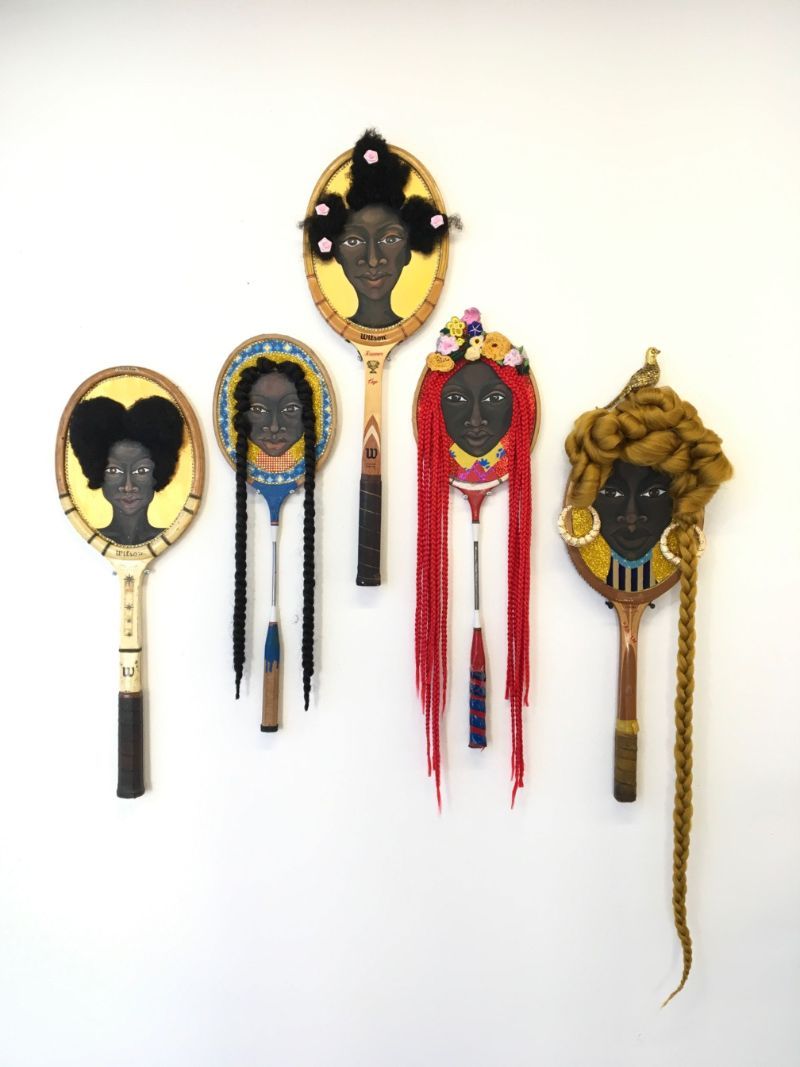
On view in the gallery are a series of 18 mixed-media assemblage sculptures using vintage tennis rackets titled, Tennis Rackets and Hair Weave, or, Intermediate Axis Theorem. Intermediate axis theorem, or tennis racket theorem, is by definition the movement of a rigid body with three distinct principal moments of inertia. German explains: “Here in this work is the rigid body (black femaleness) reckoning with three distinct principal moments of inertia: Americanness; the aesthetics of femininity (body and sex and identity), Blackness and the value in the striations of the known and unknown, and Love & Creative Power.” German utilizes historically black found objects such as hair weave and cowrie shells to adorn her hand painted portraits of black women, creating majestic and empowered presentations of a community so commonly subjected to violence and oppression in American society.
Also on view are five of German’s signature “power figures,” also copiously adorned with found objects, shimmering embellishments, hand-wrapped prayer beads, and even some of her own artist tools. Power figures, or minkisi, originated in the Congo and refers to either spirits or objects that a spirit inhabits. The purpose of these objects both traditionally and through German’s work are the same; to eradicate evil, punish wrong-doers, and create protection. Installed atop metallic painted milk crates and cinder blocks, this army power figures stand and face the front of the gallery. German describes her process of assembling these sculptures as wholly spiritual. She began making them in 2007, after a failed suicide attempt, and it is through these figures that she channels her energies and intuitions.
Vanessa German (b.1976) is a self-taught artist. German is the recipient of the 2018 Don Tyson Prize from Crystal Bridges Museum of American Art, the 2018 United States Artist Grant, the 2017 Jacob Lawrence Award from the American Academy of Arts and Letters, and the 2015 Louis Comfort Tiffany Foundation Grant. Her work is in many private and public collections, including Crystal Bridges Museum of American Art, Everson Museum of Art, Figge Art Museum, Flint Institute of Arts, David C. Driskell Center, Snite Museum of Art, and Wadsworth Atheneum Museum of Art, among others. German’s work has been exhibited widely and is currently on view at the Flint Institute of Arts and The Fralin Museum of Art at the University of Virginia.
This exhibition is conceived in partnership with Pavel Zoubok Fine Art, New York, NY.