
Exhibition · Casey Kaplan
Johanna Unzueta
Gardens in Orbit
Sep 10 – Oct 24
About the show
Johanna Unzueta's second solo exhibition Gardens in Orbit at Casey Kaplan positions drawing as a fundamental and constant action within her interdisciplinary practice. Working with hand dyed paper, natural pigments, thread, felt, found wood, and home-spun textiles, Unzueta’s artistic language is rooted in organic materials reflective of her Chilean background. These common materials are community grown, cared for, and eventually repurposed by Unzueta as part of a larger system of communal ritual. Within each body of work, drawing has remained its steady thread—an intuitive language steeped in repetition, labor, and attentive handwork, and from which each medium quietly emerges.
Gardens in Orbit unfolds through a series of 12 graphite and pastel drawings that trace the gallery's perimeter. Here, wall-based works on paper take on an expanded role for the first time, encircling and supporting an exhibition in which drawing functions not only as an image, but as a way of measuring, accumulating, and registering time through the body's movements. Across her practice, Unzueta returns to the circular and elliptical forms that have long shaped her visual language. Drawn from paper templates, embroidery hoops, and close observation of botanical, cellular, and planetary structures, these recurring motifs reflect an understanding of nature as cyclical rather than linear. Lines loop back on themselves, forms repeat at different scales, and each composition becomes part of an evolving vocabulary without a fixed beginning or end. The exhibition returns to drawing not as a point of origin left behind, but as a practice continually renewed.
Drawing takes on an active role in Gardens in Orbit. Affixed along the walls with hinges, the drawings can be opened and repositioned, allowing each arrangement to respond to its surroundings. Their mobility gives action to drawing — rather than remaining fixed, the works shape the cadence of the room, encouraging viewers to move alongside them while revealing new relationships between individual panels.
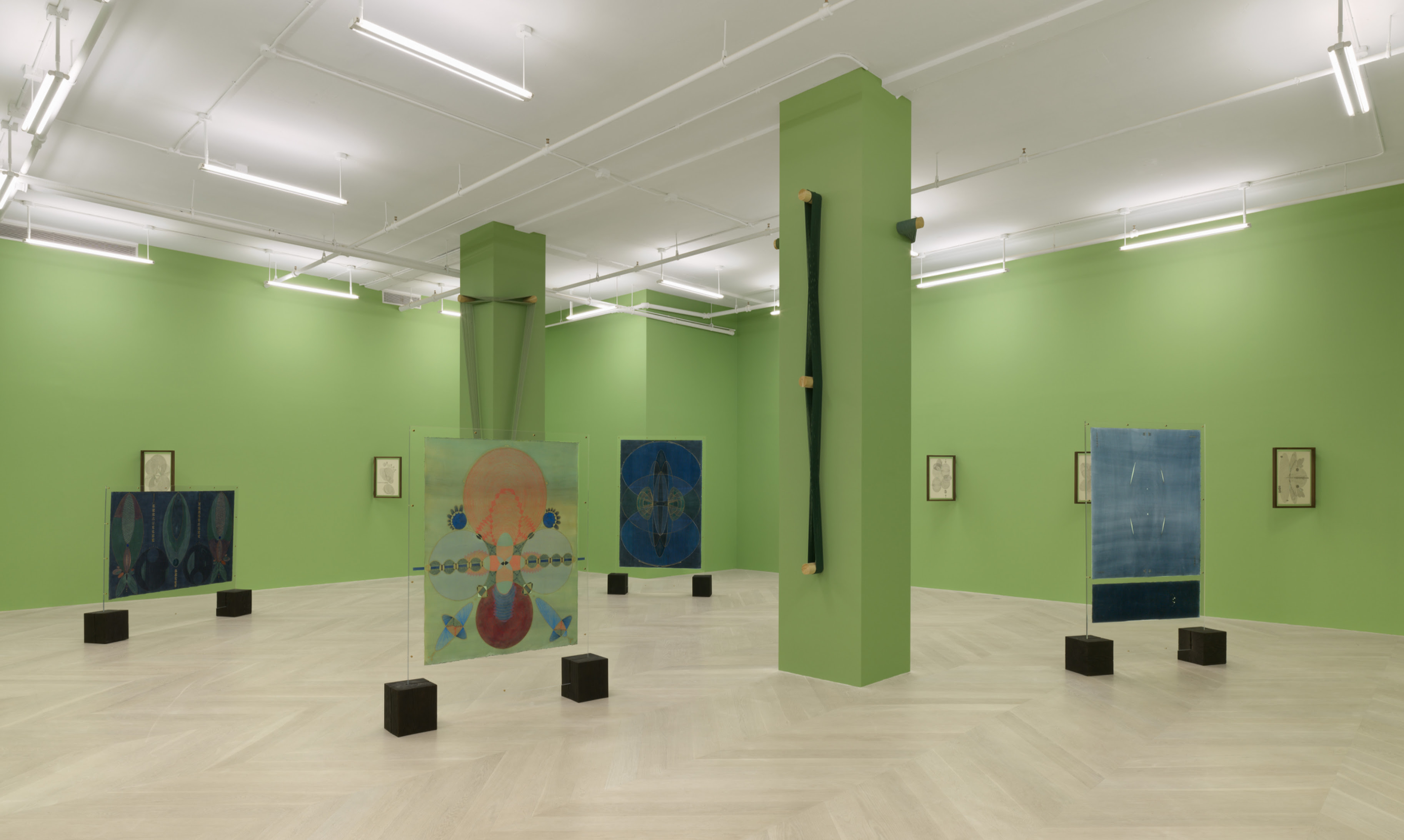
Four freestanding paintings on paper, two of which are reprised from the artist’s recent presentation in the 2026 Whitney Biennial are centered on the gallery floor, extending Unzueta's drawings into three dimensions and guiding the viewer's movement through the center of the exhibition. Each composition is double-sided and dyed with pigments sourced from plants–including indigo, turmeric, or wild berries–drenching each object in the history of its natural hue. The indigo plant, first encountered by the artist in Guatemala, has been used to laboriously tint wood and paper throughout Unzueta’s practice since 2014. The distinctive blue remains fundamental to her process, complemented by varying experimental hues while recurring through the years in a range of opacity.
Each work incorporates fine needle perforations and cut-outs that allow light to pass through the paper, enhancing a quiet sculptural presence. In some works, excised forms are delicately reattached with thread; in others, they are woven back through slits and carved openings, at times extending beyond the paper's edges. A large vertical work exists in two pieces; separate swathes that float side by side, connected by their Plexiglas display apparatus and persistent, rhythmic color. These gestures blur the boundaries between drawing and textile, emphasizing Unzueta's longstanding interest in stitching, weaving, and repair as acts of construction informed by Indigenous craft traditions, including her apprenticeship with Mapuche women in rural Chile.
Presented upright between two panes of Plexiglas and supported by charred wooden blocks, the works are conceived as double-sided compositions activated in three dimensions. Their presentation acknowledges Lina Bo Bardi's celebrated easel displays for the Museu de Arte de São Paulo (MASP), where paintings were experienced as objects on public display. Here, transparency becomes both a material and conceptual device: light moves through the perforated surfaces, front and back remain equally visible, and each work shifts with the viewer's movement. The freestanding drawings reinforce the exhibition's broader exploration of porosity, connection, and the relationship between drawing and space.
Woven elements trace the gallery’s columns, extending Unzueta’s language of line and connection into the architecture itself. The interplay between the green hues on the walls and columns evokes natural terrain, creating an environment in which boundaries between object and landscape remain fluid and permeable. Drawing, weaving, and architecture unite through recurring gestures of repetition and return, communicating throughout the body of work that materials, like natural systems, are always in a state of connection and renewal.
Johanna Unzueta was born in Santiago, Chile in 1974. She lives and works in Berlin, Germany. Unzueta’s work draws from the natural world and the balance between the earth and its living counterparts. Unzueta engages with her Chilean history through its landscape, communities, and labor practices, often working with organic materials that are indigenous to Latin America. In an interdisciplinary practice that spans drawing, weaving, installation, mural-making, and film, the artist uses common materials such as recycled wood, thread, felt, cotton, paper, and natural pigments to describe the social impact of grown and circulated objects within a belabored economy. Recent exhibitions include the 82nd Edition of the Whitney Biennial, New York, NY (2026); Soft Power, Das Minsk, Potsdam, Germany (2024); The Sky’s the Limit, National Museum of Women in the Arts, Washington, DC (2023); In the Studio, Tate Modern, London (2023); Drawing in the Continuous Present, The Drawing Center, New York (2022); Tools for Life, Modern Art Oxford (2020, solo); and From My Head to My Toes, to My Teeth to My Nose, Broad Art Museum at Michigan State University (2019, solo.) Unzueta’s work is held in the permanent collections of Tate, London; the Whitney Museum of American Art, New York; the Queens Museum, New York; MSU Broad Art Museum, East Lansing; Frac Bretagne, Rennes; and Museo de Artes Visuales, Santiago.
About Casey Kaplan
Casey Kaplan is a contemporary art gallery founded in March 1995 in New York City.
More about Casey Kaplan →