Ended Jan 15
Jacqueline Humphries
Nov 4, 2022 – Jan 15, 2023
More from Jacqueline Humphries on Gallop
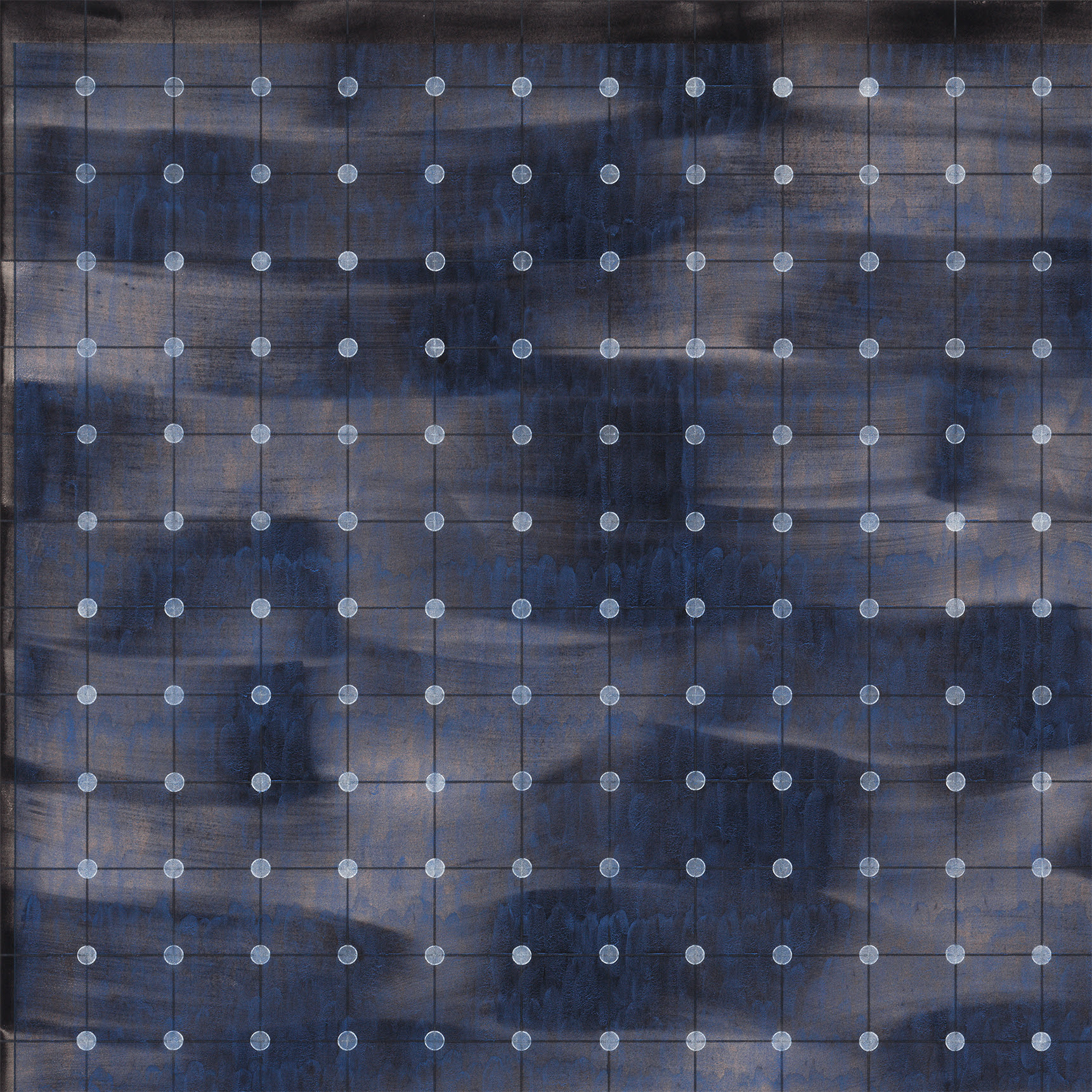
Jacqueline Humphries integrates gestural expression with the effects of new technologies, exploring how painting can capture and complicate the sensory experience of a screen-based world. Her imposing, large-scale canvases have long equated painting with other media interfaces, subjecting its analog format to an evolving set of signs and symbols from our online vernacular.
These latest works—presented singly or linked in multi-panel configurations—feature stenciled motifs of emoticons and emojis, logos, and digitally-enlarged patterns that fill the surface, derived from images of white noise or splattered ink from a faulty printer. The prevailing mood skews toward the ruminative here, and the style of rendering toward deformation; Humphries uses the trappings of our networked existence to weigh how it actually feels to inhabit it. A low-grade pathos radiates from the jittery optics of her stenciled patterns, and occasionally congeals into visual tropes of B-movie horror—a reminder that, despite perennial claims for its obsolescence, painting itself refuses to die; and that horror may be the genre most bracingly suited to processing the present.
By the mid-1980s painting had been declared “dead” several times over. But for the contemporary painter Jacqueline Humphries, the medium became a “rogue practice”; however risky, it has remained her foundation. “Painting can adapt to anything,” she notes. Throughout her career Humphries has thus adapted to—and subverted—painting’s formal and discursive conditions, often with reference to both art history and cutting-edge technological formats. Early canvases, such as those in her 1995 Greene Naftali show (the gallery’s first solo presentation), probe the legacy of Abstract Expressionism, envisioning that movement’s chaotic drips not as destructive but constructive—as a sort of code which Humphries manipulates to form the basis of her own works. Balancing conceptual maneuvers and striking opticality in the ample space of her canvases, Humphries, like her peers Laura Owens and Charline von Heyl, betrays “a profound knowledge of how to make, and fake, marks on canvas,” writes Mark Godfrey—“how to navigate the histories and associations of those marks and control what impact they might have on viewers.”
Humphries has extended these strategies into the present, reimagining her analog medium in digital terms, as a screen or interface. “Painting is my machine for thinking,” she says, and whether canvas or computer, she is “using these machines to communicate, to ‘express.’” Her silver paintings of the mid-2000s produce a quasi-cinematic effect, their metallic surfaces providing for both projection and reflection. The subsequent Black Light series utilized fluorescent paint, transmitting past aesthetics—from ’60s psychedelia to ’80s nightclubs—through present communicative networks.
Since the mid-2010s Humphries has studded her canvases (exhibited in a major survey at the Wexner Center for the Arts) with cascading, stenciled Emoticons and ASCII icons: digital languages, already outmoded, rendered in thick oil paint as if to enter real space. Today, “there’s no definitive image,” Humphries points out, “just an endless torrent. The screen itself is the unifying element, and compresses within itself this multitude.” If her art unifies, it remains singular in turn, uniquely attuned to the media of its moment. As the New York Times declared, “few painters today engage with the challenges of new technology as persuasively as Jacqueline Humphries.”
Jacqueline Humphries lives and works in New York. This solo exhibition will be her tenth with Greene Naftali since 1995. Her work is included in the 59th Venice Biennale, The Milk of Dreams (through November 27, 2022), and is currently on view in The Double: Identity and Difference in Art Since 1900 at the National Gallery of Art in Washington, DC. Humphries was the subject of a major survey at the Wexner Center for the Arts, Columbus, in 2021. Other institutional solo exhibitions include Dia Art Foundation, The Dan Flavin Art Institute, Bridgehampton, New York (2019); Carnegie Museum of Art, Pittsburgh (2015); and Contemporary Art Center New Orleans (2015).
Humphries's work is in the collections of The Museum of Modern Art, New York; Whitney Museum of American Art, New York; Solomon R. Guggenheim Museum, New York; Metropolitan Museum of Art, New York; Albright-Knox Art Gallery, Buffalo; The Art Institute of Chicago; Museum of Fine Arts, Boston; Hirshhorn Museum and Sculpture Garden, Washington, DC; Carnegie Museum of Art, Pittsburgh; Glenstone Museum, Potomac, Maryland; Hessel Museum of Art, Annandale-on-Hudson, New York; San Francisco Museum of Modern Art; Tate Modern, London; Fondation Louis Vuitton, Paris; and Museum Brandhorst, Munich, among others.