
Ended
Eloise Hess, On Kawara
April 3–May 17, 2026
Apr 3 – May 18, 2026
José Castillo-Pazos
Eloise Hess
On Kawara
The exhibition title changes every day to reflect the day’s date. Before the exhibition opens, its title is April 3, 2026; after the exhibition closes, it will be referred to as May 17, 2026. 45 days, 45 dates, 45 titles.
The exhibition includes work by José Castillo-Pazos, Eloise Hess and On Kawara.
José Castillo-Pazos’ Seven Years (2012-2019) is an archival installation, displayed on an illuminated shelving system, and consisting of avocados, photosensitive film, and documents. An avocado absentmindedly placed on photosensitive film on a window sill, spoiled in the sun, became an intentional meditation that would accompany the next seven years of Castillo-Pazos’ life, carried out in fourteen iterations. An aleatoric alchemy that etches marks suggestive of cosmic, geological or microbial scales. As with tea leaves or Rorschach blots, we can project into these various images of deforestation, disappearing seas, sunspot activity, radiological scans of human tissue, or the thermal vision of a drone. These prints both record and portend.
In a single day, Castillo-Pazos lost all of his photographic equipment and digital archive in a home invasion, covering years of work. This loss made space for a deeper practice of photography, marked by disappearance and the passage of time. The avocados have since fossilized into husks, their pits loose in the hollow space, while their stickers still immaculately record their provenance: readymade still life as durational performance. Visitors to the exhibition are encouraged to handle the avocados, the prints and the document archive, like evidence. Each time Seven Years (2012-2019) is exhibited - this is its first time - a set of fourteen silver gelatin prints are produced from the degraded negative films, of which three, from the year 2014 are displayed in this exhibition.
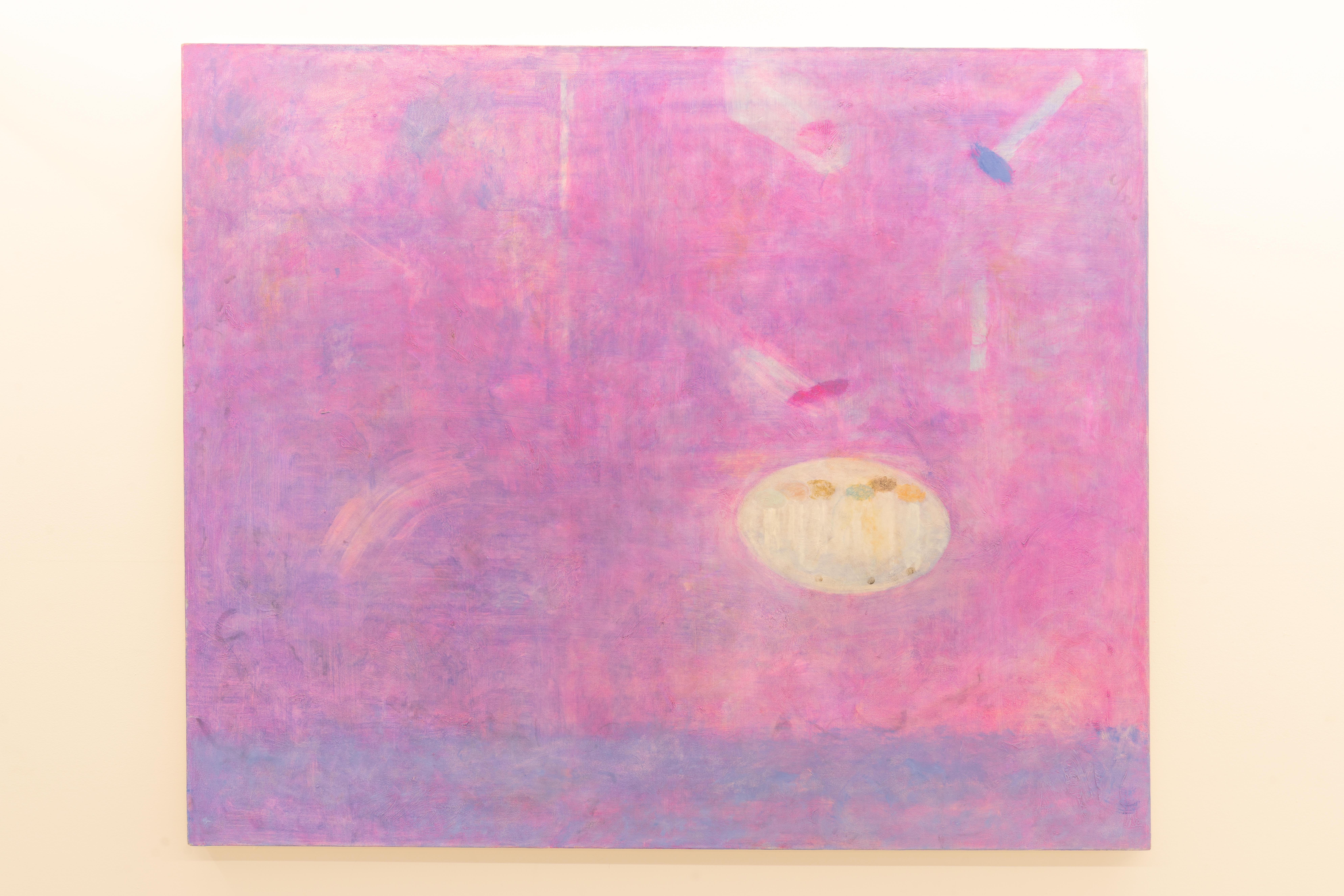
Eloise Hess’ painting Awake Without Exception (2026) layers dozens of monotype prints within encaustic medium to create a glassy, liquid image. Each monotype is a trace of the original photograph. The becoming of the image is slowed and absorbed; a material metaphor for the emotional vision of memory. A digital clock is pictured in the slippage between two instances. The liquid crystals of the hour and minute are momentarily blank, leaving only the colon and its reflection in the marble bedside table it sits on. In a childhood home in Vermont, in a bedroom nobody sleeps in, a time machine is out of sync, blinking unwatched in irregular intervals.
Water Falls Once (2026) is a sequence of 80 slides, individually cut and mounted from 4 rolls of 35mm color negatives. Hess photographed a nearby waterfall from one position, clicking and winding the film as quickly as the camera allowed. The photographs are horizontal while the slides are cut vertically; no slide contains a full image. Each image, projected on the wall long enough to absorb our attention but not lose it, is composed of partial frames, including the gap between frames, the sprocket holes that track the film, and the information in its margins. Hess’ father wanders into the frame on occasion. Processes proceed at their own innate speed: gravity accelerating the falling water, the camera’s mechanics of hands and gears, the photosensitive chemistry of the film, the synaptic speed of our perception in the gallery. The pace of projection, in an ongoing cycle, mimics the waterfall, the time it takes a single drop to fall and the time that a single slide holds our attention. A meditation on motion and stillness, the boundless and the particular, Hess registers these incongruous speeds, in attention to the delay between life and its representation. Water Falls Once is Eloise Hess’ first film work since 2012.
Starting in 1969, On Kawara sent over 900 telegrams with the words I am still alive to friends and acquaintances, often in response to requests for personal information connected to his art career. Two of these telegrams, sent to curator and historian Dr Felix Zedenek of Basel, on December 1, 1972, and on January 26, 1981, from a total of 14 telegrams sent to Zedenek over a period of 20 years, are included in this exhibition. Kawara relinquishes control over the material qualities of the telegram itself, determined by the design standards at the recipient’s location, paper stock, stamping and other annotations by the receiving agent: a local accent to the translation of a universal message. As with all transmission and reception, the gap in time between sending and receiving the telegram introduces some uncertainty about the truth of Kawara’s message, where life hangs in the balance. Telegram sent to Dr. Zdenek Felix, December 1, 1972 and Telegram sent to Dr. Zdenek Felix, January 26, 1981 - exhibited for the first time in New York.
Kawara’s work encourages ‘complementary thinking’, against polarities or dichotomies - one can think of the subtitles of the date paintings - where two or more elements nourish and amplify each other. The rhyming of mind and matter. This is an exhibition of complements and intervals: the interval in transmission between registering and receiving a message, between the personal and the impersonal, between chance and control, between absence and presence, art and life.
Many thanks to Selena Parnon and Megan Yuan for conceiving and co-organizing this exhibition. Extending our gratitude to Yoshi Hill of Jonathan A. Hill Bookseller Inc. (New York) for loaning On Kawara’s telegrams, and to the One Million Years Foundation for their support.