Ended
Ali Banisadr
The World Upside Down
Sep 28 – Nov 17, 2018
[Please scroll down for German version / Für Deutsch bitte scrollen Sie nach unten]
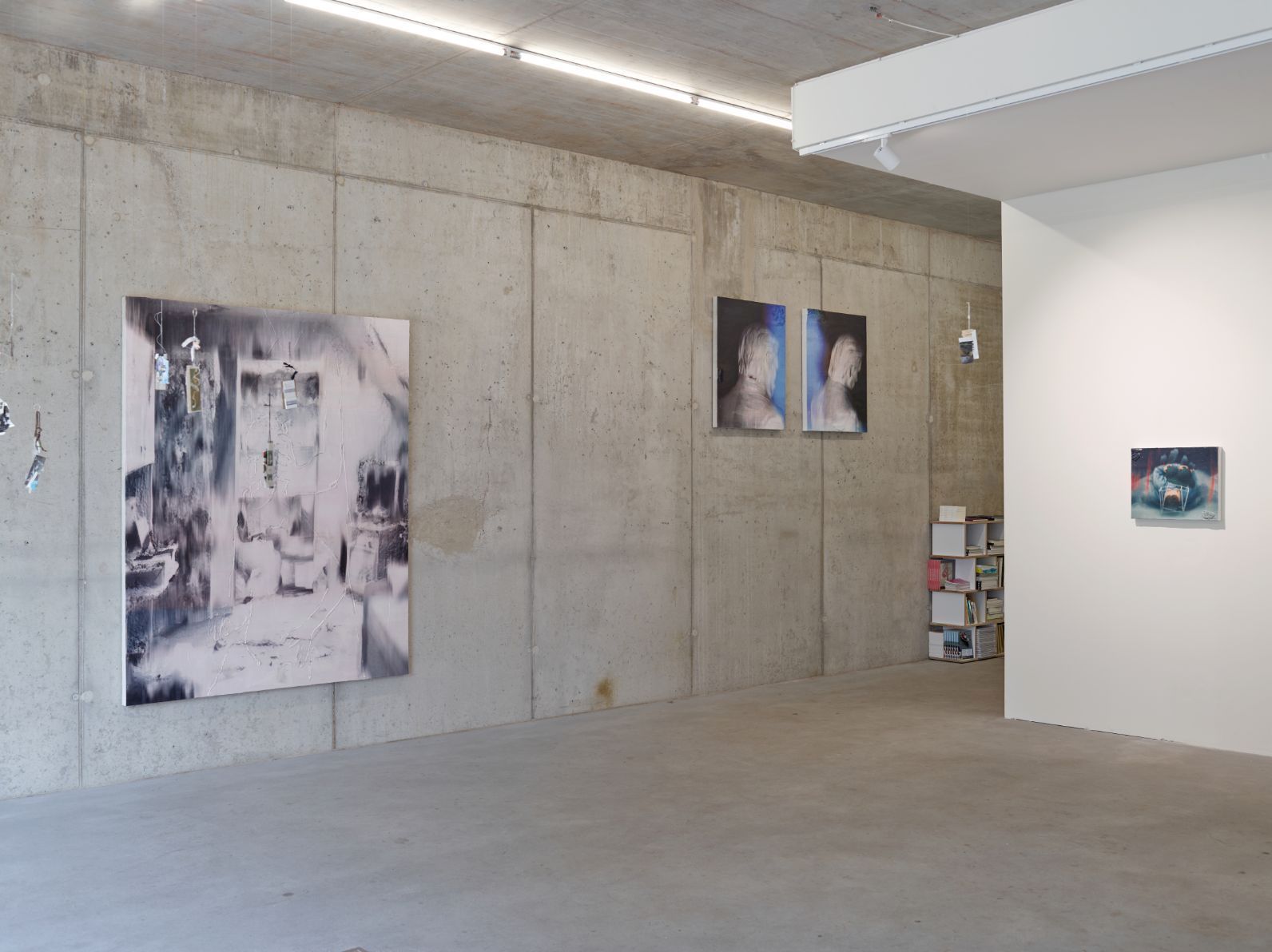
For his first solo exhibition in Germany, The World Upside Down, Ali Banisadr presents twelve paintings on canvas and twelve works on paper. Banisadr’s new body of work demonstrates a change of direction for the artist, showing a looser, freer depiction of space in the paintings, as well as a shift in palette and tone.
The new work exhibits a perspective that is more intimate and direct, yet with greater freedom and openness in his brushwork. The result is a more evocative sense of narrative compared to much of his earlier work, where Banisadr painted from a broad, bird’s-eye perspective, suggesting a relatively detached view of his subjects. In paintings such as Language of the Birds or Riders on the Storm (both 2018), Banisadr composes his visual drama like a theatre director or musical conductor orchestrates the interweaving voices or the stage scenery, yet the depiction of the forms and figures remains ambiguous. ‘In theatre, or opera,’ comments the artist, ‘you are presented with figures in costume and automatically you know that this one is the authority figure, that one is the jester, and so on. I like the duality between looking at the “real” figure and their costumed “role.” I’ve always liked not knowing which is which.’
Banisadr’s recent adoption of a monochrome palette appears in such canvases as The Levanter (2017) and The Building of Icarus (2018), each in cold tones of blue, and the dark green of The Wretched of The Earth (2018). The artist’s new palette, by turns cool and warm to create a dynamic synergy, continues in the new works on paper, where ink seems to stand suspended, contending with centrifugal and centripetal impulses within the overall frame. Hints of the trompe l’oeil, Iznik painted pottery as well as digital imaging alike inform this series. The largest works on paper that Banisadr has produced to date, they establish an exuberant almost three-dimensional style.
The title of the exhibition – The World Upside Down – resonates with a multitude of ideas. In many of the artist’s works the landscape looks like a world upside down, conjuring a great sense of bewilderment. The seeming chaos depicted in his work also allows the artist to reflect on the frail rigidity of social classes. The absurdity of life and the strange and artificial construct called ‘society’ which is divided up in classes is a theme that is core to the artists reflections: ’The world is a carnivalesque stage, we’re all actors of one sort or another. We’re all implicated. Caught up in our own madness.’ says Banisadr. The title also refers to the Russian philosopher Mikhail Bakhtin’s concept of the ‘carnivalesque’, a force that inverts social norms and structures is one of his inspirations. In the publication that accompanies the exhibition, the art historian David Anfam writes that ‘the carnivalesque pivots upon ambiguity, reversals, excess, revelation and concealment – thereby striking to the heart of Banisadr’s pictorial universe.’ The simultaneity of events is another element in Banisadr’s work and can also be seen in Pieter Bruegel’s work ‘The Netherlandish Proverbs’ which carries The World Upside Down as a subtitle.
Ali Banisadr: Volume 2 is the continuation of Ali Banisadr, One Hundred and Twenty-Five Paintings published in 2015. Volume 2 documents all paintings the artist produced since 2015 as well as all works on paper since 2010. Together these two publications form the artist’s first Catalogue Raisonné. The new volume features a newly-commissioned essay by art historian David Anfam, a text by the author Azareen van der Vliet Oloomi and an interview with art critic Negar Azimi.
In 2019 his work will be the subject of the following solo exhibitions: Bosch & Banisadr, Gemaldegalerie, Academy of Fine Arts, Vienna, AT; Ali Banisadr, Noordbrabants Museum, ‘s-Hertogenbosch, NL and Ali Banisadr & Andrew Sendor, MOCA Jacksonville, US.
Ali Banisadr was born in Tehran, IR in 1976 and lives and works in New York, US. He received his MFA from The New York Academy of Art, New York, US and his BFA from The School of Visual Arts, New York, US.
Banisadr’s work has been shown extensively internationally and has been the subject of numerous group exhibitions, including The Frist Art Museum, Nashville, US (2018); Centre Pompidou, Paris, FR (2018); Museum of Fine Arts Houston (MFA), Houston, US (2017); The British Museum, London, UK (2016); Museum of Contemporary Art, Los Angeles, US (2013); Lehmbruck Museum, Duisburg, DE (2013); The Metropolitan Museum of Art, New York, US (2012) and Stedelijk Museum voor Actuele Kunst (S.M.A.K), Ghent, BE (2010). His work is in major public and private collections internationally including The Hirshhorn Museum and Sculpture Garden, Washington DC, US, The Metropolitan Museum of Art, New York, US, The Museum of Contemporary Art, Los Angeles, US, The British Museum, London, UK, Centre Pompidou, Paris, FR, Los Angeles County Museum of Art (LACMA), Los Angeles, US, Museum der Moderne, Salzburg, AT and Albright-Knox Art Gallery, Buffalo, US among others.
*****
In The World Upside Down, Ali Banisadrs erster Einzelausstellung in Deutschland, präsentiert der Künstler zwölf Gemälde auf Leinwand und zwölf Arbeiten auf Papier. Banisadrs neue Werkreihe markiert eine Richtungsänderung in seinem Schaffen: Sie zeichnet sich durch eine lockerere, freiere Darstellung von Raum in den Gemälden aus, sowie durch eine neue Palette an Farben und Tönen.
Die neuen Arbeiten zeigen einen persönlicheren und direkteren Blickwinkel und gleichzeitig eine größere Freiheit und Offenheit in seiner Pinselführung. Im Vergleich zu seinen früheren Arbeiten, die Banisadr aus einer weiten Vogelperspektive malte, in der eine gewisse Distanz zu seinen Motiven zum Ausdruck kam, beschwören die neuen Werke ein stimmungsvolleres Narrativ herauf. In Gemälden wie Language of the Birds oder Riders on the Storm (beide 2018) inszeniert Banisadr sein visuelles Drama auf eine Weise, wie ein Theaterregisseur oder Orchesterdirigent ein Bühnenbild oder Klanggewirr arrangieren würden. Und doch bleibt seine Darstellung der Formen vieldeutig. Im Theater oder der Oper, erklärt der Künstler: „Sieht man kostümierte Figuren und weiß sofort, wer die Autoritätsperson und wer der Narr ist und so weiter. Ich mag diese Dualität des Blicks auf eine ‚reale‘ Figur und ihre ‚Rolle‘ in der Verkleidung. Es hat mich immer begeistert, nicht zu wissen, wer der eine und wer der andere ist.“
Das Banisadr kürzlich zu einer monochromen Farbpalette übergegangen ist, wird in Gemälden wie The Levanter (2017) und The Building of Icarus (2018) deutlich, die beide in kalten Blautönen gehalten sind, sowie im dunkelgrün gemalten The Wretched of The Earth (2018). Die neue Palette des Künstlers – eine abwechselnd kalte und warme Farbgebung, um eine dynamische Synergie zu schaffen – setzt sich in den neuen Arbeiten auf Papier fort. Hier scheint die Tusche zu schweben und zwischen zentrifugalen und zentripetalen Kräften innerhalb des Gesamtrahmens hin- und hergerissen zu sein. Die Werkreihe lässt an Trompe-l’oeil, Iznik- Keramik und digitale Bildgebung denken. Diese bisher größten von Banisadr auf Papier gefertigten Arbeiten begründen einen überschwänglichen, fast dreidimensionalen Stil.
Im Ausstellungstitel – The World Upside Down – schwingt eine Fülle an Ideen mit. In vielen Arbeiten des Künstlers sehen die Landschaften tatsächlich wie eine auf den Kopf gestellte Welt aus, was ein Gefühl großer Verwirrung heraufbeschwört. Das in seinen Werken dargestellte scheinbare Chaos erlaubt es dem Künstler auch, über die fragile Starrheit sozialer Schichten nachzusinnen. Die Absurdität des Lebens sowie das merkwürdige und künstliche, in Schichten unterteilte Konstrukt namens „Gesellschaft“ steht als Thema im Mittelpunkt der Überlegungen des Künstlers: „Die Welt ist eine karnevaleske Bühne, auf der wir alle Schauspieler der einen oder anderen Art sind. Wir alle spielen eine Rolle und sind in unserer Verrücktheit gefangen.“ Zudem spielt der Titel auf den vom russischen Philosophen Michael Bachtin eingeführten Begriff des „Karnevalesken“ an. Diese Idee von einer Kraft, die soziale Normen und Strukturen umkehrt, ist eine der Inspirationen des Künstlers. Im Katalog zur Ausstellung schreibt der Kunsthistoriker David Anfam: „Das Karnevaleske dreht sich um Mehrdeutigkeit, Umkehrungen, Ausschweifung, Enthüllung und Verschleierung – und trifft damit ins Herz von Banisadrs bildlichem Universum.“ Ein weiteres Element in Banisadrs Werk ist die Gleichzeitigkeit von Ereignissen, die auch in Pieter Bruegels Werk Die niederländischen Sprichwörter zu sehen ist, das den Untertitel Die verkehrte Welt trägt.
Ali Banisadr: Volume 2 ist die Fortsetzung von Ali Banisadr, One Hundred and Twenty-Five Paintings, das 2015 erschien. In Volume 2 sind alle vom Künstler seit 2015 geschaffenen Gemälde und alle seit 2010 gefertigten Arbeiten auf Papier dokumentiert. Gemeinsam bilden diese beiden Publikationen das erste Werkverzeichnis des Künstlers. Der neue Band enthält einen Essay des Kunsthistorikers David Anfam, einen Beitrag der Autorin Azareen van der Vliet Oloomi und ein Gespräch mit der Kunstkritikerin Negar Azimi.
Im Anschluss an die Ausstellung in der Galerie in Berlin werden seine Arbeiten 2019 in folgenden Einzelausstellungen gezeigt: Bosch & Banisadr, Gemäldegalerie, Akademie der bildenden Künste, Wien, AT; Ali Banisadr, Noordbrabants Museum, ‘s-Hertogenbosch, NL und Ali Banisadr & Andrew Sendor, MOCA Jacksonville, US.
Ali Banisadr wurde 1976 in Teheran, Iran, geboren. Er lebt und arbeitet in New York. Dort erhielt er auch seine Hochschulabschlüsse: Master of Fine Arts an der New York Academy of Arts und Bachelor of Fine Arts an der School of Visual Arts.
Banisadr’s Arbeit wurde umfassend international in zahlreichen Ausstellungen gezeigt. Darunter: The Frist Art Museum, Nashville, US (2018); Centre Pompidou, Paris, FR (2018); Museum of Fine Arts Houston (MFA), Houston, US (2017); The British Museum, London, UK (2016); Museum of Contemporary Art, Los Angeles, US (2013); Lehmbruck Museum, Duisburg, DE (2013); The Metropolitan Museum of Art, New York, US (2012) und Stedelijk Museum voor Actuele Kunst (S.M.A.K), Ghent, BE (2010). Außerdem sind seine Arbeiten international in renommierten privaten und öffentlichen Sammlungen, unter anderem: The Hirshhorn Museum and Sculpture Garden, Washington, DC, US; The Metropolitan Museum of Art, New York, US; The Museum of Contemporary Art, Los Angeles, US; The British Museum, London, UK; Centre Pompidou, Paris, FR; Los Angeles County Museum of Art (LACMA), Los Angeles, CA, US; Museum der Moderne, Salzburg, AT und Albright-Knox Art Gallery, Buffalo, US.