Ended Mar 18
James Welling
The Earth, the Temple and the Gods
Jan 24 – Mar 18, 2020
More from James Welling on Gallop
[Scroll down for French version / Veuillez trouver ci-dessous la version française]
Galerie Marian Goodman is pleased to present its latest exhibition by James Welling bringing together two new bodies of photographs on Greek and Roman architecture and statuary. The exhibition title refers to an essay on sacred architecture published in 1962 by the American academic Vincent Scully. Welling’s recent fascination with antiquity pervades his new work, and has become his main source of inspiration. The exhibition offers the visitors a way to travel back in time and into the history of photography. As he says, “In The Earth, the Temple and the Gods I am hoping to restore the spirit of the ancient world to a selection of material fragments”.
In 2018 Welling photographed the Greek and Roman antiquities in the Metropolitan Museum, New York. In summer 2019 he made his first trip to Greece, from which he brought back thousands of images. Most of the twelve large-format photographs on show at the gallery were taken in and around Athens: The Acropolis, the Old Agora, the Roman Agora, the Acropolis Museum and sacred site of Eleusis. Sometimes in colour, sometimes in black-and-white, these UV-ink prints on dibond represent details of torsos and sculptural decoration as well as architectural views. Two smaller colour oil prints complete the corpus.
Recognised for his innovative approach to photography, James Welling is an artistic polymath: no genre or medium is off limits and he is constantly experimenting with and inventing new processes, whether exploiting the new possibilities afforded by digital technology or revisiting the variety of ancient techniques with a personal twist. But while each new series represents an opportunity to explore all the possibilities of photography, it is colour that has dominated his research over the last two decades.
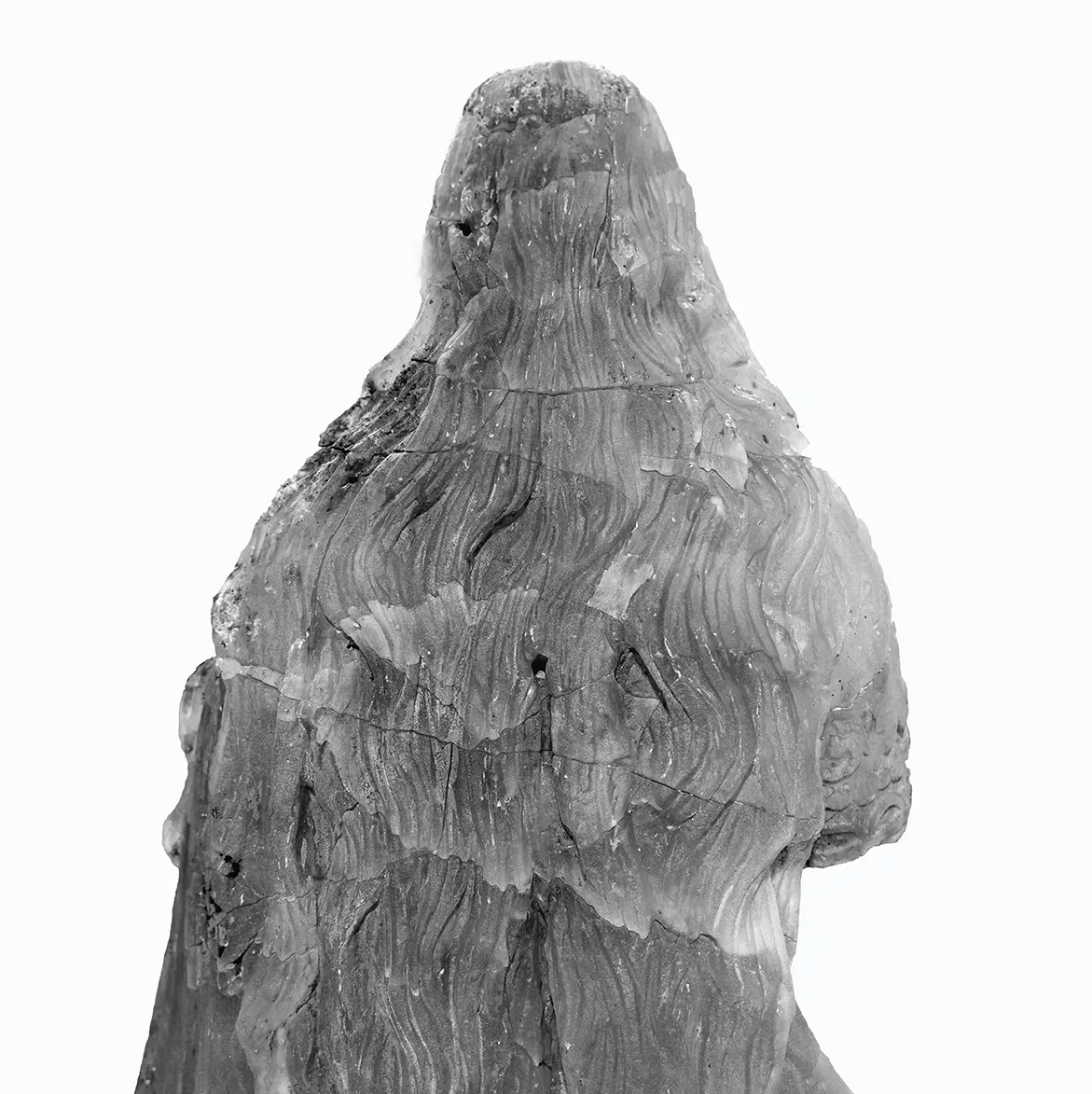
In this exhibition, for example, several antique torsos as well as drapery, the locks of a kouros, a Corinthian capital and a piece of sculptural decoration are heightened by rich colour applied using a technique invented by Welling (involving the layering of unconventional colour channels in Photoshop). These new works pay homage to the original polychromy of Ancient Greek art. As he points out, “Sculpture and architecture in Ancient Greece were commonly painted. Intense color and gold leaf emphasized textile, hair and skin and modern approximations of this polychrome are startling to viewers still accustomed to the colorless neoclassic ideals of beauty. But I was not interested in simply recreating the colors of the ancient Greeks. Using digital technology, I applied highly unnatural colors to the sculptures. My hope is that these colors seep into the ancient stone and take on a life of their own.”
The photographs of the Erechtheion and the Propylaia in this exhibition remind us that architecture is a constant among Welling’s interests, ever since one of his very first series, Los Angeles Architecture (1976–78) and all the way up to the Glass House by Philip Johnson (2006–14). Although this will be less obvious to visitors, the black-and-white images, too, have been adjusted in Photoshop. In fact, Welling took his inspiration from the tones and contrasts of the very first photographs brought back from Greece by travellers and archaeologists: “When I got home I adjusted my digital files so that they would mimic black-and-white nineteenth-century film. (The earliest film was not sensitive to blue light and skies were rendered a uniform white while red and yellow tones read darker.) The three black-and-white architectural photographs in the exhibition remind me of the photographic albums of early archaeological expeditions, the first photographic imaginings of Greece. I felt that I was turning photography into a veritable time machine.”
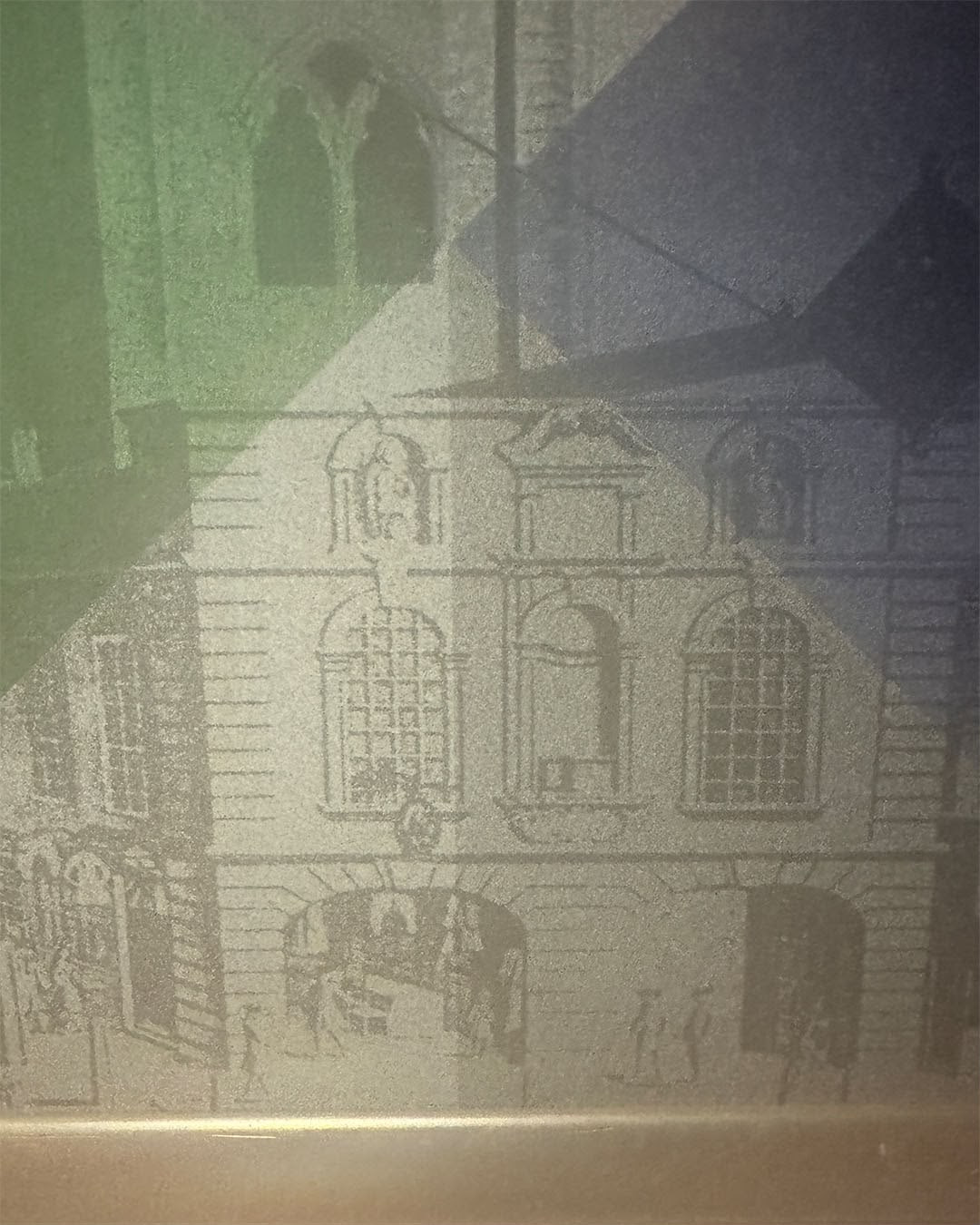
On the gallery’s lower floor, the UV prints on dibond are exhibited with a set of twenty photographs from the Julia Mamaea series, named after the Roman regent of the Severan dynasty who was the mother of its last emperor, Alexander. Inspired by a technique patented in 1855 by Alphonse Poitevin, a French chemist and civil engineer, Welling has produced over a hundred coloured variations of a single photograph showing the marble head of Julia Mamaea kept at the Metropolitan Museum. In the dark room he developed a new procedure based on chromatic unpredictability. “I had been researching early photographic processes for a number of years and I decided to print Julia Mamaea using a modified nineteenth-century printing process, collotype, in which I substituted colored dye for lithographic ink. This technique produced aqueous tints ranging from turquoise to lavender to salmon.”
The fact that the sculptural portrait of the Roman regent is damaged heightens the elusiveness and expressiveness of the images in a surprising way. Welling recalls how this mutability struck him while he was working on the series: “The cumulative effect of these multiple Julias was uncanny. It seemed that her clothing, her gaze, even her gender were fluid, changing dramatically from image to image.” Initiated in 2018, and still ongoing, the Julia Mamaea series is the subject of a forthcoming artist’s book to be published by MACK.
James Welling was born in Hartford (Connecticut) in 1951. He studied fine arts at Carnegie-Mellon University and modern dance at Pittsburgh University, then received his M.F.A. degree in visual arts at the California Institute of the Arts (CalArts) in 1974. From 1995-2016 he lived in Angeles where he taught in the art department at UCLA. He is now based in New York and since 2012 has been visiting professor at Princeton University.
In 2017 a major retrospective of Welling’s work, Metamorphosis, opened at the Stedelijk Museum voor Aktuele Kunst (SMAK) in Ghent and travelled to the Kunstforum in Vienna. In 2012 and 2013 two solo shows were organised: Monograph, at the Cincinnati Art Museum and at the Hammer Museum in Los Angeles, and Mind on Fire at the MK Gallery, Milton Keynes (England), the Centro Galego de Arte Contemporanéa, Santiago de Compostela (Spain), and the Contemporary Art Gallery, Vancouver (Canada). In 2014 Welling was awarded the Infinity Award by the International Center of Photography in New York and in 2016 the Excellence in Photography Award by the Julius Shulman Institute at Woodbury University, California.
*****
La Galerie Marian Goodman a le plaisir de présenter une nouvelle exposition de James Welling, réunissant deux nouvelles séries de photographies sur l’architecture et la statuaire greco-romaine. Le titre de l’exposition fait référence à l’essai sur l’architecture sacrée dans la Grèce antique publié en 1962 par l’universitaire américain Vincent Scully. La fascination récente de Welling pour l’antiquité imprègne son travail actuel, devenant la source principale de son inspiration. Avec The Earth, the Temple and the Gods l’artiste tente de « restituer l’esprit du monde antique à des fragments matériels choisis », proposant un voyage dans le temps historique et photographique.
Après avoir photographié les antiquités grecques et romaines du Metropolitan Museum de New York en 2018, James Welling a voyagé pour la première fois en Grèce lors de l’été 2019. Parmi les milliers d’images prises sur place, les douze grandes photographies présentées à la galerie ont pour la plupart été prises à Athènes et dans ses environs ; sur les sites de l’Acropole, de l’Ancienne Agora, de l’Agora romaine ou encroe au Musée de l’Acropole et dans la petite ville d’Eleusis. En couleur ou en noir et blanc, ces tirages U.V. sur dibond mettent en lumière des détails de torses, de décors sculptés ou d’architectures. Deux impressions couleur de plus petite dimension complètent le corpus.
Reconnu pour son approche innovante de la photographie, véritable touche-à-tout ne se cantonnant à aucun genre ni technique déterminés, James Welling n’a de cesse d’expérimenter et d’inventer de nouveaux procédés, s’emparant des nouvelles possibilités offertes par la technologie numérique ou bien puisant dans la variété des techniques anciennes qu’il revisite à sa guise. Si chaque nouvelle série est l’occasion pour lui d’explorer toutes les potentialités du médium, c’est la couleur qui, depuis une vingtaine d’années, est au centre de ses recherches.
Ainsi dans l’exposition, plusieurs torses antiques, un drapé, les tresses d’un couroï, un chapiteau corinthien ou un ornement sculptural, sont rehaussés d’une riche gamme chromatique. Grâce à une technique qu’il a mise au point (consistant à superposer des canaux de couleurs non conventionnels dans le logiciel Photoshop), les nouvelles œuvres rendent hommage à la polychromie originelle de l’art de la Grèce antique : « Des couleurs intenses et de la feuille d’or mettaient en valeur textiles, cheveux et carnation ; les reconstitutions modernes de cette polychromie étonnent les visiteurs encore habitués à la pureté de l’idéal de beauté néo-classique. Mais je ne me suis pas uniquement intéressé à recréer la palette des Grecs anciens. Avec la technologie numérique, j’ai appliqué sur les sculptures des couleurs clairement antinaturelles dans l’idée que celles-ci s’infiltrent dans la pierre ancestrale et prennent vie indépendamment. »
Dans l’exposition, les clichés consacrés à l’Érechthéion et aux Propylées rappellent l’intérêt constant de James Welling pour l’architecture, depuis l’une de ses premières séries Los Angeles Architecture (1976-1978) jusqu’à son projet dédié à la Glass House de Philip Johnson (2006-2014). Moins évident à détecter pour le visiteur, les images en noir et blanc ont aussi été ajustées sur Photoshop. En effet Welling s’est inspiré des teintes et des contrastes des toutes premières photographies de Grèce rapportées par les voyageurs et archéologues : « Quand je suis rentré de voyage, j’ai travaillé mes fichiers numériques afin d’imiter le noir et blanc de la photographie du XIXe siècle. (Les tout premiers films n’étaient pas sensibles à la lumière bleue et le ciel était rendu par un blanc uniforme tandis que les tonalités rouges et jaunes étaient plus sombres). Dans l’exposition, les trois photographies d’architecture en noir et blanc évoquent pour moi les albums photos des premières expéditions archéologiques, le début de l’imaginaire photographique de la Grèce. Il m’a semblé que la photographie devenait une véritable machine à remonter le temps. »
Au niveau inférieur de la galerie, les tirages U.V. sont exposés avec un ensemble de vingt photographies de la série Julia Mamaea, du nom de la mère de l’empereur Sévère Alexandre, dernier empereur de ladite dynastie. James Welling a décliné une unique photographie du buste de Julia Mamaea conservé au Metropolitan Museum en plus d’une centaine de variations colorées. Inspiré d’une technique inventée breveté en 1855 par Alphonse Poitevin, chimiste et ingénieur civil français, Welling a conçu en chambre noire un procédé inédit reposant sur l’imprévisibilité chromatique : « Je faisais des recherches sur les premiers procédés photographiques depuis de nombreuses années quand j’ai décidé de développer Julia Mamaea en adaptant un procédé d’impression du XIXe, le calotype, pour lequel j’ai substitué la teinture colorée par de l’encre lithographique. Cette technique a produit des teintes aqueuses allant du turquoise au lavande jusqu’au saumon. »
Le visage sculpté en partie détruit de Julia Mamaea participe de manière surprenante à renforcer le caractère insaisissable et l’expressivité de chacune des images. Ainsi l’artiste décrit-il ce qui lui est apparu au cours de la production de cette série : « L’effet cumulatif de ces multiples Julia était troublant. Il me semblait que son vêtement, son regard, son genre même, étaient devenus fluctuant, changeant de façon spectaculaire d’image en image. » Initiée en 2018, et toujours en cours de réalisation, la série Julia Mamaea fera prochainement l’objet d’un livre d’artiste publié chez MACK à l’automne 2020.
James Welling est né à Hartford (Connecticut) aux Etats-Unis en 1951. Il a étudié les beaux-arts à l'Université Carnegie-Mellon et la danse moderne à l'Université de Pittsburgh. Il a obtenu sa maîtrise en arts visuels au California Institute of the Arts (CalArts) en 1974. Au cours des quarante dernières années, il a vécu à Los Angeles de 1995 à 2016, où il a été professeur au département d'art de l'Université de Californie, puis à New York où il réside actuellement. Depuis 2012 il enseigne en tant que professeur invité à l’Université de Princeton dans le New Jersey.
Pendant l’année 2017, Metamorphosis, une important retrospective de son travail a été présentée en Europe, au Stedelijk Museum voor Aktuele Kunst (S.M.A.K.) à Gand puis au Kunstforum de Vienne. En 2012 et 2013 deux expositions personnelles ont été organisées : Monograph, au Cincinnati Art Museum et au Hammer Museum à Los Angeles, puis Mind on Fire présentée à la MK Gallery, Milton Keynes en Angleterre, au Centro Galego de Arte Contemporanéa, Saint- Jacques-de-Compostelle en Espagne et à la Contemporary Art Gallery, Vancouver au Canada. En 2014, il a reçu le ICP Infinity Award du Centre International de la Photographie à New York et en 2016 le Prix d’excellence de l’Institut Julius Shulman de l’Université de Woodbury en Californie.