Ended Jun 16
Soufiane Ababri
Haunted Lives
May 5 – Jun 16, 2018
More from Soufiane Ababri on Gallop
[Scroll down for French version / Veuillez trouver ci-dessous la version française]
"His gaze was not someone else’s: it was my own that I was meeting in a mirror, inadvertently and in a state of solitude and self-oblivion."
— Jean Genet
Praz-Delavallade Paris is proud to present Soufiane Ababri’s first exhibition at the gallery. Ababri was born in Tangiers, a city famous for its verbal jousting which was observed by many a wandering author and immortalised in the works of Ginsberg, Burroughs and Kessel. He brings to bear on Tangiers what Genet called his “magnifying judgements”, in this case an outlook that transforms the reality of East and West and which is asserted in Ababri’s aesthetic and literary choices.
It is easy to imagine the artist giving into the pleasure of simply wandering, catching unposed, candid photos (in moments of Genet-like complicity) of fleeting fragments of desire to inspire his drawings; sketches that portray his favourite themes that are seemingly thrown in the observer’s face without regret. Right from the start, it’s all about virility, but a different kind of virility, an abrupt analysis that goes from dialectic to tragic thoughts. “I think a lot about the role violence has played in the history of forms and the mechanisms of domination and how I can produce work that negates them”, Ababri explains.
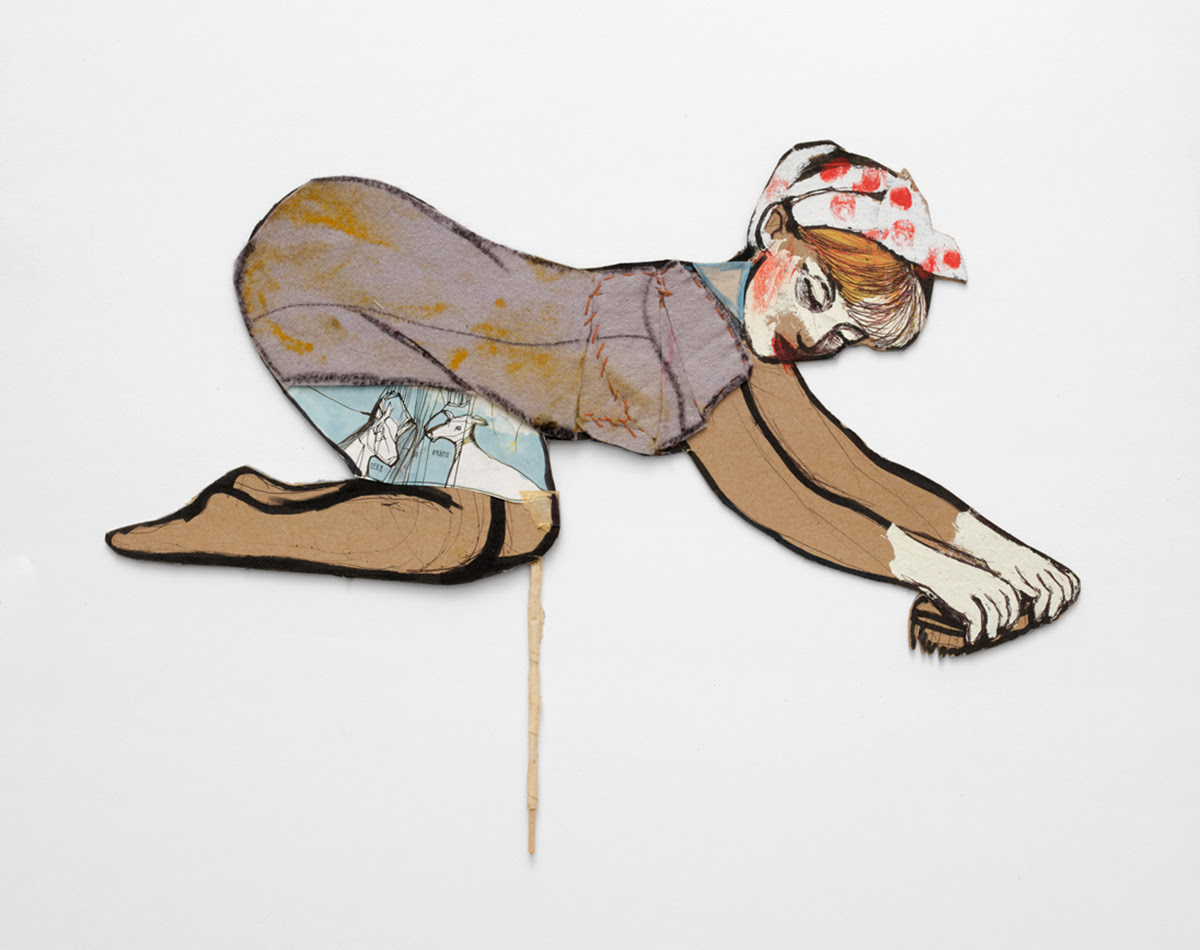
How can these apparently inoffensive drawings, the artist’s so-called “bed works” (which are produced lying in bed to conceptualise how orientalist artists portrayed their subjects) convey such powerful statements? “My drawings play with the notion of sexualisation as a political tool: making politics erotic and eroticism political.”
Ababri obviously wishes to distance himself from studio work and all that this place represents in terms of the image of the artist’s power and authority based on technical skills. His work sings the praises of domesticity: it is a way of putting himself in the position of the model, those women the orientalists painted as slaves and Arabs, dominating them by having them lie in passive and lascivious postures.
Ababri’s goal is to produce a militant discourse and this leads to a performative approach inspired by certain forms of resistance seen in the Afro-American and gay movements, a form of empowerment thanks to which these movements’ members took what was considered as a failing and turned it to their advantage. A political message therefore, but not one that relies on the authoritarian vocabulary of the dominant caste. Its sole weapons are coloured pencils, the prone position and drawings that address various personal themes in a sort of intersectionality combining race, class, immigration, gender, sexuality, the body and post-colonial history.
In essence, Soufiane Ababri examines the ambivalence of a society that is criss-crossed by tensions that are not so much the reflection of its contradictions, but rather of its complementarity. His heritage lies in his own story, built up by layer upon layer of personal and intimate events. A lover of sociology, Ababri’s entire body of work plays with the idea of seeing: the artist observes a world that observes him in a form of introspection combining his own unique perception, shared representations and accepted social facts in an exercise that is reminiscent of Persian miniatures and their subtle play with what is hidden and what is revealed.
*****
"Son regard n'était pas d'un autre : c'était le mien que je rencontrais dans une glace, par inadvertance et dans la solitude et l'oubli de moi."
— Jean Genet.
Praz-Delavallade Paris présente la première exposition de Soufiane Ababri à la galerie. Originaire de Tanger, ville peuplée de joutes verbales et de flâneries littéraires immortalisées sous la plume de Ginsberg, Burroughs ou Kessel, Soufiane Ababri porte sur Tanger ce que Genet appelait ses « jugements magnifiants », un regard transformant la réalité entre Orient et Occident revendiqué par ses choix esthétiques et littéraires.
On l’imagine se laissant aller à la déambulation, saisissant sur le vif par la photo volée (dans une complicité « Genétienne ») ces fugaces fragments de désir irriguant ses dessins, esquisses révélatrices de ses thèmes de prédilection comme jetés, sans remord à la face du regardeur. D’emblée il est question de virilité, mais d’une virilité autre, décryptage abrupte d’une pensée dialectique à une pensée tragique. « Je réfléchis beaucoup au rôle de la violence dans l'histoire des formes, aux mécanismes de domination et comment produire un travail qui les démantèle », précise-t-il.
Comment des dessins apparemment inoffensifs, « bed works » exécutés par Ababri en position allongée dans son lit conceptualisant l’idée de représentation des artistes orientalistes, portent en eux une telle charge revendicatrice, « Mes dessins jouent avec la notion d’érotisation comme outil politique. Érotiser le politique et politiser l'érotisme ».
Il y a une volonté de mettre à distance le travail d'atelier et tout ce qu'il génère comme imaginaire lié à la puissance et la technique autoritaire de l'artiste. Un éloge à la domesticité et une façon de se mettre dans la position des modèles peints par les orientalistes qui dominaient les femmes, les esclaves, les arabes en les allongeant dans cette position lascive et passive.
L'ambition d’Ababri est de produire un discours combattant avec pour corollaire une proposition de travailler performative, une démarche inspirée par certaines formes de résistance dans les mouvements Afro-Américains et gay, de "l'empowerment" qui prenaient ce qui était considéré comme un défaut pour le détourner en leur faveur. Un discours politique mais qui ne reprend pas un vocabulaire autoritaire de dominant, ses seules armes, le crayon de couleur, la position allongée et des dessins qui abordent des thématiques personnelles diverses, une sorte d’ intersectionnalité entre race, classe sociale, immigration, genre, sexualité, corps et histoire post-coloniale.
Soufiane Ababri examine essentiellement l’ambivalence d’une société, traversée de tensions qui ne reflètent pas tant des contradictions que des complémentarités. Il porte en héritage sa propre histoire comme un mille-feuille d’événements intimes. Féru de sociologie son travail est tout entier un jeu de regard, il observe un monde qui l’observe jouant la carte d’une introspection mêlant perception particulière, représentations communes et faits sociaux convenus. Un exercice à l’image des miniatures perses, jeu subtil entre ce que l’on cache et ce que l’on montre.