
Exhibition · Korean Pavilion
History Has Failed Us, But No Matter
Apr 25 – Nov 24
About the show
Hwayeon Nam Siren Eun Young Jung Jane Jin Kaisen
Under the title History Has Failed Us, But No Matter, the Korean Pavilion at the 58th International Art Exhibition – La Biennale di Venezia is curated by Hyunjin Kim, Lead Curator for Asia at Kadist. “Who canonized the formation of history and whose bodies are yet to be written about as part of that story? What changes would emerge, if we revisited the solid strata demarking East Asia and its myths, and what would we discover if we approached these sites of modernization and nationalistic history through the lens of gender diversity?” It is these vital questions that frame the exhibition, presenting the work of three women artists: Siren Eun Young Jung, Hwayeon Nam, and Jane Jin Kaisen. Each artist approaches these questions through a rubric of research, developing their practices using critical reflection based on a strong gender consciousness as they delve into both the present and parse the history surrounding the modernization of Korea and East Asia.
Siren Eun Young Jung is widely recognized for her practice that looks at how one’s individual desire impacts their experience of world events, and how such encounters become forms of resistance, informing history and politics. Winner of the Korea Artist Prize in 2018, her work over the past ten years has focused on yeoseong gukgeuk, a genre of Korean traditional theater that features only women actors. The genre still survives today in an altered modernized form, but it is waning quickly. Documenting the performance of second generation gukgeuk actor Lee Deung Woo (aka Lee Ok Chun), jung’s A Performing by Flash, Afterimage, Velocity and Noise also calls forth four performers that succeed the genealogy of contemporary queer performance—a transgender musician, a disabled woman performer/director, an openly lesbian actor, and a dragking performer. Engaging in these performers’ contestation against aesthetic canons, the artist lures the audience into an audiovisual setting activated by the feast of light, noise, and the moving body. siren eun young jung’s new production for the Venice Biennale was co-commissioned by Kadist.
Hwayeon Nam’s experimentation with archives investigates how human desire can amplify certain myths and values in today’s discursive operations of nation and economy. In her new video Dancer from the Peninsula, Nam traces the fragmented archive of Choi Seung-hee, a legendary but controversial choreographer and modern dancer, whose life intersected many of the most tumultuous events of the 20th century in East Asia. Nam’s manifold presentation includes single-channel videos that utilize found footage and images from Choi’s archives, as well as a large sculptural structure, and a small garden installed behind the Pavilion. This layered multi-media installation offers an enchanting and performative bricolage of a controversial woman artist figure’s life and her lofty aspiration toward an East-Asian dance, mobilizing her from the simplified nationalistic or ideological arguments against her.
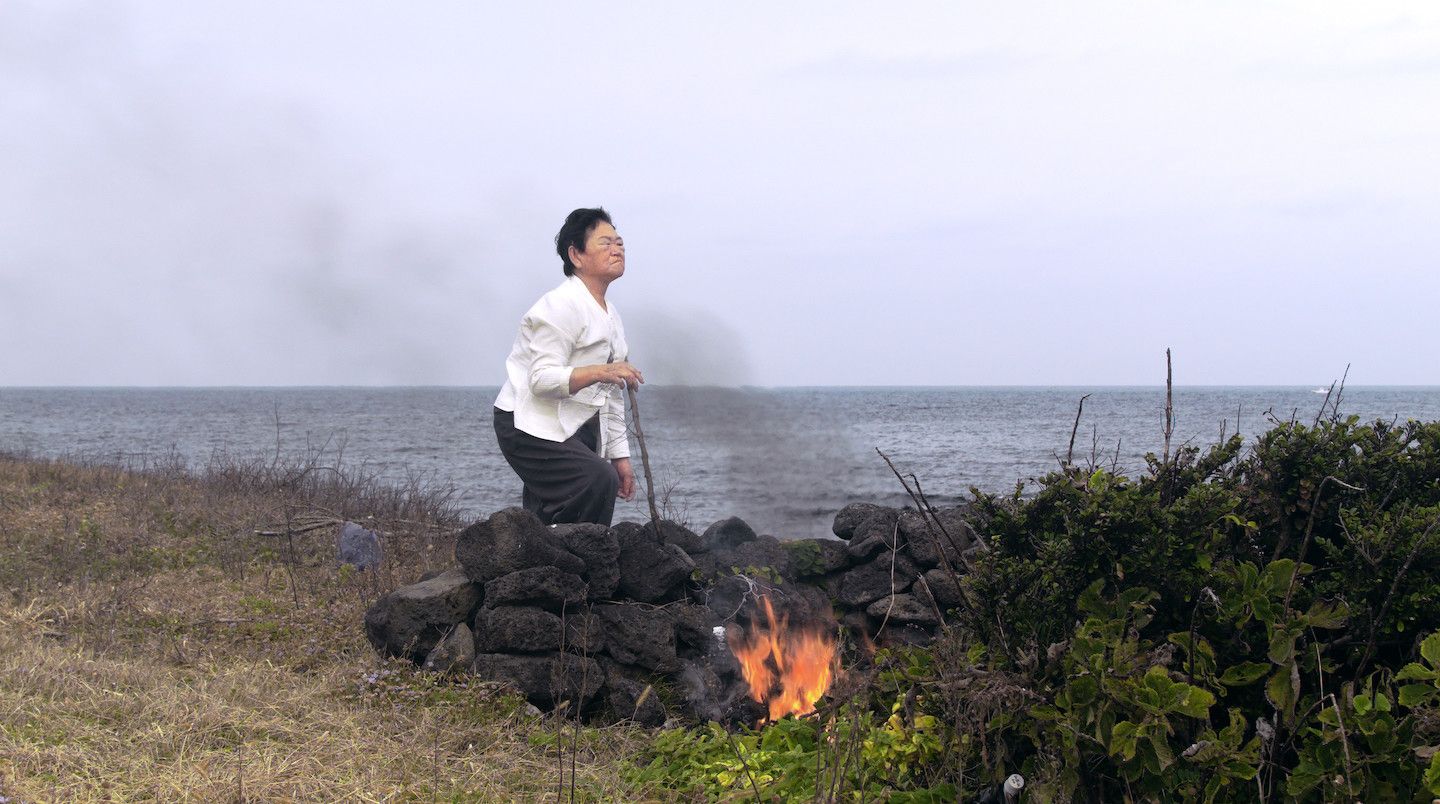
Jane Jin Kaisen is a Berlin and Copenhagen–based visual artist and filmmaker. Stemming from the artist’s own diasporic awareness and experience, Kaisen’s new piece Community of Parting keenly interprets the ancient Korean shamanic myth of Bari, in which an abandoned daughter revives the dead and ultimately becomes a goddess who mediates at the threshold of life and death. For the artist, a different approach to memory, borders and translation can be traced in the epic myth that resonates with gendered migrations caused by war, nationalism, ideological conflicts, rapid modernization and patriarchic oppression in East Asia. Dissolving spatial and temporal boundaries by juxtaposing images, sounds, archive material, and poetry with the redemptive performances of shaman Koh Sun Ahn, the artist explores the embodiment of liminality as she sharply dives into stories of resilient women and images of borders throughout the history of the Korean peninsula.
The various narratives presented by these three artists weave formally complex compositions of mesmerizing sound, color, lights, rhythm and organically curve- shaped architectural installations, alongside alluring movements of the plural body to vigorously explore the heterogeneous narratives of the history of East Asian modernization. The exhibition presents the veiled, the forgotten, the abandoned, the condemned, and the oppressed, bringing these voices into the spotlight.
The exhibition title is borrowed from the first sentence of the novel Pachinko with the generous permission of its author, Min Jin Lee.