
Ended
Moshe Kupferman
Early Works (1960s-1970s)
Oct 17 – Nov 7, 2024
Gordon Gallery is pleased to present Moshe Kupferman: Early Works (1960s-1970s).
Moshe Kupferman (1926–2003), a central figure in Israeli art and a recipient of the Israel Prize for painting in 2000, stands as one of the most influential artists of his generation.
With the work ethic of a laborer and a background in construction work, Kupferman’s abstract works reflect both his loss and trauma as a Holocaust survivor and his efforts to rebuild his life in Israel, where he was a founding member of Kibbutz Lohamei HaGetaot.
Kupferman worked primarily in oil on canvas, influenced by his teachers, Zaritsky and Stematsky. Yet his approach to painting was uniquely his own. He abandoned the idea of painting as a window to reality, instead presenting the canvas as a surface where color functions not as a carrier of content or representation, but as a material in itself.
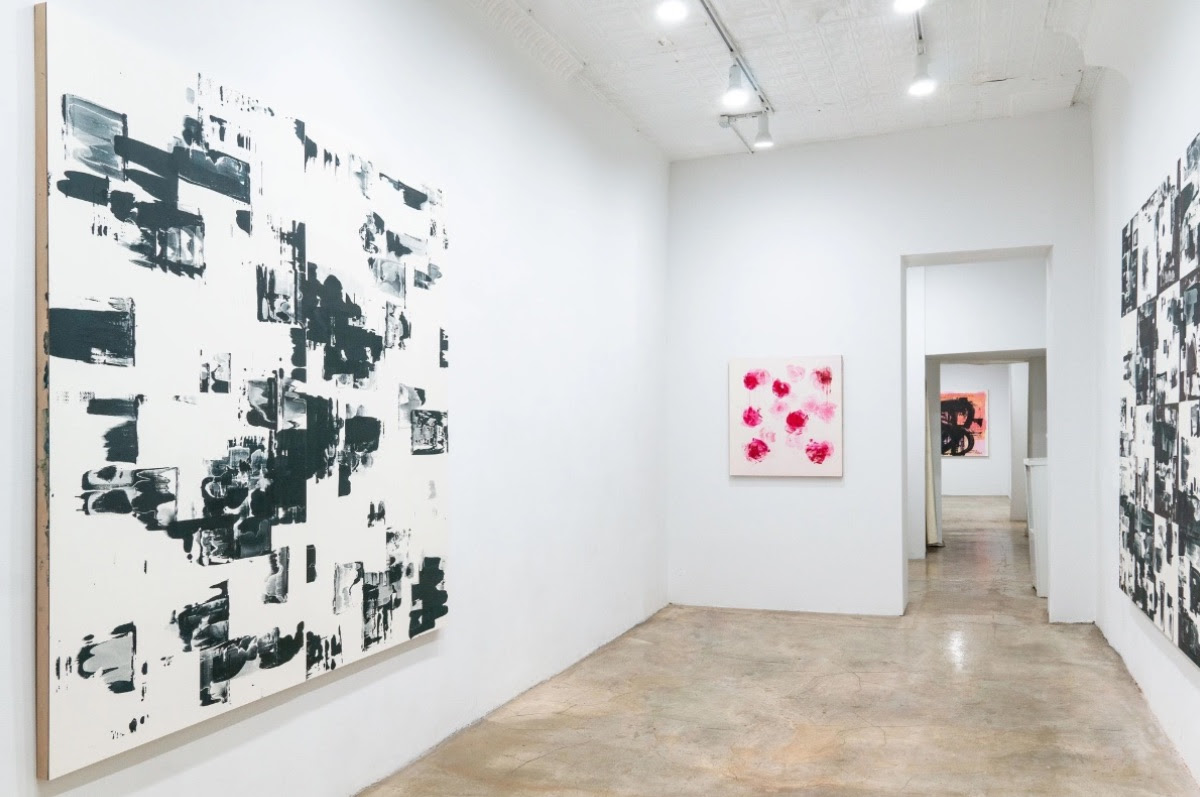
In many of his works, Kupferman would scratch or scrape away paint, responding to the wooden stretcher behind the canvas, and marking its central vertical axis to guide the inner logic of the composition. His paintings are spare, utilizing a limited palette of green (which often serves as the initial contact with the canvas), alizarin (a cool red, which Kupferman likened to the color of beets), black, and white. These combine to create a range of purples in varying shades of gray.
Kupferman’s compositions are constructed from a few recurring motifs: vertical and horizontal stripes, sometimes forming comb-like patterns, bars, or "menorah" shapes; arches; and areas of blockage, often white. Scribbles and his signature are also integral elements. These simple components are rearranged in countless variations, forming the basis for his works.
Kupferman's paintings can range from minimal squares with a few horizontal stripes to dense, multilayered compositions, paintings within paintings. Each iteration engages with the same elements, yet through processes of superimposing, erasing, and reworking, he continually creates new combinations, much like assembling words in language or elements in chemistry—demonstrating the infinite possibilities of his visual and material vocabulary.